

You must update DOCA on the host side before installing the BF-bundle on the BlueField device.
Users have three options for installing or upgrading DOCA on BlueField DPU or SuperNIC:
|
Method |
Option Name |
Description |
|---|---|---|
|
Installation |
This option overwrites the entire boot partition with an Ubuntu 22.04 installation and updates BlueField and NIC firmware |
|
|
Upgrade |
This option upgrades DOCA components without overwriting the boot partition. Use this option to preserve configurations or files on BlueField itself |
|
|
Installation |
ISO DOCA image |
This option overwrites the entire boot partition with an Ubuntu 22.04 installation |
Find the DOCA installation files for BlueField on the NVIDIA DOCA Downloads page.
Installing DOCA-Host
Make sure to update DOCA on the host side before installing the BF-bundle on the BlueField.
Installing Software on BlueField Using BF-Bundle
The ATF will not boot 150W BlueField-3 platforms if the ATX +12V power supply is not connected. This requirement ensures the proper operation of the BlueField device. For detailed instructions on connecting the external power supply connector, refer to the NVIDIA BlueField-3 Networking Platform User Guide.
Users can install DOCA on BlueField DPU or SuperNIC by upgrading the full DOCA image on the BlueField device. This process overwrites the entire boot partition with an Ubuntu 22.04 installation and updates BlueField and NIC firmware. It also setups up the OVS bridge.
Upgrading DOCA components on BlueField networking platforms, such as DPUs or SuperNICs, using standard Linux tools will install the new doca-eula package at /etc/NVIDIA/doca-license/DOCA-EULA.txt. By installing this package, you accept the NVIDIA DOCA SDK end-user license agreement.
Option 1 – No Pre-defined Password
To change the default Ubuntu password during the BFB bundle installation, proceed to BF-Bundle Installation and Upgrade | id (3.1.0 core update)BF BundleInstallationandUpgrade Option2.
To install a BFB, use the following command:
host# sudo bfb-install --rshim rshim<N> --bfb <image_path.bfb>
Where:
-
<N>– the appropriate RShim device identifier. If you have only one BlueField device, usershim0. -
<image_path.bfb>– Replace this with the path to the BFB image file.
To list the RShim devices present on your system, run the following command:
host# ls -la /dev/ | grep rshim
By default bfb-install will clear the RShim log in /dev/rshim<N>/misc and save it as tmp/bfb-install-rshim[N].log instead. To preserve the RShim log in /dev/rshim<N>/misc, provide the --keep-log argument to the bfb-install command line.
Option 2 – Set Pre-defined Password
Ubuntu users can set a unique password for the ubuntu user in the bf.cfg configuration file, which will be applied automatically at the end of the BlueField BFB bundle installation.
To do this, follow these steps:
-
Generate the hashed password:
host# openssl passwd -1
Password:
Verifying - Password:
$1$3B0RIrfX$TlHry93NFUJzg3Nya00rE1
-
Add the password hash to the
bf.cfgconfiguration file:host# echo ubuntu_PASSWORD='$1$3B0RIrfX$TlHry93NFUJzg3Nya00rE1' > bf.cfg
-
Use the
--configflag to specify the configuration file when running the installation command:host# sudo bfb-install --rshim rshim<N> --bfb <image_path.bfb> --config bf.cfgIf
--configis not used, then upon first login to the BlueField device, users will be prompted to update the defaultubuntupassword.
Optionally, to upgrade the BlueField integrated BMC firmware using BFB bundle, please provide the current BMC root credentials in a
bf.cfgfile, as shown in the following:BMC_PASSWORD="<root password>" BMC_USER="root" BMC_REBOOT="yes"Unless previously changed, the default BMC root password is
0penBmc.The following is an example output of Ubuntu-22.04 BFB bundle installation:
host# sudo bfb-install --rshim rshim0 --bfb bf-bundle-2.7.0_24.04_ubuntu-22.04_prod.bfb --config bf.cfg
Pushing bfb 1.41GiB 0:02:02 [11.7MiB/s] [           <=>                                                                                                                                ]
Collecting BlueField booting status. Press Ctrl+C to stop
 INFO[PSC]: PSC BL1 START
 INFO[BL2]: start
 INFO[BL2]: boot mode (rshim)
 INFO[BL2]: VDDQ: 1120 mV
 INFO[BL2]: DDR POST passed
 INFO[BL2]: UEFI loaded
 INFO[BL31]: start
 INFO[BL31]: lifecycle GA Secured
 INFO[BL31]: VDD: 850 mV
 INFO[BL31]: runtime
 INFO[BL31]: MB ping success
 INFO[UEFI]: eMMC init
 INFO[UEFI]: eMMC probed
 INFO[UEFI]: UPVS valid
 INFO[UEFI]: PMI: updates started
 INFO[UEFI]: PMI: total updates: 1
 INFO[UEFI]: PMI: updates completed, status 0
 INFO[UEFI]: PCIe enum start
 INFO[UEFI]: PCIe enum end
 INFO[UEFI]: UEFI Secure Boot
 INFO[UEFI]: PK configured
 INFO[UEFI]: Redfish enabled
 INFO[UEFI]: exit Boot Service
 INFO[MISC]: Found bf.cfg
 INFO[MISC]: Ubuntu installation started
 INFO[MISC]: Installing OS image
 INFO[MISC]: Changing the default password for user ubuntu
 INFO[MISC]: Ubuntu installation completed
 INFO[MISC]: Updating NIC firmware...
 INFO[MISC]: NIC firmware update done
 INFO[MISC]: Installation finished
-
To verify that the BlueField device has completed booting, wait 90 seconds after the installation process finishes and run the following command:
host# sudo cat /dev/rshim<N>/misc
...
 INFO[MISC]: Linux up
 INFO[MISC]: DPU is ready
-
Retrieve installed packages and their versions as part of BF-Bundle installation:
-
Log in to BlueField.
-
Run the following command:
bf# sudo bf-infoExample output:
Firmware:
- ATF: v2.2(release):4.11.0-31-g3cc9f6506
- UEFI: 4.11.0-44-gb67dfb4a53
- BSP: 4.11.0.13582
- NIC Firmware: 32.45.0350
- BMC Firmware: 25.04-3
- CEC Firmware: 00.02.0195.0000

Drivers:
- mlnx-dpdk:  'MLNX_DPDK 22.11.2504.0.2'
- Kernel: 5.15.0-1064-bluefield

Tools:
- MFT: 4.32.0-94
- mstflint: 4.29.0-1

Storage:
- mlnx-libsnap 1.6.0-1
- spdk 23.01.5-24
- virtio-net-controller 24.10.15-1

DOCA:
- doca-apsh-config 2.9.0064-1
- libdoca-sdk-urom-dev 2.9.0064-1
...
FlexIO:
- flexio-samples 24.10.2447
- flexio-sdk 24.10.2447
...
SoC Platform:
- mlxbf-gige-modules 1.0-0.kver.6.1.0-11-arm64
- sdhci-of-dwcmshc-modules 1.0-0.kver.6.1.0-11-arm64
...
OFED:
rdma-core 2410mlnx54-1.2410051
ucx 1.18.0-1.2410051
...
-
-
Run the following command to configure the
tmfifo_net0interface over IPv4 for SSH access to the BlueField Arm OS:host# ifconfig tmfifo_net0 192.168.100.1/24
Upgrading BlueField Using Standard Linux Tools
This procedure allows for upgrading DOCA components on BlueField networking platforms (DPUs or SuperNICs) using standard Linux tools (e.g., apt update and yum update). This method uses native package manager repositories to update components without requiring a full reinstallation.
Although this method allows you to update specific DOCA components, the combinations resulting from selective updates are not validated by NVIDIA. NVIDIA only validates the full installation of the BF-Bundle package.
Upgrading DOCA components on BlueField networking platforms using standard Linux tools will install the new doca-eula package located at /etc/NVIDIA/doca-license/DOCA-EULA.txt. By installing this package, you accept the NVIDIA DOCA SDK end-user license agreement.
This process has the following benefits:
-
Only updates components that include modifications
-
Includes upgrade of:
-
DOCA drivers and libraries
-
DOCA reference applications
-
BSP (UEFI/ATF) upgrade while maintaining the configuration
-
NIC firmware upgrade while maintaining the configuration
-
BMC components upgrade
-
-
Does not:
-
Impact user binaries
-
Upgrade non-Ubuntu OS kernels
-
-
After completion of BlueField upgrade:
-
If NIC firmware was not updated, perform BlueField Arm reset (software reset/reboot BlueField)
-
If NIC firmware was updated, perform firmware reset (
mlxfwreset) or perform a graceful shutdown and power cycle
-
DEB-based
|
|
Action |
Instructions |
|---|---|---|
|
1 |
Export the desired distribution |
Export |
|
2 |
Add GPG key to APT trusted keyring |
|
|
3 |
Add DOCA online repository |
|
|
4 |
Update index |
|
|
5 |
Choose one of the two options for packages upgrade
|
Option 1 Upgrade BlueField FW Bundle package (including ATF-UEFI, NIC firmware, and BMC firmware): |
|
Option 2
|
||
|
6 |
Configure BMC parameters |
Add the BMC user and password to config file |
|
7 |
Components activation |
The upgrade process should take up to 20 minutes. |
|
8 |
Apply the new changes, NIC firmware, and UEFI/ATF |
For the upgrade to take effect, perform BlueField system reboot. This step triggers immediate reboot of the BlueField Arm cores. |
RPM-based
|
|
Action |
Instructions |
|---|---|---|
|
1 |
Export the desired distribution |
Export |
|
2 |
Add DOCA online repository |
A file is created under |
|
3 |
Update index |
|
|
4 |
Choose one of the two options for packages upgrade
|
Option 1 Upgrade BlueField FW Bundle package (including ATF-UEFI, NIC firmware, and BMC firmware): |
|
Option 2
|
||
|
5 |
Configure BMC parameters |
Add the BMC user and password to config file |
|
6 |
Components activation |
The upgrade process should take up to 20 minutes. |
|
7 |
Apply the new changes, NIC firmware, and UEFI/ATF |
For the upgrade to take effect, perform BlueField system reboot. This step triggers immediate reboot of the BlueField Arm cores. |
Installing Multiple BlueField Devices with DOCA Installer Tool
The DOCA Installer is a utility for installing or upgrading one or more BlueField DPUs in parallel. It supports both bf-bundle and bf-fw-bundle image types and is compatible with multiple BlueField operation modes, including NIC mode, DPU mode, or both on the same host. Customization is supported through INI or YAML configuration files.
Prerequisites
Make sure to update DOCA on the host side before installing doca-installer.
|
DEB-based |
|
|---|---|
|
RPM-based |
|
DOCA Installer Operation Modes
The installer supports the following execution modes:
-
Global run (applies to all devices):
host# doca-installer -b <image_path.bfb> -c <path-to-config> -
Per PSID group (targets devices sharing the same PSID):
host# doca-installer -b <image_path.bfb> --psid <PSID> -c <path-to-config>
-
Per RShim device (targets a specific RShim interface):
host# doca-installer -b <image_path.bfb> --rshim rshim<N> -c <path-to-config>
Where:
-
-cor--config-file– defines a configuration via INI or YAML files -
<path-to-config>– Path to the INI or YAML configuration file -
<image_path.bfb>– Path to the BFB image file -
<PSID>– Shared PSID value for the target groupDevices that do not match the provided PSID will not be upgraded.
-
<N>– RShim device index (e.g.,0for a single-device setup)
The doca-installer script attempts to load the new NIC firmware automatically, but if that fails, it will print out the following message:
INFO: At least one device requires a host power cycle for new NIC Firmware to be loaded.
If the script discovers that one or more of the devices did not have BMC_REBOOT set to 'yes' as part of the configuration file, it will print out the following message:
WARNING: BMC_REBOOT is not configured for all devices or is not set to 'yes'.
BMC firmware updates will only take effect after a BMC reboot.
Configuration File Options
YAML Configuration File
The YAML format supports global and per-device customization using structured keys:
-
global_configs– Shared parameters for all devices (e.g., credentials) -
rshim– Device-specific configurations-
Each key under
rshim(e.g.,rshim1,rshim2) defines variables and methods for that device
-
-
variables– Parameters that control the installation process (e.g.,WITH_NIC_FW_UPDATE,BMC_REBOOT) -
methods– Custom shell commands run during installation. You can use YAML anchors (&,*) to reuse methods across devices.
When a value is defined both globally and per-device, the per-device value takes precedence.
Per-Device Configuration Only Example
rshim:
  rshim1:
    variables:
      BMC_USER: 'root'
      BMC_PASSWORD: '<root password>'
    methods:
      bfb_modify_os:
        command: |
          sed -i -e "s@192.168.100.2@192.168.101.2@" /mnt/var/lib/cloud/seed/nocloud-net/network-config
          sed -i -e "s@192.168.100.1@192.168.101.1@" /mnt/var/lib/cloud/seed/nocloud-net/network-config
Global Configuration Only Example
global_configs:
  variables:
    BMC_USER: 'root'
    BMC_PASSWORD: '<root password>'
Global and Per-Device Configuration Example
global_configs:
  variables:
    BMC_USER: 'root'
    BMC_PASSWORD: '<root password>'

rshim:
  rshim1:
    variables:
      WITH_NIC_FW_UPDATE: 'no'
  rshim2:
    variables:
      BMC_PASSWORD: '<rshim2 password>'
Reusing Methods with Anchors Example
global_configs:
  variables:
    BMC_USER: 'root'
    BMC_PASSWORD: '<root password>'

rshim:
  rshim1:
    variables:
      BMC_REBOOT: 'yes'
    methods:
      bfb_post_install: &default_post_install
        command: |
          echo "Running post-install on rshim1"

  rshim2:
    methods:
      bfb_post_install: *default_post_install
INI Configuration File
Per-Device Configuration ini Copy Edit Example
RSHIM0_BMC_USER="root"
RSHIM0_BMC_PASSWORD="<password>"

RSHIM1_BMC_USER="root"
RSHIM1_BMC_PASSWORD="<password>"
Shared and Per-Device Parameters Example
# Shared across all devices
BMC_USER="root"
BMC_PASSWORD="<password>"
BMC_NEW_PASSWORD="<new password>"

# Device-specific (optional)
RSHIM0_NET_RSHIM_MAC=00:1a:ca:ff:ff:01
RSHIM1_NET_RSHIM_MAC=00:1a:ca:ff:ff:03
Logs and Debuggability
The DOCA Installer tool provides extended logging and improved debuggability compared to the legacy bfb-install tool.
For each execution of the doca-installer, a unique log directory is created under:
/var/log/doca_installer_logs/doca_installer_<timestamp>
This directory includes comprehensive logs and outputs such as:
-
Full execution log of the
doca-installertool -
rshimdiagnostics (per device) -
lspcioutput (per device and full system) -
bfb-installoutput -
mlxconfigoutput -
mlxprivhostoutput -
mstdumpoutput (if applicable) -
flintimage retrieval logs (if applicable)
DOCA Installer Standalone Flags
The doca-installer tool introduces enhanced capabilities for comparing target image firmware versions with those currently running on devices. This allows for safer, more controlled upgrade decisions.
Fetch Firmware Versions from Image
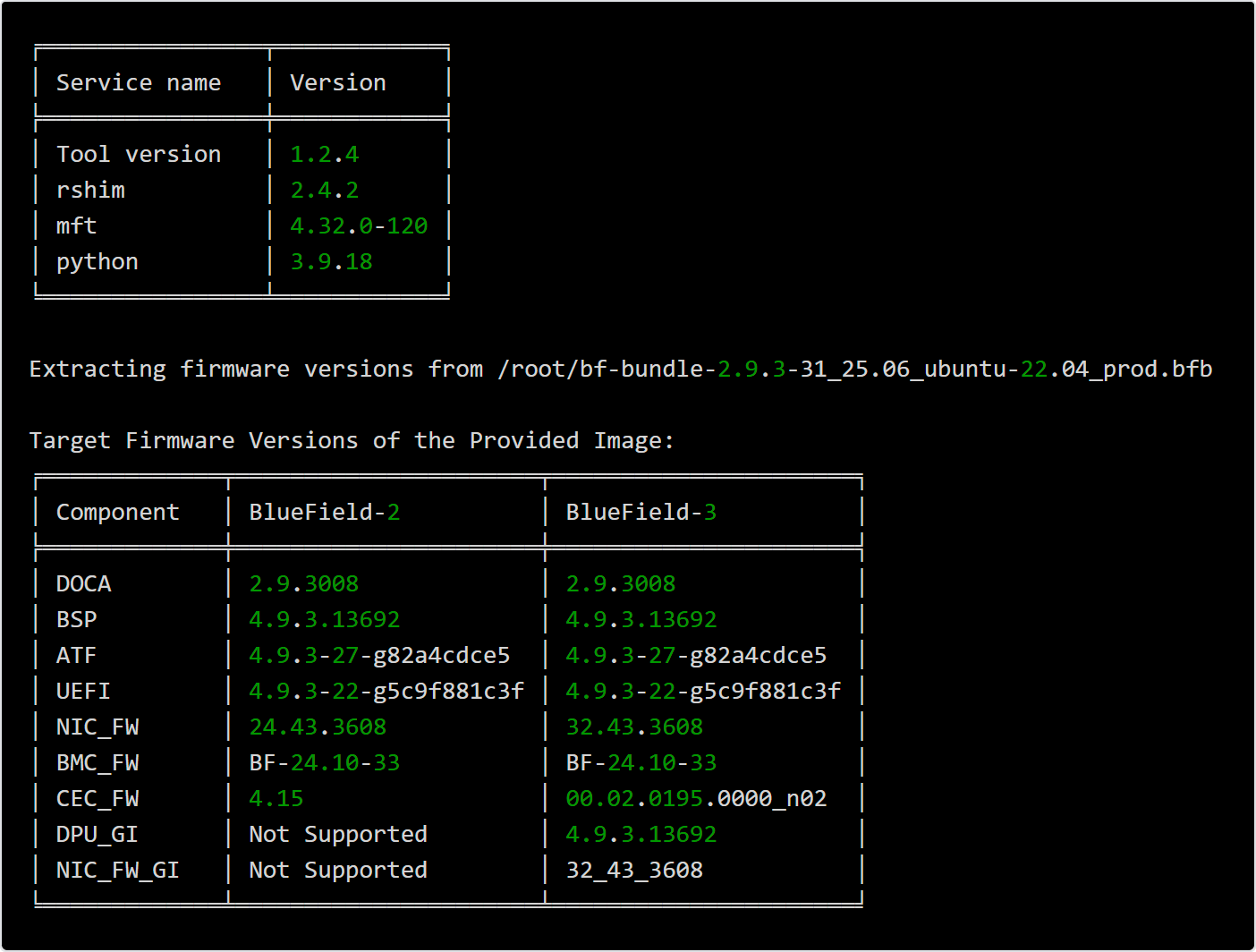
Use the --show-target-fw flag to display firmware versions embedded in the provided BFB image:
host# doca-installer -b <image_path.bfb> --show-target-fw
Example output:
Fetch Firmware Versions from Running Devices
Use the --show-running-fw flag to display firmware versions currently installed on each detected BlueField device:
host# doca-installer --show-running-fw
Example output:

Compare Image vs. Running Firmware Versions
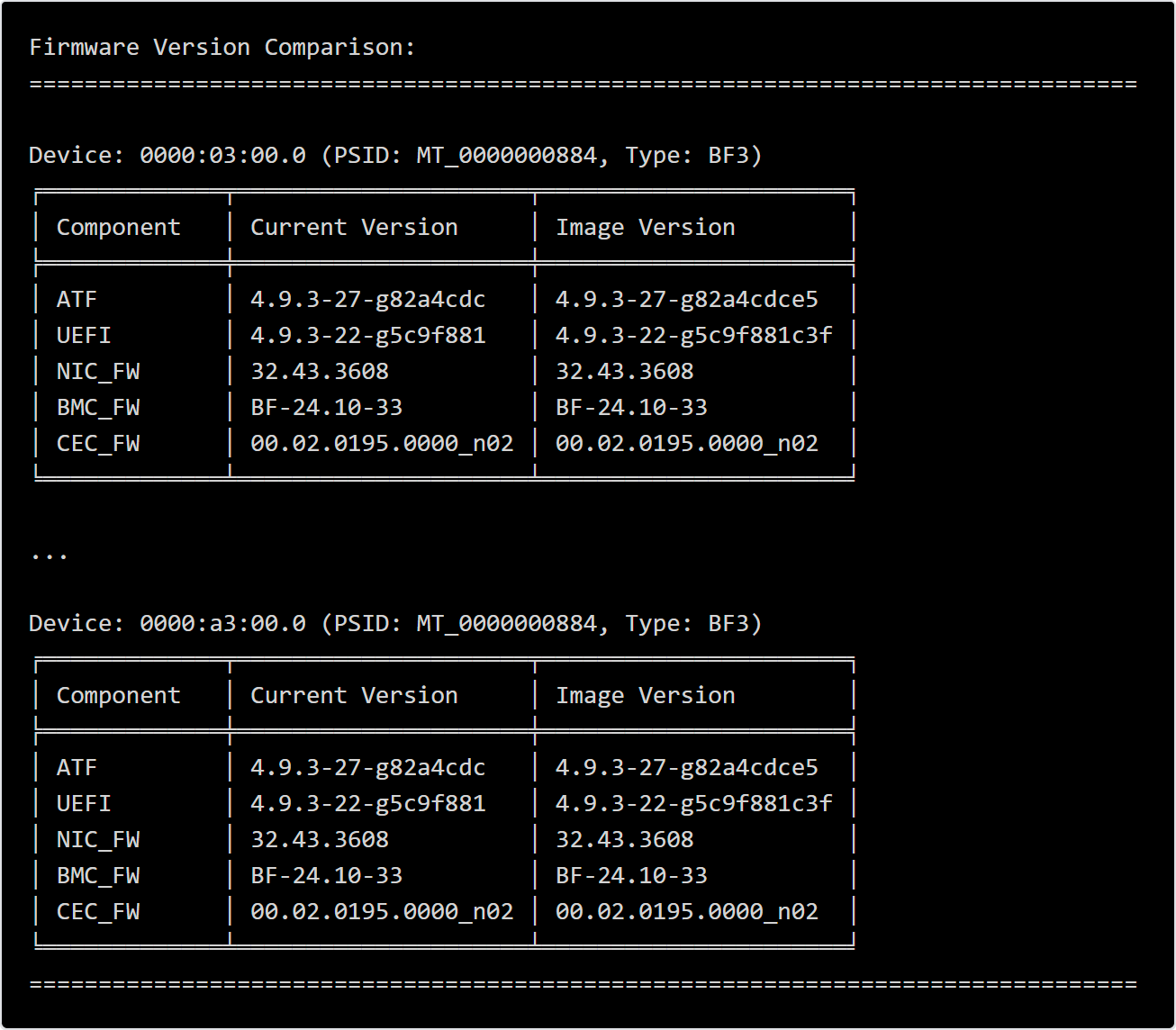
Use the --compare option to compare current firmware versions on each device with those contained in the image:
host# doca-installer -b <image_path.bfb> --compare
Example output:
Supported DOCA-Host OS for DOCA Installer
The following OSs on the host machine are supported for doca-installer:
|
Operating System |
Architecture |
|---|---|
|
debian10.13 |
x86_64 |
|
aarch64 |
|
|
debian12.1 |
x86_64 |
|
aarch64 |
|
|
debian12.5 |
x86_64 |
|
aarch64 |
|
|
openeuler24.03 |
x86_64 |
|
aarch64 |
|
|
ol8.4 |
x86_64 |
|
ol8.6 |
x86_64 |
|
ol8.7 |
x86_64 |
|
ol8.8 |
x86_64 |
|
ol8.10 |
x86_64 |
|
ol9.1 |
x86_64 |
|
ol9.2 |
x86_64 |
|
ol9.4 |
aarch64 |
|
rhel8.2 |
x86_64 |
|
aarch64 |
|
|
rhel8.4 |
x86_64 |
|
aarch64 |
|
|
rhel8.6 |
x86_64 |
|
ppc64le |
|
|
aarch64 |
|
|
rhel8.8 |
x86_64 |
|
ppc64le |
|
|
aarch64 |
|
|
rhel8.9 |
x86_64 |
|
ppc64le |
|
|
aarch64 |
|
|
rhel8.10 |
x86_64 |
|
ppc64le |
|
|
aarch64 |
|
|
rhel9.0 |
x86_64 |
|
ppc64le |
|
|
aarch64 |
|
|
rhel9.2 |
x86_64 |
|
ppc64le |
|
|
aarch64 |
|
|
rhel9.4 |
x86_64 |
|
ppc64le |
|
|
aarch64 |
|
|
rhel9.5 |
x86_64 |
|
aarch64 |
|
|
ppc64le |
|
|
rhel9.6 |
x86_64 |
|
aarch64 |
|
|
ppc64le |
|
|
ubuntu22.04 |
x86_64 |
|
ppc64le |
|
|
aarch64 |
|
|
ubuntu24.04 |
x86_64 |
|
aarch64 |
|
|
ppc64le |
|
|
ubuntu24.10 |
x86_64 |
|
ubuntu25.04 |
x86_64 |
|
aarch64 |
|
|
azurelinux3.0 |
x86_64 |
|
aarch64 |
Building Custom BFB Installation Image
To build a customized BlueField OS image, use the BFB build environment. For more details, refer to the bfb-build project in in GitHub.
To boot a customized BlueField OS image on a UEFI secure-boot-enabled BlueField (the default secure boot setting), the following conditions must be met:
-
The OS image must be signed with a key already present in the UEFI DB (e.g., the Microsoft key)
-
If the above is not possible, UEFI secure boot must be disabled to allow booting of an unsigned or differently signed image
For detailed instructions on managing UEFI secure boot, refer to the "Secure Boot" page in the BlueField Platform SW Documentation.
Last updated: