

Introduction
Remote Direct Memory Access (RDMA) provides direct memory access from the memory of one host (storage or compute) to the memory of another host without involving the remote Operating System and CPU, boosting network and host performance with lower latency, lower CPU load and higher bandwidth. In contrast, TCP/IP communications typically require copy operations, which add latency and consume significant CPU and memory resources.
For further information, please refer to RDMA Core GitHub.
Glossary
|
Term |
Description |
|---|---|
|
Access Layer |
Low level operating system infrastructure (plumbing) used for accessing the interconnect fabric (VPI™, InfiniBand®, Ethernet, FCoE). It includes all basic transport services needed to support upper level network protocols, middleware, and management agents. |
|
AH (Address Handle) |
An object which describes the path to the remote side used in UD QP |
|
CA (Channel Adapter) |
A device which terminates an InfiniBand link, and executes transport level functions |
|
CI (Channel Interface) |
Presentation of the channel to the Verbs Consumer as implemented through the combination of the network adapter, associated firmware, and device driver software |
|
CM (Communication Manager) |
An entity responsible to establish, maintain, and release communication for RC and UC QP service types The Service ID Resolution Protocol enables users of UD service to locate QPs supporting their desired service. There is a CM in every IB port of the end nodes. |
|
Compare & Swap |
Instructs the remote QP to read a 64-bit value, compare it with the compare data provided, and if equal, replace it with the swap data, provided in the QP. |
|
CQ (Completion Queue) |
A queue (FIFO) which contains CQEs |
|
CQE (Completion Queue Entry) |
An entry in the CQ that describes the information about the completed WR (status size etc.) |
|
DMA (Direct Memory Access) |
Allowing Hardware to move data blocks directly to and from the memory, bypassing the CPU |
|
Fetch & Add |
Instructs the remote QP to read a 64-bit value and replace it with the sum of the 64-bit value and the added data value, provided in the QP. |
|
GUID (Globally Unique IDentifier) |
A 64 bit number that uniquely identifies a device or component in a subnet |
|
GID (Global IDentifier) |
A 128-bit identifier used to identify a Port on a network adapter, a port on a Router, or a Multicast Group.
|
|
GRH (Global Routing Header) |
A packet header used to deliver packets across a subnet boundary and also used to deliver Multicast messagesThis Packet header is based on IPv6 protocol. |
|
Network Adapter |
A hardware device that allows for communication between computers in a network. |
|
Host |
A computer platform executing an Operating System which may control one or more network adapters |
|
IB |
InfiniBand |
|
Join operation |
An IB port must explicitly join a multicast group by sending a request to the SA to receive multicast packets. |
|
lkey |
A number that is received upon registration of MR is used locally by the WR to identify the memory region and its associated permissions. |
|
LID (Local IDentifier) |
A 16 bit address assigned to end nodes by the subnet manager.Each LID is unique within its subnet. |
|
LLE (Low LatencyEthernet) |
RDMA service over CEE (Converged Enhanced Ethernet) allowing IB transport over Ethernet. |
|
NA (Network Adapter) |
A device which terminates a link and executes transport level functions. |
|
MGID (Multicast Group ID) |
IB multicast groups, identified by MGIDs, are managed by the SM. The SM associates a MLID with each MGID and explicitly programs the IB switches in the fabric to ensure that the packets are received by all the ports that joined the multicast group. |
|
MR (Memory Region) |
A contiguous set of memory buffers which have already been registered with access permissions. These buffers need to be registered for the network adapter to make use of them. During registration an L_Key and R_Key are created and associated with the created memory region |
|
MTU (MaximumTransfer Unit) |
The maximum size of a packet payload (not including headers) that can be sent /received from a port |
|
MW (Memory Window) |
An allocated resource that enables remote access after being bound to a specified area within an existing Memory Registration. Each Memory Window has an associated Window Handle, set of access privileges, and current R_Key. |
|
Outstanding Work Request |
WR which was posted to a work queue and its completion was not polled |
|
pkey (Partition key) |
The pkey identifies a partition that the port belongs to. A pkey is roughly analogous to a VLAN ID in ethernet networking. It is used to point to an entry within the port's partition key (pkey) table. Each port is assigned at least one pkey by the subnet manager (SM). |
|
PD (Protection Domain) |
Object whose components can interact with only each other.AHs interact with QPs, and MRs interact with WQs. |
|
QP (Queue Pair) |
The pair (send queue and receive queue) of independent WQs packed together in one object for the purpose of transferring data between nodes of a network.
|
|
RC (Reliable Connection) |
A QP Transport service type based on a connection oriented protocol.A QP (Queue pair) is associated with another single QP. The messages are sent in a reliable way (in terms of the correctness and order of the information.) |
|
RDMA (Remote Direct Memory Access) |
Accessing memory in a remote side without involvement of the remote CPU |
|
RDMA_CM (Remote Direct Memory Access CommunicationManager) |
API used to setup reliable, connected and unreliable datagram data transfers. It provides an RDMA transport neutral interface for establishing connections. The API is based on sockets, but adapted for queue pair (QP) based semantics: communication must be over a specific RDMA device, and data transfers are message based. |
|
Requestor |
The side of the connection that will initiate a data transfer (by posting a send request) |
|
Responder |
The side of the connection that will respond to commands from the requestor which may include a request to write to the responder memory or read from the responder memory and finally a command requesting the responder to receive a message. |
|
rkey |
A number that is received upon registration of MR is used to enforce permissions on incoming RDMA operations |
|
RNR (Receiver Not Ready) |
The flow in an RC QP where there is a connection between the sides but a RR is not present in the Receive side |
|
RQ (Receive Queue) |
A Work Queue which holds RRs posted by the user |
|
RR (Receive Request) |
A WR which was posted to an RQ which describes where incoming data using a send opcode is going to be written. Also note that a RDMA Write with immediate will consume a RR. |
|
RTR (Ready To Receive) |
A QP state in which an RR can be posted and be processed |
|
RTS (Ready To Send) |
A QP state in which an SR can be posted and be processed |
|
SA (SubnetAdministrator) |
The interface for querying and manipulating subnet management data |
|
SGE (Scatter /GatherElements) |
An entry to a pointer to a full or a part of a local registered memory block.The element hold the start address of the block, size, and lkey (with its associated permissions). |
|
S/G Array |
An array of S/G elements which exists in a WR that according to the used opcode either collects data from multiple buffers and sends them as a single stream or takes a single stream and breaks it down to numerous buffers |
|
SM (Subnet Manager) |
An entity that configures and manages the subnet Discovers the network topology Assign LIDs Determines the routing schemes and sets the routing tables One master SM and possible several slaves (Standby mode) Administers switch routing tables thereby establishing paths through the fabric |
|
SQ (Send Queue) |
A Work Queue which holds SRs posted by the user |
|
SR (Send Request) |
A WR which was posted to an SQ which describes how much data is going to be transferred, its direction, and the way (the opcode will specify the transfer) |
|
SRQ (Shared Receive Queue) |
A queue which holds WQEs for incoming messages from any RC/UC/UD QP which is associated with it.More than one QPs can be associated with one SRQ. |
|
TCA (Target Channel Adapter) |
A Channel Adapter that is not required to support verbs, usually used in I/O devices |
|
UC (UnreliableConnection) |
A QP transport service type based on a connection oriented protocol,where a QP (Queue pair) is associated with another single QP. The QPs do not execute a reliable Protocol and messages can be lost. |
|
UD (UnreliableDatagram) |
A QP transport service type in which messages can be one packet length and every UD QP can send/receive messages from another UD QP in the subnetMessages can be lost and the order is not guaranteed. UD QP is the only type which supports multicast messages. The message size of a UD packet is limited to the Path MTU |
|
Verbs |
An abstract description of the functionality of a network adapter.Using the verbs, any application can create / manage objects that are needed in order to use RDMA for data transfer. |
|
VPI (Virtual Protocol Interface) |
Allows the user to change the layer 2 protocol of the port. |
|
WQ (Work Queue) |
One of Send Queue or Receive Queue. |
|
WQE (Work QueueElement) |
A WQE, pronounced "wookie", is an element in a work queue. |
|
WR (Work Request) |
A request which was posted by a user to a work queue. |
RDMA Architecture
InfiniBand
InfiniBand (IB) is a high-speed, low latency, low CPU overhead, highly efficient and scalable server and storage interconnect technology. One of the key capabilities of InfiniBand is its support for native Remote Direct Memory Access (RDMA). InfiniBand enables data transfer between servers and between server and storage without the involvement of the host CPU in the data path. InfiniBand uses I/O channels for data communication (up to 16 million per host), where each channel provides the semantics of a virtualized NIC or HCA (security, isolations, etc). InfiniBand provides various technology or solution speeds ranging from 10Gb/s (SDR) up to 56Gb/s (FDR) per port, using copper and optical fiber connections. InfiniBand efficiency and scalability have made it the optimal performance and cost/performance interconnect solution for the world's leading high-performance computing, cloud, Web 2.0, storage, database and financial data centers and applications. InfiniBand is a standard technology, defined and specified by the IBTA organization.
Virtual Protocol Interconnect® (VPI)
Virtual Protocol Interconnect (VPI) architecture provides a high performance, low latency and reliable means for communication among network adapters and switches supporting both InfiniBand and Ethernet semantics. A VPI adapter or switch can be set to deliver either InfiniBand or Ethernet semantics per port. A dual-port VPI adapter, for example, can be configured to one of the following options:
-
An adapter (HCA) with two InfiniBand ports
-
A NIC with two Ethernet ports
-
An adapter with one InfiniBand port and one Ethernet port at the same time
Similarly, a VPI switch can have InfiniBand-only ports, Ethernet-only ports, or a mix of both InfiniBand and Ethernet ports working at the same time. VPI adapters and switches support both the InfiniBand RDMA and the Ethernet RoCE solutions.
RDMA over Converged Ethernet (RoCE)
RoCE is a standard for RDMA over Ethernet that is also defined and specified by the IBTA organization. RoCE provides true RDMA semantics for Ethernet as it does not require the complex and low performance TCP transport (needed for iWARP, for example).RoCE is the most efficient low latency Ethernet solution today. It requires a very low CPU overhead and takes advantage of Priority Flow Control in Data Center Bridging Ethernet for lossless connectivity. RoCE has been fully supported by the Open Fabrics Software since the release of OFED 1.5.1.
Comparison of RDMA Technologies
Currently, there are three technologies that support RDMA: InfiniBand, Ethernet RoCE and Ethernet iWARP. All three technologies share a common user API which is defined in this document, but have different physical and link layers.
When it comes to the Ethernet solutions, RoCE has clear performance advantages over iWARP— both for latency, throughput and CPU overhead. RoCE is supported by many leading solutions, and is incorporated within Windows Server software (as well as InfiniBand).
RDMA technologies are based on networking concepts found in a traditional network but there are differences them and their counterparts in IP networks. The key difference is that RDMA provides a messaging service which applications can use to directly access the virtual memory on remote computers. The messaging service can be used for Inter Process Communication (IPC), communication with remote servers and to communicate with storage devices using Upper Layer Protocols (ULPs) such as iSCSI Extensions for RDMA (ISER) and SCSI RDMA Protocol (SRP), Storage Message Block (SMB), Samba, Lustre, ZFS and many more.
RDMA provides low latency through stack bypass and copy avoidance, reduces CPU utilization, reduces memory bandwidth bottlenecks and provides high bandwidth utilization. The key benefits that RDMA delivers accrue from the way that the RDMA messaging service is presented to the application and the underlying technologies used to transport and deliver those messages. RDMA provides Channel based IO. This channel allows an application using an RDMA device to directly read and write remote virtual memory.
In traditional sockets networks, applications request network resources from the operating system through an API which conducts the transaction on their behalf. However RDMA use the OS to establish a channel and then allows applications to directly exchange messages without further OS intervention. A message can be an RDMA Read, an RDMA Write operation or a Send/ Receive operation. InfiniBand and RoCE also support Multicast transmission.
The InfiniBand Link layer offers features such as a credit based flow control mechanism for congestion control. It also allows the use of Virtual Lanes (VLs) which allow simplification of the higher layer level protocols and advanced Quality of Service. It guarantees strong ordering within the VL along a given path. The InfiniBand Transport layer provides reliability and delivery guarantees.
The Network Layer used by InfiniBand has features which make it simple to transport messages directly between applications' virtual memory even if the applications are physically located on different servers. Thus the combination of InfiniBand Transport layer with the Software Transport Interface is better thought of as a RDMA message transport service. The entire stack, including the Software Transport Interface comprises the InfiniBand messaging service.
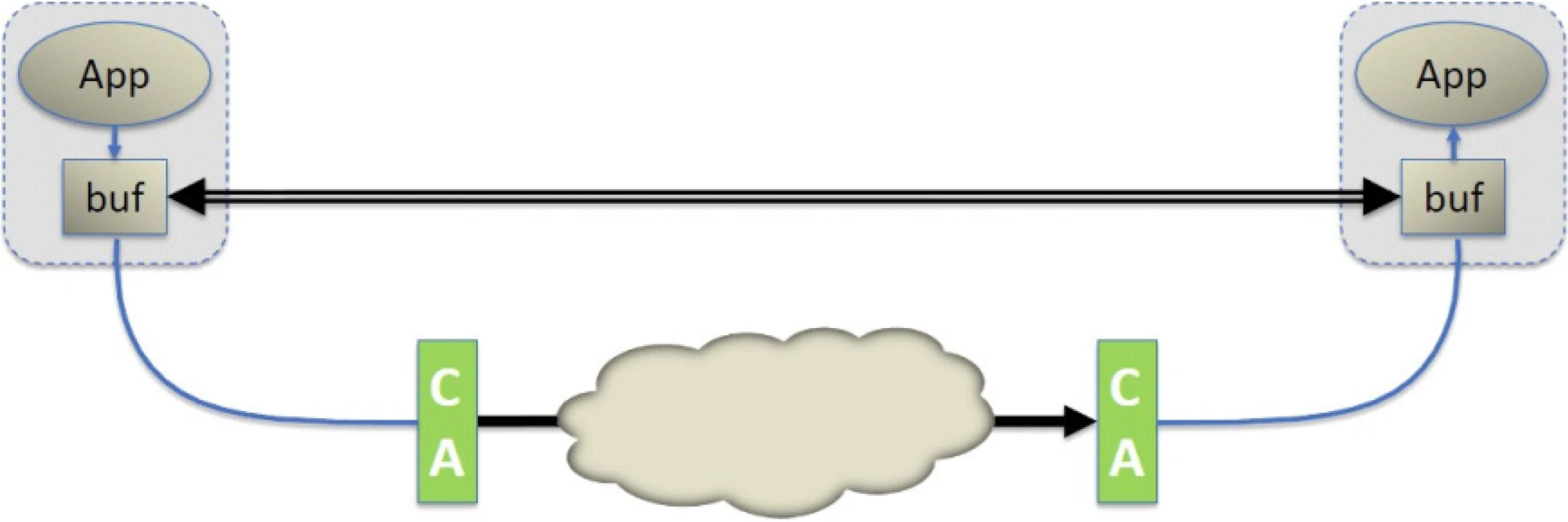
The most important point is that every application has direct access to the virtual memory of devices in the fabric. This means that applications do not need to make requests to an operating system to transfer messages. Contrast this with the traditional network environment where the shared network resources are owned by the operating system and cannot be accessed by a user application. Thus, an application must rely on the involvement of the operating system to move data from the application's virtual buffer space, through the network stack and out onto the wire. Similarly, at the other end, an application must rely on the operating system to retrieve the data on the wire on its behalf and place it in its virtual buffer space.
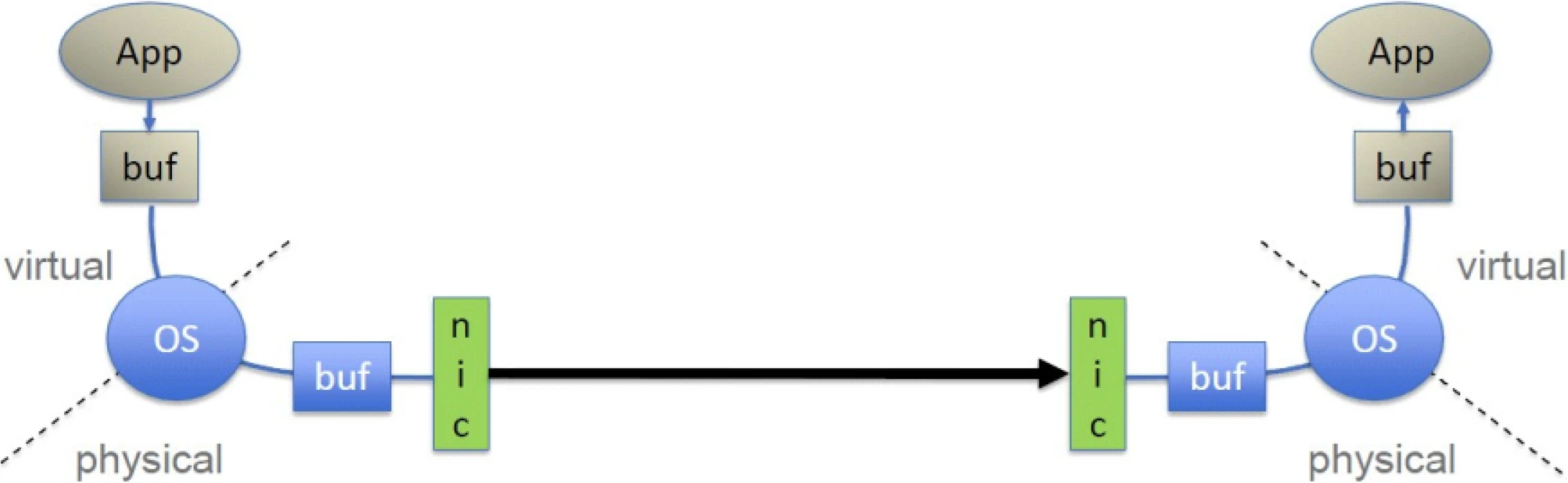
TCP/IP/Ethernet is a byte-stream oriented transport for passing bytes of information between sockets applications. TCP/IP is lossy by design but implements a reliability scheme using the Transmission Control Protocol (TCP). TCP/IP requires Operating System (OS) intervention for every operation which includes buffer copying on both ends of the wire. In a byte stream-oriented network, the idea of a message boundary is lost. When an application wants to send a packet, the OS places the bytes into an anonymous buffer in main memory belonging to the operating system and when the byte transfer is complete, the OS copies the data in its buffer into the receive buffer of the application. This process is repeated each time a packet arrives until the entire byte stream is received. TCP is responsible for retransmitting any lost packets due to congestion.
In InfiniBand, a complete message is delivered directly to an application. Once an application has requested transport of an RDMA Read or Write, the InfiniBand hardware segments the outbound message as needed into packets whose size is determined by the fabric path maximum transfer unit. These packets are transmitted through the InfiniBand network and delivered directly into the receiving application's virtual buffer where they are re-assembled into a complete message. The receiving application is notified once the entire message has been received. Thus neither the sending nor the receiving application is involved until the entire message is delivered into the receiving application's buffer.
Key Components
These are being presented only in the context of the advantages of deploying IB and RoCE. We do not discuss cables and connectors.
Host Channel Adapter
HCAs provide the point at which an IB end node (for example, a server) connects to an IB network. These are the equivalent of the Ethernet (NIC) card but they do much more. HCAs provide address translation mechanism under the control of the operating system which allows an application to access the HCA directly. The same address translation mechanism is the means by which an HCA accesses memory on behalf of a user level application. The application refers to virtual addresses while the HCA has the ability to translate these addresses into physical addresses in order to affect the actual message transfer.
Range Extenders
InfiniBand range extension is accomplished by encapsulating the InfiniBand traffic onto the WAN link and extending sufficient buffer credits to ensure full bandwidth across the WAN.
Subnet Manager
The InfiniBand subnet manager assigns Local Identifiers (LIDs) to each port connected to the InfiniBand fabric and develops a routing table based on the assigned LIDs. The IB Subnet Manager is a concept of Software Defined Networking (SDN) which eliminates the interconnect complexity and enables the creation of very large scale compute and storage infrastructures.
Switches
IB switches are conceptually similar to standard networking switches but are designed to meet IB performance requirements. They implement flow control of the IB Link Layer to prevent packet dropping, and to support congestion avoidance and adaptive routing capabilities, and advanced Quality of Service. Many switches include a Subnet Manager. At least one Subnet Manager is required to configure an IB fabric.
Support for Existing Applications and ULPs
IP applications are enabled to run over an InfiniBand fabric using IP over IB (IPoIB) or Ethernet over IB (EoIB) or RDS ULPs. Storage applications are supported via iSER, SRP, RDS, NFS, ZFS, SMB and others. MPI and Network Direct are all supported ULPs as well, but are outside the scope of this document.
RDMA-Aware Programming
The VPI architecture permits direct user mode access to the hardware. Mellanox provides a dynamically loaded library, creating access to the hardware via the verbs API. This document contains verbs and their related inputs, outputs, descriptions, and functionality as exposed through the operating system programming interface.
This section and its verbs are valid only for user space. See header files for the kernel space verbs.
Programming with verbs allows for customizing and optimizing the RDMA-Aware network. This customizing and optimizing should be done only by programmers with advanced knowledge and experience in the VPI systems.
To perform RDMA operations, establishment of a connection to the remote host, as well as appropriate permissions need to be set up first. The mechanism for accomplishing this is the Queue Pair (QP). For those familiar with a standard IP stack, a QP is roughly equivalent to a socket. The QP needs to be initialized on both sides of the connection. Communication Manager (CM) can be used to exchange information about the QP prior to actual QP setup.
Once a QP is established, the verbs API can be used to perform RDMA reads, RDMA writes, and atomic operations. Serialized send/receive operations, which are similar to socket reads/writes, can be performed as well.
Available Communication Operations
Send/Send With Immediate
The send operation allows you to send data to a remote QP's receive queue. The receiver must have previously posted a receive buffer to receive the data. The sender does not have any control over where the data will reside in the remote host. Optionally, an immediate 4 byte value may be transmitted with the data buffer. This immediate value is presented to the receiver as part of the receive notification, and is not contained in the data buffer.
Receive
This is the corresponding operation to a send operation. The receiving host is notified that a data buffer has been received, possibly with an inline immediate value. The receiving application is responsible for receive buffer maintenance and posting.
RDMA Read
A section of memory is read from the remote host. The caller specifies the remote virtual address as well as a local memory address to be copied to. Prior to performing RDMA operations, the remote host must provide appropriate permissions to access its memory. Once these permissions are set, RDMA read operations are conducted with no notification whatsoever to the remote host. For both RDMA read and write, the remote side isn't aware that this operation being done (other than the preparation of the permissions and resources).
RDMA Write/RDMA Write With Immediate
Similar to RDMA read, but the data is written to the remote host. RDMA write operations are performed with no notification to the remote host. RDMA write with immediate operations, however, do notify the remote host of the immediate value.
Atomic Fetch and Add/Atomic Compare and Swap
These are atomic extensions to the RDMA operations. The atomic fetch and add operation atomically increments the value at a specified virtual address by a specified amount. The value prior to being incremented is returned to the caller. The atomic compare and swap will atomically compare the value at a specified virtual address with a specified value and if they are equal, a specified value will be stored at the address.
Transport Modes
There are several different transport modes you may select from when establishing a QP. Operations available in each mode are shown in the following table.
|
Operation |
UD |
UC |
RC |
RD |
|---|---|---|---|---|
|
Send (with immediate) |
+ |
+ |
+ |
+ |
|
Receive |
+ |
+ |
+ |
+ |
|
RDMA Write (with immediate) |
|
+ |
+ |
+ |
|
RDMA Read |
|
|
+ |
+ |
|
Atomic: Fetch and Add/ Cmp and Swap |
|
|
+ |
+ |
|
Max message size |
MTU |
1GB |
1GB |
1GB |
RD is not supported by this API.
Reliable Connection (RC)
Queue Pair is associated with only one other QP. Messages transmitted by the send queue of one QP are reliably delivered to receive queue of the other QP. Packets are delivered in order. A RC connection is very similar to a TCP connection.
Unreliable Connection (UC)
A Queue Pair is associated with only one other QP. The connection is not reliable so packets may be lost. Messages with errors are not retried by the transport, and error handling must be provided by a higher level protocol.
Unreliable Datagram (UD)
A Queue Pair may transmit and receive single-packet messages to/from any other UD QP. Ordering and delivery are not guaranteed, and delivered packets may be dropped by the receiver. Multicast messages are supported (one to many). A UD connection is very similar to a UDP connection.
Key Concepts
Send Request (SR)
An SR defines how much data will be sent, from where, how and, with RDMA, to where. struct ibv_send_wr is used to implement SRs.
Receive Request (RR)
An RR defines buffers where data is to be received for non-RDMA operations. If no buffers are defined and a transmitter attempts a send operation or a RDMA Write with immediate, a receive not ready (RNR) error will be sent. struct ibv_recv_wr is used to implement RRs.
Completion Queue
A Completion Queue is an object which contains the completed work requests which were posted to the Work Queues (WQ). Every completion says that a specific WR was completed (both successfully completed WRs and unsuccessfully completed WRs).A Completion Queue is a mechanism to notify the application about information of ended Work Requests (status, opcode, size, source). CQs have n Completion Queue Entries (CQE). The number of CQEs is specified when the CQ is created. When a CQE is polled it is removed from the CQ. CQ is a FIFO of CQEs. CQ can service send queues, receive queues, or both. Work queues from multiple QPs can be associated with a single CQ. struct ibv_cq is used to implement a CQ.
Memory Registration
Memory Registration is a mechanism that allows an application to describe a set of virtually contiguous memory locations or a set of physically contiguous memory locations to the network adapter as a virtually contiguous buffer using Virtual Addresses.
The registration process pins the memory pages (to prevent the pages from being swapped out and to keep physical <-> virtual mapping). During the registration, the OS checks the permissions of the registered block. The registration process writes the virtual to physical address table to the network adapter. When registering memory, permissions are set for the region. Permissions are local write, remote read, remote write, atomic, and bind. Every MR has a remote and a local key (r_key, l_key). Local keys are used by the local HCA to access local memory, such as during a receive operation. Remote keys are given to the remote HCA to allow a remote process access to system memory during RDMA operations. The same memory buffer can be registered several times (even with different access permissions) and every registration results in a different set of keys.
Struct ibv_mr is used to implement memory registration.
Memory Window
An MW allows the application to have more flexible control over remote access to its memory. Memory Windows are intended for situations where the application:
-
wants to grant and revoke remote access rights to a registered Region in a dynamic fashion with less of a performance penalty than using deregistration/registration or reregistration.
-
wants to grant different remote access rights to different remote agents and/or grant those rights over different ranges within a registered Region.
The operation of associating an MW with an MR is called Binding. Different MWs can overlap the same MR (event with different access permissions).
Address Vector
An Address Vector is an object that describes the route from the local node to the remote node. In every UC/RC QP there is an address vector in the QP context. In UD QP the address vector should be defined in every post SR. struct ibv_ah is used to implement address vectors.
Global Routing Header (GRH)
The GRH is used for routing between subnets. When using RoCE, the GRH is used for routing inside the subnet and therefore is a mandatory. The use of the GRH is mandatory in order for an application to support both IB and RoCE.
When global routing is used on UD QPs, there will be a GRH contained in the first 40 bytes of the receive buffer. This area is used to store global routing information, so an appropriate address vector can be generated to respond to the received packet. If GRH is used with UD, the RR should always have extra 40 bytes available for this GRH. struct ibv_grh is used to implement GRHs.
Protection Domain
Object whose components can interact with only each other. These components can be AH, QP, MR, and SRQ. A protection domain is used to associate Queue Pairs with Memory Regions and Memory Windows, as a means for enabling and controlling network adapter access to Host System memory. PDs are also used to associate Unreliable Datagram queue pairs with Address Handles, as a means of controlling access to UD destinations. struct ibv_pd is used to implement protection domains.
Asynchronous Events
The network adapter may send async events to inform the SW about events that occurred in the system.
There are two types of async events:
-
Affiliated events: events that occurred to personal objects (CQ, QP, SRQ). Those events will be sent to a specific process.
-
Unaffiliated events: events that occurred to global objects (network adapter, port error). Those events will be sent to all processes.
Scatter Gather
Data is being gathered/scattered using scatter gather elements, which include:
-
Address: address of the local data buffer that the data will be gathered from or scattered to. Size: the size of the data that will be read from / written to this address.
-
L_key: the local key of the MR that was registered to this buffer. struct
ibv_sgeimplements scatter gather elements.
Polling
Polling the CQ for completion is getting the details about a WR (Send or Receive) that was posted. If we have completion with bad status in a WR, the rest of the completions will be all be bad (and the Work Queue will be moved to error state). Every WR that does not have a completion (that was polled) is still outstanding. Only after a WR has a completion, the send / receive buffer may be used/reused/freed. The completion status should always be checked. When a CQE is polled it is removed from the CQ. Polling is accomplished with the ibv_poll_cq operation.
Typical Application
This documents provides two program examples:
-
The first code,
RDMA_RC_example, uses the VPI verbs API, demonstrating how to perform RC: Send, Receive, RDMA Read and RDMA Write operations. -
The second code, multicast example, uses
RDMA_CMverbs API, demonstrating Multicast UD.
The structure of a typical application is as follows:
-
Get the device list (implemented in programming example by
resources_create):
First you must retrieve the list of available IB devices on the local host. Every device in this list contains both a name and a GUID. For example the device names can be: mthca0, mlx4_1. -
Open the requested device (implemented in programming example by
resources_create):
Iterate over the device list, choose a device according to its GUID or name and open it. -
Query the device capabilities (implemented in programming example by
resources_create):
The device capabilities allow the user to understand the supported features (APM, SRQ) and capabilities of the opened device. -
Allocate a Protection Domain to contain your resources (implemented in programming example by
resources_create):
A Protection Domain (PD) allows the user to restrict which components can interact with only each other. These components can be AH, QP, MR, MW, and SRQ. -
Register a memory region (implemented in programming example by
resources_create):
VPI only works with registered memory. Any memory buffer which is valid in the process's virtual space can be registered. During the registration process the user sets memory permissions and receives local and remote keys (lkey/rkey) which will later be used to refer to this memory buffer. -
Create a Completion Queue (CQ) (implemented in programming example by
resources_create):
A CQ contains completed work requests (WR). Each WR will generate a completion queue entry (CQE) that is placed on the CQ. The CQE will specify if the WR was completed successfully or not. -
Create a Queue Pair (QP) (implemented in programming example by
resources_create):
Creating a QP will also create an associated send queue and receive queue. -
Bring up a QP (implemented in programming example by
connect_qp,modify_qp_to_init,post_receive,modify_qp_to_rtr, andmodify_qp_to_rts):
A created QP still cannot be used until it is transitioned through several states, eventually getting to Ready To Send (RTS). This provides needed information used by the QP to be able send/receive data. -
Post work requests and poll for completion (implemented in programming example by
post_sendandpoll_completion):
Use the created QP for communication operations. -
Cleanup (implemented in programming example by
resources_destroy):
Destroy objects in the reverse order you created them:-
Delete QP.
-
Delete CQ.
-
Deregister MR.
-
Deallocate PD.
-
Close device.
-
VPI Verbs API
This chapter describes the details of the VPI verbs API.
Initialization
-
Template:
int ibv_fork_init(void) -
Input parameters: None
-
Output parameters: None
-
Return value: 0 on success, -1 on error. If the call fails, errno will be set to indicate the reason for the failure.
Description:
ibv_fork_init initializes libibverbs' data structures to handle the fork() function safely and avoid data corruption, whether fork() is called explicitly or implicitly such as in system() calls.
It is not necessary to call ibv_fork_init if all parent process threads are always blocked until all child processes end or change address space via an exec() operation.
This function works on Linux kernels supporting the MADV_DONTFORK flag for madvise() (2.6.17 and higher).
Setting the environment variable RDMAV_FORK_SAFE or IBV_FORK_SAFE to any value has the same effect as calling ibv_fork_init().
Setting the environment variable RDMAV_HUGEPAGES_SAFE to any value tells the library to check the underlying page size used by the kernel for memory regions. This is required if an application uses huge pages either directly or indirectly via a library such as libhugetlbfs.
Calling ibv_fork_init() will reduce performance due to an extra system call for every memory registration, and the additional memory allocated to track memory regions. The precise performance impact depends on the workload and usually will not be significant.
Setting RDMAV_HUGEPAGES_SAFE adds further overhead to all memory registrations.
Verb Context Operations
The following commands are used once a device has been opened. These commands allow you to get more specific information about a device or one of its ports, create completion queues (CQ), completion channels (CC), and protection domains (PD) which can be used for further operations.
ibv_query_device
-
Template:
int ibv_query_device(struct ibv_context *context, struct ibv_device_attr *device_attr) -
Input Parameters:
-
contextstructibv_contextfromibv_open_device
-
-
Output Parameters:
struct ibv_device_attrcontaining device attributes -
Return Value: 0 on success, -1 on error. If the call fails, errno will be set to indicate the reason for the failure.
Description:
ibv_query_device retrieves the various attributes associated with a device. The user should malloc a struct ibv_device_attr, pass it to the command, and it will be filled in upon successful return. The user is responsible to free this struct.
struct ibv_device_attr is defined as follows:
struct ibv_device_attr

{
       char                                     fw_ver[64];
       uint64_t                                 node_guid;
       uint64_t                                 sys_image_guid;
       uint64_t                                 max_mr_size;
       uint64_t                                 page_size_cap;
       uint32_t                                 vendor_id;
       uint32_t                                 vendor_part_id;
       uint32_t                                 hw_ver;
       int                                      max_qp;
       int                                      max_qp_wr;
       int                                      device_cap_flags;
       int                                      max_sge;
       int                                      max_sge_rd;
       int                                      max_cq;
       int                                      max_cqe;
       int                                      max_mr;
       int                                      max_pd;
       int                                      max_qp_rd_atom;
       int                                      max_ee_rd_atom;
       int                                      max_res_rd_atom;
       int                                      max_qp_init_rd_atom;
       int                                      max_ee_init_rd_atom;
       enum ibv_atomic_cap                      atomic_cap;
       int                                      max_ee;
       int                                      max_rdd;
       int                                      max_mw;
       int                                      max_raw_ipv6_qp;
       int                                      max_raw_ethy_qp;
       int                                      max_mcast_grp;
       int                                      max_mcast_qp_attach;
       int                                      max_total_mcast_qp_attach;
       int                                      max_ah;
       int                                      max_fmr;
       int                                      max_map_per_fmr;
       int                                      max_srq;
       int                                      max_srq_wr;
       int                                      max_srq_sge;
       uint16_t                                 max_pkeys;
       uint8_t                                  local_ca_ack_delay;
       uint8_t                                  phys_port_cnt;
}

fw_ver              Firmware version
node_guid           Node global unique identifier (GUID)
sys_image_guid      System image GUID
max_mr_size         Largest contiguous block that can be registered
page_size_cap       Supported page sizes
vendor_id           Vendor ID, per IEEE
vendor_part_id      Vendor supplied part ID
hw_ver              Hardware version
max_qp              Maximum number of Queue Pairs (QP)
max_qp_wr           Maximum outstanding work requests (WR) on any queue
device_cap_flags    IBV_DEVICE_RESIZE_MAX_WR
                     IBV_DEVICE_BAD_PKEY_CNTR
                     IBV_DEVICE_BAD_QKEY_CNTR
                     IBV_DEVICE_RAW_MULTI
                     IBV_DEVICE_AUTO_PATH_MIG
                     IBV_DEVICE_CHANGE_PHY_PORT
                     IBV_DEVICE_UD_AV_PORT_ENFORCE
                     IBV_DEVICE_CURR_QP_STATE_MOD
                     IBV_DEVICE_SHUTDOWN_PORT
                     IBV_DEVICE_INIT_TYPE
                     IBV_DEVICE_PORT_ACTIVE_EVENT
                     IBV_DEVICE_SYS_IMAGE_GUID
                     IBV_DEVICE_RC_RNR_NAK_GEN
                     IBV_DEVICE_SRQ_RESIZE
                     IBV_DEVICE_N_NOTIFY_CQ
                     IBV_DEVICE_XRC
max_sge             Maximum scatter/gather entries (SGE) per WR for non-RD QPs
max_sge_rd          Maximum SGEs per WR for RD QPs
max_cq              Maximum supported completion queues (CQ)
max_cqe             Maximum completion queue entries (CQE) per CQ
max_mr              Maximum supported memory regions (MR)
max_pd              Maximum supported protection domains (PD)
max_qp_rd_atom      Maximum outstanding RDMA read and atomic operations per QP
max_ee_rd_atom      Maximum outstanding RDMA read and atomic operations per End to End (EE) context (RD connections)
max_res_rd_atom     Maximum resources used for incoming RDMA read and atomic operations
max_qp_init_rd_atom Maximium RDMA read and atomic operations that may be initiated per QP
max_ee_init_atom    Maximum RDMA read and atomic operations that may be initiated per EE
atomic_cap          IBV_ATOMIC_NONE - no atomic guarantees
                     IBV_ATOMIC_HCA - atomic guarantees within this device
                     IBV_ATOMIC_GLOB - global atomic guarantees
max_ee              Maximum supported EE contexts
max_rdd             Maximum supported RD domains
max_mw              Maximum supported memory windows (MW)
max_raw_ipv6_qp     Maximum supported raw IPv6 datagram QPs
max_raw_ethy_qp     Maximum supported ethertype datagram QPs
max_mcast_grp       Maximum supported multicast groups
max_mcast_qp_attach Maximum QPs per multicast group that can be attached

max_total_mcast_qp_attach
                    Maximum total QPs that can be attached to multicast groups
max_ah              Maximum supported address handles (AH)
max_fmr             Maximum supported fast memory regions (FMR)
max_map_per_fmr     Maximum number of remaps per FMR before an unmap operation is required
max_srq             Maximum supported shared receive queues (SRCQ)
max_srq_wr          Maximum work requests (WR) per SRQ
max_srq_sge         Maximum SGEs per SRQ
max_pkeys           Maximum number of partitions
local_ca_ack_delay  Local CA ack delay
phys_port_cnt       Number of physical ports
ibv_query_port
-
Template:
int ibv_query_port(struct ibv_context *context, uint8_t port_num, struct ibv_port_attr *port_attr) -
Input Parameters:
-
contextstructibv_contextfromibv_open_deviceport_numphysical port number (1 is first port).
-
-
Output Parameters:
port_attrstructibv_port_attrcontaining port attributes. -
Return Value: 0 on success, -1 on error. If the call fails, errno will be set to indicate the reason for the failure.
Description:
ibv_query_port retrieves the various attributes associated with a port. The user should allocate a struct ibv_port_attr, pass it to the command, and it will be filled in upon successful return. The user is responsible to free this struct.
struct ibv_port_attr is defined as follows:
struct ibv_port_attr
{
	enum ibv_port_state	state;
	enum ibv_mtu	max_mtu;
	enum ibv_mtu	active_mtu;
	int	gid_tbl_len;
	uint32_t	port_cap_flags;
	uint32_t	max_msg_sz;
	uint32_t	bad_pkey_cntr;
	uint32_t	qkey_viol_cntr;
	uint16_t	pkey_tbl_len;
	uint16_t	lid;
	uint16_t	sm_lid;
	uint8_t	lmc;
	uint8_t	max_vl_num;
	uint8_t	sm_sl;
	uint8_t	subnet_timeout;
	uint8_t	init_type_reply;
	uint8_t	active_width;
	uint8_t	active_speed;
	uint8_t	phys_state;
};

state	IBV_PORT_NOP
	IBV_PORT_DOWN
	IBV_PORT_INIT
	IBV_PORT_ARMED
	IBV_PORT_ACTIVE
	IBV_PORT_ACTIVE_DEFER
max_mtu	Maximum Transmission Unit (MTU) supported by port. Can be:
	IBV_MTU_256
	IBV_MTU_512
	IBV_MTU_1024
	IBV_MTU_2048
	IBV_MTU_4096
active_mtu	Actual MTU in use
gid_tbl_len	Length of source global ID (GID) table
port_cap_flags	Supported capabilities of this port. There are currently no enumerations/defines declared in verbs.h
max_msg_sz	Maximum message size
bad_pkey_cntr	Bad P_Key counter
qkey_viol_cntr	Q_Key violation counter
pkey_tbl_len	Length of partition table
lid	First local identifier (LID) assigned to this port
sm_lid	LID of subnet manager (SM)
lmc	LID Mask control (used when multiple LIDs are assigned to port)
max_vl_num	Maximum virtual lanes (VL)
sm_sl	SM service level (SL)
subnet_timeout	Subnet propagation delay
init_type_reply	Type of initialization performed by SM
active_width	Currently active link width
active_speed	Currently active link speed
phys_state	Physical port state
ibv_query_gid
-
Template:
intibv_query_gid(struct ibv_context *context, uint8_t port_num, int index, union ibv_gid *gid) -
Input Parameters:
-
contextstructibv_contextfromibv_open_device -
port_numphysical port number (1 is first port) -
indexwhich entry in the GID table to return (0 is first)
-
-
Output Parameters:
-
gidunionibv_gidcontaining gid information
-
-
Return Value: 0 on success, -1 on error. If the call fails, errno will be set to indicate the reason for the failure.
Description:
ibv_query_gid retrieves an entry in the port’s global identifier (GID) table. Each port is assigned at least one GID by the subnet manager (SM). The GID is a valid IPv6 address composed of the globally unique identifier (GUID) and a prefix assigned by the SM. GID[0] is unique and contains the port's GUID.
The user should allocate a union ibv_gid, pass it to the command, and it will be filled in upon successful return. The user is responsible to free this union.
Union ibv_gid is defined as follows:
union ibv_gid
{
       uint8_t                                  raw[16];
       struct
       {
           uint64_t                             subnet_prefix;
           uint64_t                             interface_id;
       } global;
};
ibv_query_pkey
-
Template:
int ibv_query_pkey(struct ibv_context *context, uint8_t port_num, int index, uint16_t *pkey) -
Input Parameters:
-
contextstructibv_contextfromibv_open_device -
port_numphysical port number (1 is first port) -
indexwhich entry in the pkey table to return (0 is first)
-
-
Output Parameters:
-
pkeydesired pkey
-
-
Return Value: 0 on success, -1 on error. If the call fails, errno will be set to indicate the reason for the failure.
Description:
ibv_query_pkey retrieves an entry in the port's partition key (pkey) table. Each port is assigned at least one pkey by the subnet manager (SM). The pkey identifies a partition that the port belongs to. A pkey is roughly analogous to a VLAN ID in Ethernet networking.The user passes in a pointer to a uint16 that will be filled in with the requested pkey. The user is responsible to free this uint16.
ibv_alloc_pd
-
Template:
struct ibv_pd{}ibv_alloc_pd{*}(struct ibv_context *context) -
Input Parameters:
-
contextstructibv_contextfromibv_open_device
-
-
Output Parameters: None
-
Return Value: Pointer to created protection domain or NULL on failure.
Description:
ibv_alloc_pd creates a protection domain (PD). PDs limit which memory regions can be accessed by which queue pairs (QP) providing a degree of protection from unauthorized access. The user must create at least one PD to use VPI verbs.
ibv_dealloc_pd
-
Template:
int ibv_dealloc_pd(struct ibv_pd *pd) -
Input Parameters:
-
pdstructibv_pdfromibv_alloc_pd
-
-
Output Parameters: none
-
Return Value: 0 on success, -1 on error. If the call fails, errno will be set to indicate the reason for the failure.
Description:
ibv_dealloc_pd frees a protection domain (PD). This command will fail if any other objects are currently associated with the indicated PD.
ibv_create_cq
-
Template:
struct ibv_cq {}ibv_create_cq{*}(struct ibv_context *context, int cqe, void *cq_context, struct ibv_comp_channel *channel, int comp_vector) -
Input Parameters:
-
context– structibv_contextfromibv_open_device -
cqe– Minimum number of entries CQ will support -
cq_context– (Optional) User defined value returned with completion events -
channel– (Optional) Completion channel -
comp_vector– (Optional) Completion vector
-
-
Output Parameters: none
-
Return Value: pointer to created CQ or NULL on failure.
Description:
ibv_create_cq creates a completion queue (CQ). A completion queue holds completion queue entries (CQE). Each Queue Pair (QP) has an associated send and receive CQ. A single CQ can be shared for sending and receiving as well as be shared across multiple QPs.
The parameter cqe defines the minimum size of the queue. The actual size of the queue may be larger than the specified value.
The parameter cq_context is a user defined value. If specified during CQ creation, this value will be returned as a parameter in ibv_get_cq_event when using a completion channel (CC).
The parameter channel is used to specify a CC. A CQ is merely a queue that does not have a built in notification mechanism. When using a polling paradigm for CQ processing, a CC is unnecessary. The user simply polls the CQ at regular intervals. If, however, you wish to use a pend paradigm, a CC is required. The CC is the mechanism that allows the user to be notified that a new CQE is on the CQ.
The parameter comp_vector is used to specify the completion vector used to signal completion events. It must be >=0 and < context→num_comp_vectors.
ibv_resize_cq
-
Template:
int ibv_resize_cq(struct ibv_cq *cq, int cqe) -
Input Parameters:
-
cqCQ to resize cqe Minimum number of entries CQ will support
-
-
Output Parameters: none
-
Return Value: 0 on success, -1 on error. If the call fails, errno will be set to indicate the reason for the failure.
Description:
ibv_resize_cq resizes a completion queue (CQ). The parameter cqe must be at least the number of outstanding entries on the queue. The actual size of the queue may be larger than the specified value. The CQ may (or may not) contain completions when it is being resized thus, it can be resized during work with the CQ.
ibv_destroy_cq
-
Template:
int ibv_destroy_cq(struct ibv_cq *cq) -
Input Parameters:
-
cqCQ to destroy
-
-
Output Parameters: none
-
Return Value: 0 on success, -1 on error. If the call fails, errno will be set to indicate the reason for the failure.
Description:
ibv_destroy_cq frees a completion queue (CQ). This command will fail if there is any queue pair (QP) that still has the specified CQ associated with it.
ibv_create_comp_channel
-
Template:
struct ibv_comp_channel {}ibv_create_comp_channel{*}(struct ibv_context *context) -
Input Parameters:
-
contextstructibv_contextfromibv_open_device
-
-
Output Parameters: none
-
Return Value: pointer to created CC or NULL on failure.
Description:
ibv_create_comp_channel creates a completion channel. A completion channel is a mechanism for the user to receive notifications when new completion queue event (CQE) has been placed on a completion queue (CQ).
ibv_destroy_comp_channel
-
Template:
int ibv_destroy_comp_channel(struct ibv_comp_channel *channel) -
Input Parameters:
-
channelstructibv_comp_channelfromibv_create_comp_channel
-
-
Output Parameters: none
-
Return Value: 0 on success, -1 on error. If the call fails, errno will be set to indicate the reason for the failure.
Description:
ibv_destroy_comp_channel frees a completion channel. This command will fail if there are any completion queues (CQ) still associated with this completion channel.
Protection Domain Operations
Once you have established a protection domain (PD), you may create objects within that domain. This section describes operations available on a PD. These include registering memory regions (MR), creating queue pairs (QP) or shared receive queues (SRQ) and address handles (AH).
ibv_reg_mr
-
Template:
struct ibv_mr {}ibv_reg_mr{*}(struct ibv_pd *pd, void *addr, size_t length, enum ibv_access_flags access) -
Input Parameters:
-
pdprotection domain, struct ibv_pd from ibv_alloc_pd -
addrmemory base address -
lengthlength of memory region in bytes -
accessaccess flags
-
-
Output Parameters: none
-
Return Value: pointer to created memory region (MR) or NULL on failure.
-
Description:
ibv_reg_mr registers a memory region (MR), associates it with a protection domain (PD), and assigns it local and remote keys (lkey, rkey). All VPI commands that use memory require the memory to be registered via this command. The same physical memory may be mapped to different MRs even allowing different permissions or PDs to be assigned to the same memory, depending on user requirements.
Access flags may be bitwise or one of the following enumerations:
-
IBV_ACCESS_LOCAL_WRITEAllow local host write access -
IBV_ACCESS_REMOTE_WRITEAllow remote hosts write access -
IBV_ACCESS_REMOTE_READAllow remote hosts read access -
IBV_ACCESS_REMOTE_ATOMICAllow remote hosts atomic access -
IBV_ACCESS_MW_BINDAllow memory windows on this MR
Local read access is implied and automatic.
Any VPI operation that violates the access permissions of the given memory operation will fail. Note that the queue pair (QP) attributes must also have the correct permissions or the operation will fail.
If IBV_ACCESS_REMOTE_WRITE or IBV_ACCESS_REMOTE_ATOMIC is set, then IBV_ACCESS_LOCAL_WRITE must be set as well.
Struct ibv_mr is defined as follows:
struct ibv_mr
{
struct ibv_context*context;
struct ibv_pd *pd;
void*addr;
size_tlength;
uint32_thandle;
uint32_tlkey;
uint32_trkey;
};
ibv_dereg_mr
-
Template:
int ibv_dereg_mr(struct ibv_mr *mr) -
Input Parameters:
-
mrstructibv_mrfromibv_reg_mr
-
-
Output Parameters: none
-
Return Value: 0 on success, -1 on error. If the call fails, errno will be set to indicate the reason for the failure.
Description:
ibv_dereg_mr frees a memory region (MR). The operation will fail if any memory windows (MW) are still bound to the MR.
ibv_create_qp
-
Template:
struct ibv_qp {}ibv_create_qp{*}(struct ibv_pd *pd, struct ibv_qp_init_attr *qp_init_attr) -
Input Parameters:
-
pdstructibv_pdfromibv_alloc_pd -
qp_init_attrinitial attributes of queue pair
-
-
Output Parameters:
-
qp_init_attractualvalues are filled in
-
-
Return Value: pointer to created queue pair (QP) or NULL on failure.
Description:
ibv_create_qp creates a QP. When a QP is created, it is put into the RESET state.
struct qp_init_attr is defined as follows:
struct ibv_qp_init_attr
{
	void	*qp_context;
	struct ibv_cq	*send_cq;
	struct ibv_cq	*recv_cq;
	struct ibv_srq	*srq;
	struct ibv_qp_cap	cap;
	enum ibv_qp_type	qp_type;
	int	sq_sig_all;
	struct ibv_xrc_domain	*xrc_domain;
};

qp_context	(optional) user defined value associated with QP.
send_cq	send CQ. This must be created by the user prior to calling ibv_create_qp.
recv_cq	receive CQ. This must be created by the user prior to calling ibv_create_qp. It may be the same as send_cq.
srq	(optional) shared receive queue. Only used for SRQ QP’s.
cap	defined below.
qp_type	must be one of the following:
		IBV_QPT_RC = 2,
	IBV_QPT_UC,
	IBV_QPT_UD,
	IBV_QPT_XRC,
	IBV_QPT_RAW_PACKET = 8,
	IBV_QPT_RAW_ETH = 8
sq_sig_all	If this value is set to 1, all send requests (WR) will generate completion queue events (CQE). If this value is set to 0, only WRs that are flagged will generate CQE’s (see ibv_post_send).
xrc_domain	(Optional) Only used for XRC operations.

struct ibv_qp_cap is defined as follows:

struct ibv_qp_cap
{
	uint32_t	max_send_wr;
	uint32_t	max_recv_wr;
	uint32_t	max_send_sge;
	uint32_t	max_recv_sge;
	uint32_t	max_inline_data;
};

max_send_wr	Maximum number of outstanding send requests in the send queue.
max_recv_wr	Maximum number of outstanding receive requests (buffers) in the receive queue.
max_send_sge	Maximum number of scatter/gather elements (SGE) in a WR on the send queue.
max_recv_sge	Maximum number of SGEs in a WR on the receive queue.
max_inline_data	Maximum size in bytes of inline data on the send queue.
ibv_destroy_qp
-
Template:
int ibv_destroy_qp(struct ibv_qp *qp) -
Input Parameters:
-
qpstruct ibv_qp fromibv_create_qp
-
-
Output Parameters: none
-
Return Value: 0 on success, -1 on error. If the call fails, errno will be set to indicate the reason for the failure.
Description:
ibv_destroy_qp frees a queue pair (QP).
ibv_create_srq
-
Template:
struct ibv_srq *ibv_create_srq(struct ibv_pd *pd, struct ibv_srq_init_attr *srq_init_attr) -
Input Parameters:
-
pdThe protection domain associated with the shared receive queue (SRQ) -
srq_init_attrA list of initial attributes required to create the SRQ
-
-
Output Parameters:
-
ibv_srq_attrActual values of the struct are set
-
-
Return Value: A pointer to the created SRQ or NULL on failure
Description:
ibv_create_srq creates a shared receive queue (SRQ). srq_attr->max_wr and srq_attr->max_sge are read to determine the requested size of the SRQ, and set to the actual values allocated on return. If ibv_create_srq succeeds, then max_wr and max_sge will be at least as large as the requested values.
struct ibv_srq is defined as follows:
struct ibv_srq {
        struct ibv_context     *context;	struct ibv_context from ibv_open_device
        void                   *srq_context;
        struct ibv_pd          *pd;		Protection domain
        uint32_t                handle;
        pthread_mutex_t         mutex;
        pthread_cond_t          cond;
        uint32_t                events_completed;
}
struct ibv_srq_init_attr is defined as follows:
struct ibv_srq_init_attr
{
	void			*srq_context;
	struct ibv_srq_attr	attr;
};

srq_context	struct ibv_context from ibv_open_device
attr 		An ibv_srq_attr struct defined as follows:


struct ibv_srq_attr is defined as follows:

struct ibv_srq_attr
{
	uint32_t		max_wr;
	uint32_t		max_sge;
	uint32_t		srq_limit;
};

max_wr		Requested maximum number of outstanding WRs in the SRQ
max_sge	Requested number of scatter elements per WR
srq_limit;	The limit value of the SRQ (irrelevant for ibv_create_srq)
ibv_modify_srq
-
Template:
int ibv_modify_srq (struct ibv_srq *srq, struct ibv_srq_attr *srq_attr, int srq_attr_mask) -
Input Parameters:
-
srqThe SRQ to modify -
srq_attrSpecifies the SRQ to modify (input)/the current values of the selected SRQ attributes are returned (output) -
srq_attr_maskA bit-mask used to specify which SRQ attributes are being modified
-
-
Output Parameters:
-
srq_attrThe structibv_srq_attris returned with the updated values
-
-
Return Value: 0 on success, -1 on error. If the call fails, errno will be set to indicate the reason for the failure.
Description:
ibv_modify_srq modifies the attributes of the SRQ srq using the attribute values in srq_attr based on the mask srq_attr_mask. srq_attr is an ibv_srq_attr struct as defined above under the verb ibv_create_srq. The argument srq_attr_mask specifies the SRQ attributes to be modified. It is either 0 or the bitwise OR of one or more of the flags:
-
IBV_SRQ_MAX_WRResize the SRQ -
IBV_SRQ_LIMITSet the SRQ limit
If any of the attributes to be modified is invalid, none of the attributes will be modified. Also, not all devices support resizing SRQs. To check if a device supports resizing, check if the IBV_DEVICE_SRQ_RESIZE bit is set in the device capabilities flags.
Modifying the SRQ limit arms the SRQ to produce an IBV_EVENT_SRQ_LIMIT_REACHED 'low watermark' async event once the number of WRs in the SRQ drops below the SRQ limit.
ibv_destroy_srq
-
Template:
int ibv_destroy_srq(struct ibv_srq *srq) -
Input Parameters:
-
srqThe SRQ to destroy
-
-
Output Parameters: none
-
Return Value: 0 on success, -1 on error. If the call fails, errno will be set to indicate the reason for the failure.
Description:
ibv_destroy_srq destroys the specified SRQ. It will fail if any queue pair is still associated with this SRQ.
ibv_open_xrc_domain
-
Template:
struct ibv_xrc_domain *ibv_open_xrc_domain(struct ibv_context *context, int fd, int oflag) -
Input Parameters:
-
contextstructibv_contextfromibv_open_device -
fdThe file descriptor to be associated with the XRC domain -
oflagThe desired file creation attributes
-
-
Output Parameters: A file descriptor associated with the opened XRC domain
-
Return Value: A reference to an opened XRC domain or NULL
Description: ibv_open_xrc_domain opens an eXtended Reliable Connection (XRC) domain for the RDMA device context. The desired file creation attributes oflag can either be 0 or the bitwise OR of O_CREAT and O_EXCL. If a domain belonging to the device named by the context is already associated with the inode, then the O_CREAT flag has no effect. If both O_CREAT and O_EXCL are set, open will fail if a domain associated with the inode already exists. Otherwise a new XRC domain will be created and associated with the inode specified by fd.
Please note that the check for the existence of the domain and creation of the domain if it does not exist is atomic with respect to other processes executing open with fd naming the same inode.
If fd equals -1, then no inode is associated with the domain, and the only valid value for oflag is O_CREAT.
Since each ibv_open_xrc_domain call increments the xrc_domain object's reference count, each such call must have a corresponding ibv_close_xrc_domain call to decrement the xrc_domain object's reference count.
ibv_create_xrc_srq
-
Template:
struct ibv_srq {}ibv_create_xrc_srq{*}(struct ibv_pd *pd, struct ibv_xrc_domain *xrc_domain, struct ibv_cq *xrc_cq, struct ibv_srq_init_attr *srq_init_attr) -
Input Parameters:
-
pdThe protection domain associated with the shared receive queue -
xrc_domainThe XRC domain -
xrc_cqThe CQ which will hold the XRC completion -
srq_init_attrA list of initial attributes required to create the SRQ (described above)
-
-
Output Parameters:
-
ibv_srq_attrActual values of the struct are set
-
-
Return Value: A pointer to the created SRQ or NULL on failure
Description:
ibv_create_xrc_srq creates an XRC shared receive queue (SRQ) associated with the protection domain pd, the XRC domain domain_xrc and the CQ which will hold the completion xrc_cq.
Struct ibv_xrc_domain is defined as follows:
struct ibv_xrc_domain {
        struct ibv_context     *context;	struct ibv_context from ibv_open_device
        uint64_t                handle;
}
ibv_close_xrc_domain
-
Template:
int ibv_close_xrc_domain(struct ibv_xrc_domain *d) -
Input Parameters:
-
dA pointer to the XRC domain the user wishes to close -
Output Parameters: none
-
Return Value: 0 on success, -1 on error. If the call fails, errno will be set to indicate the reason for the failure.
Description:
ibv_close_xrc_domain closes the XRC domain, d. If this happens to be the last reference, then the XRC domain will be destroyed. This function decrements a reference count and may fail if any QP or SRQ are still associated with the XRC domain being closed.
ibv_create_xrc_rcv_qp
-
Template:
int ibv_create_xrc_rcv_qp(struct ibv_qp_init_attr *init_attr, uint32_t *xrc_rcv_qpn) -
Input Parameters:
-
init_attrThe structure to be populated with QP information -
xrc_rcv_qpnThe QP number associated with the receive QP to be created
-
-
Output Parameters:
-
init_attrPopulated with the XRC domain information the QP will be associated with -
xrc_rcv_qpnThe QP number associated with the receive QP being created
-
-
Return Value: 0 on success, -1 on error. If the call fails, errno will be set to indicate the reason for the failure.
Description:
ibv_create_xrc_rcv_qp creates an XRC queue pair (QP) to serve as a receive side only QP and returns the QP number through xrc_rcv_qpn. This number must be passed to the remote (sender) node. The remote node will use xrc_rcv_qpn in ibv_post_send when it sends messages to an XRC SRQ on this host in the same xrc domain as the XRC receive QP.
The QP with number xrc_rcv_qpn is created in kernel space and persists until the last process registered for the QP called ibv_unreg_xrc_rcv_qp, at which point the QP is destroyed. The process which creates this QP is automatically registered for it and should also call ibv_unreg_xrc_rcv_qp at some point to unregister.
Any process which wishes to receive on an XRC SRQ via this QP must call ibv_reg_xrc_rcv_qp for this QP to ensure that the QP will not be destroyed while they are still using it.
Please note that because the QP xrc_rcv_qpn is a receive only QP, the send queue in the init_attr struct is ignored.
ibv_modify_xrc_rcv_qp
-
Template:
int ibv_modify_xrc_rcv_qp(struct ibv_xrc_domain *xrc_domain, uint32_t xrc_qp_num, struct ibv_qp_attr *attr, int attr_mask) -
Input Parameters:
-
xrc_domainThe XRC domain associated with this QPxrc_qp_numThe queue pair number to identify this QP -
attrThe attributes to use to modify the XRC receive QPattr_maskThe mask to use for modifying the QP attributes
-
-
Output Parameters: None
-
Return Value: 0 on success, -1 on error. If the call fails, errno will be set to indicate the reason for the failure.
Description:
ibv_modify_xrc_rcv_qp modifies the attributes of an XRC receive QP with the number xrc_qp_num which is associated with the attributes in the struct attr according to the mask attr_mask. It then moves the QP through the following transitions: Reset→Init→RTR.
At least the following masks must be set (the user may add optional attributes as needed)
|
Next State |
Next State Required attributes |
|---|---|
|
Init |
|
|
RTR |
|
Please note that if any attribute to modify is invalid or if the mask as invalid values, then none of the attributes will be modified, including the QP state.
ibv_reg_xrc_rcv_qp
-
Template:
int ibv_reg_xrc_rcv_qp(struct ibv_xrc_domain *xrc_domain, uint32_t xrc_qp_num) -
Input Parameters:
-
xrc_domainThe XRC domain associated with the receive QP -
xrc_qp_numThe number associated with the created QP to which the user process is to be registered
-
-
Output Parameters: None
-
Return Value: 0 on success, -1 on error. If the call fails, errno will be set to indicate the reason for the failure.
Description:
ibv_reg_xrc_rcv_qp registers a user process with the XRC receive QP whose number is xrc_qp_num associated with the XRC domain xrc_domain.This function may fail if the number xrc_qp_num is not the number of a valid XRC receive QP (for example if the QP is not allocated or it is the number of a non-XRC QP), or the XRC receive QP was created with an XRC domain other than xrc_domain.
ibv_unreg_xrc_rcv_qp
-
Template:
int ibv_unreg_xrc_rcv_qp(struct ibv_xrc_domain *xrc_domain, uint32_t xrc_qp_num) -
Input Parameters:
-
xrc_domainThe XRC domain associated with the XRC receive QP from which the user wishes to unregister -
xrc_qp_numThe QP number from which the user process is to be unregistered
-
-
Output Parameters: None
-
Return Value: 0 on success, -1 on error. If the call fails, errno will be set to indicate the reason for the failure.
Description:
ibv_unreg_xrc_rcv_qp unregisters a user process from the XRC receive QP number xrc_qp_num which is associated with the XRC domain xrc_domain. When the number of user processes registered with this XRC receive QP drops to zero, the QP is destroyed.
ibv_create_ah
-
Template:
struct ibv_ah {}ibv_create_ah{*}(struct ibv_pd *pd, struct ibv_ah_attr *attr) -
Input Parameters:
-
pdstructibv_pdfromibv_alloc_pd -
attrattributes of address
-
-
Output Parameters: none
-
Return Value: pointer to created address handle (AH) or NULL on failure.
Description:
ibv_create_ah creates an AH. An AH contains all of the necessary data to reach a remote destination. In connected transport modes (RC, UC) the AH is associated with a queue pair (QP). In the datagram transport modes (UD), the AH is associated with a work request (WR).
Struct ibv_ah_attr is defined as follows:
struct ibv_ah_attr
{
	struct ibv_global_route	grh;
	uint16_t	dlid;
	uint8_t	sl;
	uint8_t	src_path_bits;
	uint8_t	static_rate;
	uint8_t	is_global;
	uint8_t	port_num;
};

grh	defined below
dlid	destination lid
sl	service level
src_path_bits	source path bits
static_rate	static rate
is_global	this is a global address, use grh.
port_num	physical port number to use to reach this destination
struct ibv_global_route is defined as follows:

struct ibv_global_route
{
	union ibv_gid	dgid;
	uint32_t	flow_label;
	uint8_t	sgid_index;
	uint8_t	hop_limit;
	uint8_t	traffic_class;
};

dgid	destination GID (see ibv_query_gid for definition)
flow_label	flow label
sgid_index	index of source GID (see ibv_query_gid)
hop_limit	hop limit
traffic_class	traffic class
ibv_destroy_ah
-
Template:
int ibv_destroy_ah(struct ibv_ah *ah) -
Input Parameters:
-
ahstructibv_ahfromibv_create_ah
-
-
Output Parameters: none
-
Return Value: 0 on success, -1 on error. If the call fails, errno will be set to indicate the reason for the failure.
Description:
ibv_destroy_ah frees an address handle (AH). Once an AH is destroyed, it cannot be used anymore in UD QPs.
Queue Pair Bringup (ibv_modify_qp)
Queue pairs (QP) must be transitioned through an incremental sequence of states prior to being able to be used for communication.
QP states:
RESET	Newly created, queues empty.
INIT	Basic information set. Ready for posting to receive queue.
RTR	Ready to Receive. Remote address info set for connected QPs, QP may now receive packets.
RTS	Ready to Send. Timeout and retry parameters set, QP may now send packets.
ibv_modify_qp
-
Template:
int ibv_modify_qp(struct ibv_qp *qp, struct ibv_qp_attr *attr, enum ibv_qp_attr_mask attr_mask) -
Input Parameters:
-
qpstructibv_qpfromibv_create_qp -
attrQP attributes -
attr_maskBit mask that defines which attributes within attr have been set for this call
-
-
Output Parameters: none
-
Return Value: 0 on success, -1 on error. If the call fails, errno will be set to indicate the reason for the failure.
Description:
ibv_modify_qp this verb changes QP attributes and one of those attributes may be the QP state. Its name is a bit of a misnomer, since you cannot use this command to modify qp attributes at will. There is a very strict set of attributes that may be modified during each transition, and transitions must occur in the proper order. The following subsections describe each transition in more detail.
Struct ibv_qp_attr is defined as follows:
struct ibv_qp_attr
{
	enum ibv_qp_state	qp_state;
	enum ibv_qp_state	cur_qp_state;
	enum ibv_mtu	path_mtu;
	enum ibv_mig_state	path_mig_state;
	uint32_t	qkey;
	uint32_t	rq_psn;
	uint32_t	sq_psn;
	uint32_t	dest_qp_num;
	int	qp_access_flags;
	struct ibv_qp_cap	cap;
	struct ibv_ah_attr	ah_attr;
	struct ibv_ah_attr	alt_ah_attr;
	uint16_t	pkey_index;
	uint16_t	alt_pkey_index;
	uint8_t	en_sqd_async_notify;
	uint8_t	sq_draining;
	uint8_t	max_rd_atomic;
	uint8_t	max_dest_rd_atomic;
	uint8_t	min_rnr_timer;
	uint8_t	port_num;
	uint8_t	timeout;
	uint8_t	retry_cnt;
	uint8_t	rnr_retry;
	uint8_t	alt_port_num;
	uint8_t	alt_timeout;
};
The following values select one of the above attributes and should be OR'd into the attr_mask field:
IBV_QP_STATE
	IBV_QP_CUR_STATE
	IBV_QP_EN_SQD_ASYNC_NOTIFY
	IBV_QP_ACCESS_FLAGS
	IBV_QP_PKEY_INDEX
	IBV_QP_PORT
	IBV_QP_QKEY
	IBV_QP_AV
	IBV_QP_PATH_MTU
	IBV_QP_TIMEOUT
	IBV_QP_RETRY_CNT
	IBV_QP_RNR_RETRY
	IBV_QP_RQ_PSN
	IBV_QP_MAX_QP_RD_ATOMIC
	IBV_QP_ALT_PATH
	IBV_QP_MIN_RNR_TIMER
	IBV_QP_SQ_PSN
	IBV_QP_MAX_DEST_RD_ATOMIC
	IBV_QP_PATH_MIG_STATE
	IBV_QP_CAP
	IBV_QP_DEST_QPN
RESET to INIT
When a queue pair (QP) is newly created, it is in the RESET state. The first state transition that needs to happen is to bring the QP in the INIT state.
-
Required Attributes:
*** All QPs *** qp_state / IBV_QP_STATE IBV_QPS_INIT pkey_index / IBV_QP_PKEY_INDEX pkey index, normally 0 port_num / IBV_QP_PORT physical port number (1...n) qp_access_flags / IBV_QP_ACCESS_FLAGS access flags (see ibv_reg_mr) *** Unconnected QPs only *** qkey / IBV_QP_QKEY qkey (see ibv_post_send) -
Optional Attributes: none
-
Effect of Transition: Once the QP is transitioned into the INIT state, the user may begin to post receive buffers to the receive queue via the
ibv_post_recvcommand. At least one receive buffer should be posted before the QP can be transitioned to the RTR state.
INIT to RTR
Once a queue pair (QP) has receive buffers posted to it, it is now possible to transition the QP into the ready to receive (RTR) state.
-
Required Attributes:
*** All QPs *** qp_state / IBV_QP_STATE IBV_QPS_RTR path_mtu / IBV_QP_PATH_MTU IB_MTU_256 IB_MTU_512 (recommended value) IB_MTU_1024 IB_MTU_2048 IB_MTU_4096 *** Connected QPs only *** ah_attr / IBV_QP_AV an address handle (AH) needs to be created and filled in as appropriate. Minimally, ah_attr.dlid needs to be filled in. dest_qp_num / IBV_QP_DEST_QPN QP number of remote QP. rq_psn / IBV_QP_RQ_PSN starting receive packet sequence number (should match remote QP’s sq_psn) max_dest_rd_atomic / IBV_MAX_DEST_RD_ATOMIC maximum number of resources for incoming RDMA requests min_rnr_timer / IBV_QP_MIN_RNR_TIMER minimum RNR NAK timer (recommended value: 12) -
Optional Attributes:
*** All QPs *** qp_access_flags / IBV_QP_ACCESS_FLAGS access flags (see ibv_reg_mr) pkey_index / IBV_QP_PKEY_INDEX pkey index, normally 0 *** Connected QPs only *** alt_ah_attr / IBV_QP_ALT_PATH AH with alternate path info filled in *** Unconnected QPs only *** qkey / IBV_QP_QKEY qkey (see ibv_post_send) -
Effect of Transition: Once the QP is transitioned into the RTR state, the QP begins receive processing.
RTR to RTS
Once a queue pair (QP) has reached ready to receive (RTR) state, it may then be transitioned to the ready to send (RTS) state.
-
Required Attributes:
*** All QPs *** qp_state / IBV_QP_STATE IBV_QPS_RTS *** Connected QPs only *** timeout / IBV_QP_TIMEOUT local ack timeout (recommended value: 14) retry_cnt / IBV_QP_RETRY_CNT retry count (recommended value: 7) rnr_retry / IBV_QP_RNR_RETRY RNR retry count (recommended value: 7) sq_psn / IBV_SQ_PSN send queue starting packet sequence number (should match remote QP’s rq_psn) max_rd_atomic / IBV_QP_MAX_QP_RD_ATOMIC number of outstanding RDMA reads and atomic operations allowed. -
Optional Attributes:
*** All QPs *** qp_access_flags / IBV_QP_ACCESS_FLAGS access flags (see ibv_reg_mr) *** Connected QPs only *** alt_ah_attr / IBV_QP_ALT_PATH AH with alternate path info filled in min_rnr_timer / IBV_QP_MIN_RNR_TIMER minimum RNR NAK timer *** Unconnected QPs only *** qkey / IBV_QP_QKEY qkey (see ibv_post_send) -
Effect of Transition:
Once the QP is transitioned into the RTS state, the QP begins send processing and is fully operational. The user may now post send requests with the
ibv_post_sendcommand.
Active Queue Pair Operations
A QP can be queried staring at the point it was created and once a queue pair is completely operational, you may query it, be notified of events and conduct send and receive operations on it. This section describes the operations available to perform these actions.
ibv_query_qp
-
Template:
int ibv_query_qp(struct ibv_qp *qp, struct ibv_qp_attr *attr, enum ibv_qp_attr_mask attr_mask, struct ibv_qp_init_attr *init_attr) -
Input Parameters:
-
qpstructibv_qpfromibv_create_qp -
attr_maskbitmask of items to query (seeibv_modify_qp)
-
-
Output Parameters:
-
attrstructibv_qp_attrto be filled in with requested attributes -
init_attrstructibv_qp_init_attrto be filled in with initial attributes
-
-
Return Value: 0 on success, -1 on error. If the call fails, errno will be set to indicate the reason for the failure.
Description:
ibv_query_qp retrieves the various attributes of a queue pair (QP) as previously set through ibv_create_qp and ibv_modify_qp. The user should allocate a struct ibv_qp_attr and a struct ibv_qp_init_attr and pass them to the command. These structs will be filled in upon successful return. The user is responsible to free these structs.
Struct ibv_qp_init_attr is described in ibv_create_qp and struct ibv_qp_attr is described in ibv_modify_qp.
ibv_query_srq
-
Template:
int ibv_query_srq(struct ibv_srq *srq, struct ibv_srq_attr *srq_attr) -
Input Parameters:
-
srqThe SRQ to query -
srq_attrThe attributes of the specified SRQ
-
-
Output Parameters:
-
srq_attrThe structibv_srq_attris returned with the attributes of the specified SRQ
-
-
Return Value: 0 on success, -1 on error. If the call fails, errno will be set to indicate the reason for the failure.
Description:
ibv_query_srq returns the attributes list and current values of the specified SRQ. It returns the attributes through the pointer srq_attr which is an ibv_srq_attr struct described above under ibv_create_srq. If the value of srq_limit in srq_attr is 0, then the SRQ limit reached ('low watermark') event is not or is no longer armed. No asynchronous events will be generated until the event is re-armed.
ibv_query_xrc_rcv_qp
-
Template:
int ibv_query_xrc_rcv_qp(struct ibv_xrc_domain *xrc_domain, uint32_t xrc_qp_num, struct ibv_qp_attr *attr, int attr_mask, struct ibv_qp_init_attr *init_attr) -
Input Parameters:
-
xrc_domainThe XRC domain associated with this QP -
xrc_qp_numThe queue pair number to identify this QP -
attrTheibv_qp_attrstruct in which to return the attributes -
attr_maskA mask specifying the minimum list of attributes to retrieve -
init_attrTheibv_qp_init_attrstruct to return the initial attributes
-
-
Output Parameters:
-
attrA pointer to the struct containing the QP attributes of interest -
init_attrA pointer to the struct containing initial attributes
-
-
Return Value: 0 on success, -1 on error. If the call fails, errno will be set to indicate the reason for the failure.
Description:
ibv_query_xrc_rcv_qp retrieves the attributes specified in attr_mask for the XRC receive QP with the number xrc_qp_num and domain xrc_domain. It returns them through the pointers attr and init_attr.
The attr_mask specifies a minimal list to retrieve. Some RDMA devices may return extra attributes not requested. Attributes are valid if they have been set using the ibv_modify_xrc_rcv_qp.
The exact list of valid attributes depends on the QP state. Multiple ibv_query_xrc_rcv_qp calls may yield different returned values for these attributes: qp_state, path_mig_state, sq_draining, ah_attr if automatic path migration (APM) is enabled.
ibv_post_recv
-
Template:
int ibv_post_recv(struct ibv_qp *qp, struct ibv_recv_wr *wr, struct ibv_recv_wr **bad_wr) -
Input Parameters:
-
qpstructibv_qpfromibv_create_qp -
wrfirst work request (WR) containing receive buffers
-
-
Output Parameters:
-
bad_wrpointer to first rejected WR
-
-
Return Value: 0 on success, -1 on error. If the call fails, errno will be set to indicate the reason for the failure.
Description:
ibv_post_recv posts a linked list of WRs to a queue pair's (QP) receive queue. At least one receive buffer should be posted to the receive queue to transition the QP to RTR. Receive buffers are consumed as the remote peer executes Send, Send with Immediate and RDMA Write with Immediate operations. Receive buffers are not used for other RDMA operations. Processing of the WR list is stopped on the first error and a pointer to the offending WR is returned in bad_wr.
Struct ibv_recv_wr is defined as follows:
struct ibv_recv_wr
{
	uint64_t	wr_id;
	struct ibv_recv_wr	*next;
	struct ibv_sge	*sg_list;
	int	num_sge;
};

wr_id	user assigned work request ID
next	pointer to next WR, NULL if last one.
sg_list	scatter array for this WR
num_sge	number of entries in sg_list
struct ibv_sge is defined as follows:
struct ibv_sge
{
	uint64_t	addr;
	uint32_t	length;
	uint32_t	lkey;
};

addr	address of buffer
length	length of buffer
lkey	local key (lkey) of buffer from ibv_reg_mr
ibv_post_send
-
Template:
int ibv_post_send(struct ibv_qp *qp, struct ibv_send_wr *wr, struct ibv_send_wr **bad_wr) -
Input Parameters:
-
qpstructibv_qpfromibv_create_qp -
wrfirst work request (WR)
-
-
Output Parameters:
-
bad_wrpointer to first rejected WR
-
-
Return Value: 0 on success, -1 on error. If the call fails, errno will be set to indicate the reason for the failure.
Description:
ibv_post_send posts a linked list of WRs to a queue pair's (QP) send queue. This operation is used to initiate all communication, including RDMA operations. Processing of the WR list is stopped on the first error and a pointer to the offending WR is returned in bad_wr.
The user should not alter or destroy AHs associated with WRs until the request has been fully executed and a completion queue entry (CQE) has been retrieved from the corresponding completion queue (CQ) to avoid unexpected behaviour.
The buffers used by a WR can only be safely reused after the WR has been fully executed and a WCE has been retrieved from the corresponding CQ. However, if the IBV_SEND_INLINE flag was set, the buffer can be reused immediately after the call returns.
Struct ibv_send_wr is defined as follows:
struct ibv_send_wr
{
	uint64_t	wr_id;
	struct ibv_send_wr	*next;
	struct ibv_sge	*sg_list;
	int	num_sge;
	enum ibv_wr_opcode	opcode;
	enum ibv_send_flags	send_flags;
	uint32_t	imm_data;/* network byte order */
	union
	{
	    struct
	    {
	        uint64_t				remote_addr;
	        uint32_t	rkey;
	    } rdma;
	    struct
	    {
	        uint64_t	remote_addr;
	        uint64_t	compare_add;
	        uint64_t	swap;
	        uint32_t	rkey;
	    } atomic;
	    struct
	    {
	        struct ibv_ah 	*ah;
	        uint32_t	remote_qpn;
	        uint32_t	remote_qkey;
	    } ud;
	} wr;
	uint32_t	xrc_remote_srq_num;
};
wr_id	user assigned work request ID
next	pointer to next WR, NULL if last one.
sg_list	scatter/gather array for this WR
num_sge	number of entries in sg_list
opcode	IBV_WR_RDMA_WRITE
	IBV_WR_RDMA_WRITE_WITH_IMM
	IBV_WR_SEND
	IBV_WR_SEND_WITH_IMM
	IBV_WR_RDMA_READ
	IBV_WR_ATOMIC_CMP_AND_SWP
	IBV_WR_ATOMIC_FETCH_AND_ADD
send_flags	(optional) - this is a bitwise OR of the flags. See the details below.
imm_data	immediate data to send in network byte order
remote_addr	remote virtual address for RDMA/atomic operations
rkey	remote key (from ibv_reg_mr on remote) for RDMA/atomic operations
compare_add	compare value for compare and swap operation
swap	swap value
ah	address handle (AH) for datagram operations
remote_qpn	remote QP number for datagram operations
remote_qkey	Qkey for datagram operations
xrc_remote_srq_num	shared receive queue (SRQ) number for the destination extended reliable connection (XRC). Only used for XRC operations.

send flags:
IBV_SEND_FENCE	set fence indicator
IBV_SEND_SIGNALED	send completion event for this WR. Only meaningful for QPs that had the sq_sig_all set to 0
IBV_SEND_SEND_SOLICITED
	set solicited event indicator
IBV_SEND_INLINE	send data in sge_list as inline data.
struct ibv_sge is defined in ibv_post_recv.
ibv_post_srq_recv
-
Template:
int ibv_post_srq_recv(struct ibv_srq *srq, struct ibv_recv_wr *recv_wr, struct ibv_recv_wr **bad_recv_wr) -
Input Parameters:
-
srqThe SRQ to post the work request to -
recv_wrA list of work requests to post on the receive queue
-
-
Output Parameters:
-
bad_recv_wrpointer to first rejected WR
-
-
Return Value: 0 on success, -1 on error. If the call fails, errno will be set to indicate the reason for the failure.
Description:
ibv_post_srq_recv posts a list of work requests to the specified SRQ. It stops processing the WRs from this list at the first failure (which can be detected immediately while requests are being posted), and returns this failing WR through the bad_recv_wr parameter.
The buffers used by a WR can only be safely reused after WR the request is fully executed and a work completion has been retrieved from the corresponding completion queue (CQ).
If a WR is being posted to a UD QP, the Global Routing Header (GRH) of the incoming message will be placed in the first 40 bytes of the buffer(s) in the scatter list. If no GRH is present in the incoming message, then the first 40 bytes will be undefined. This means that in all cases for UD QPs, the actual data of the incoming message will start at an offset of 40 bytes into the buffer(s) in the scatter list.
ibv_req_notify_cq
-
Template:
int ibv_req_notify_cq(struct ibv_cq *cq, int solicited_only) -
Input Parameters:
-
cqstructibv_cqfromibv_create_cq -
solicited_onlyonly notify if WR is flagged as solicited
-
-
Output Parameters: none
-
Return Value: 0 on success, -1 on error. If the call fails, errno will be set to indicate the reason for the failure.
Description:
ibv_req_notify_cq arms the notification mechanism for the indicated completion queue (CQ). When a completion queue entry (CQE) is placed on the CQ, a completion event will be sent to the completion channel (CC) associated with the CQ. If there is already a CQE in that CQ, an event won't be generated for this event. If the solicited_only flag is set, then only CQEs for WRs that had the solicited flag set will trigger the notification.
The user should use the ibv_get_cq_event operation to receive the notification.
The notification mechanism will only be armed for one notification. Once a notification is sent, the mechanism must be re-armed with a new call to ibv_req_notify_cq.
ibv_get_cq_event
-
Template:
int ibv_get_cq_event(struct ibv_comp_channel *channel, struct ibv_cq **cq, void **cq_context) -
Input Parameters:
-
channelstructibv_comp_channelfromibv_create_comp_channel
-
-
Output Parameters:
-
cqpointer to completion queue (CQ) associated with event -
cq_contextuser supplied context set inibv_create_cq
-
-
Return Value: 0 on success, -1 on error. If the call fails, errno will be set to indicate the reason for the failure.
Description:
ibv_get_cq_event waits for a notification to be sent on the indicated completion channel (CC). Note that this is a blocking operation. The user should allocate pointers to a struct ibv_cq and a void to be passed into the function. They will be filled in with the appropriate values upon return. It is the user's responsibility to free these pointers.
Each notification sent MUST be acknowledged with the ibv_ack_cq_events operation. Since the ibv_destroy_cq operation waits for all events to be acknowledged, it will hang if any events are not properly acknowledged.
Once a notification for a completion queue (CQ) is sent on a CC, that CQ is now "disarmed" and will not send any more notifications to the CC until it is rearmed again with a new call to the ibv_req_notify_cq operation.
This operation only informs the user that a CQ has completion queue entries (CQE) to be processed, it does not actually process the CQEs. The user should use the ibv_poll_cq operation to process the CQEs.
ibv_ack_cq_events
-
Template:
void ibv_ack_cq_events(struct ibv_cq *cq, unsigned int nevents) -
Input Parameters:
-
cqstructibv_cqfromibv_create_cq -
neventsnumber of events to acknowledge (1...n)
-
-
Output Parameters: None
-
Return Value: None
Description:
ibv_ack_cq_events acknowledges events received from ibv_get_cq_event. Although each notification received from ibv_get_cq_event counts as only one event, the user may acknowledge multiple events through a single call to ibv_ack_cq_events. The number of events to acknowledge is passed in nevents and should be at least 1. Since this operation takes a mutex, it is somewhat expensive and acknowledging multiple events in one call may provide better performance. See ibv_get_cq_event for additional details.
ibv_poll_cq
-
Template:
int ibv_poll_cq(struct ibv_cq *cq, int num_entries, struct ibv_wc *wc) -
Input Parameters:
-
cqstructibv_cqfromibv_create_cq -
num_entriesmaximum number of completion queue entries (CQE) to return
-
-
Output Parameters:
-
wcCQE array
-
-
Return Value: Number of CQEs in array wc or -1 on error
Description:
ibv_poll_cq retrieves CQEs from a completion queue (CQ). The user should allocate an array of struct ibv_wc and pass it to the call in wc. The number of entries available in wc should be passed in num_entries. It is the user's responsibility to free this memory.
The number of CQEs actually retrieved is given as the return value. CQs must be polled regularly to prevent an overrun. In the event of an overrun, the CQ will be shut down and an async event IBV_EVENT_CQ_ERR will be sent.
Struct ibv_wc is defined as follows:
struct ibv_wc
{
	uint64_t	wr_id;
	enum ibv_wc_status	status;
	enum ibv_wc_opcode	opcode;
	uint32_t	vendor_err;
	uint32_t	byte_len;
	uint32_t	imm_data;/* network byte order */
	uint32_t	qp_num;
	uint32_t	src_qp;
	enum ibv_wc_flags	wc_flags;
	uint16_t	pkey_index;
	uint16_t	slid;
	uint8_t	sl;
	uint8_t	dlid_path_bits;
};
wr_id	user specified work request id as given in ibv_post_send or ibv_post_recv
status	IBV_WC_SUCCESS
	IBV_WC_LOC_LEN_ERR
	IBV_WC_LOC_QP_OP_ERR
	IBV_WC_LOC_EEC_OP_ERR
	IBV_WC_LOC_PROT_ERR
	IBV_WC_WR_FLUSH_ERR
	IBV_WC_MW_BIND_ERR
	IBV_WC_BAD_RESP_ERR
	IBV_WC_LOC_ACCESS_ERR
	IBV_WC_REM_INV_REQ_ERR
	IBV_WC_REM_ACCESS_ERR
	IBV_WC_REM_OP_ERR
	IBV_WC_RETRY_EXC_ERR
	IBV_WC_RNR_RETRY_EXC_ERR
	IBV_WC_LOC_RDD_VIOL_ERR
	IBV_WC_REM_INV_RD_REQ_ERR
	IBV_WC_REM_ABORT_ERR
	IBV_WC_INV_EECN_ERR
	IBV_WC_INV_EEC_STATE_ERR
	IBV_WC_FATAL_ERR
	IBV_WC_RESP_TIMEOUT_ERR
	IBV_WC_GENERAL_ERR
opcode		IBV_WC_SEND,
	IBV_WC_RDMA_WRITE,
	IBV_WC_RDMA_READ,
	IBV_WC_COMP_SWAP,
	IBV_WC_FETCH_ADD,
	IBV_WC_BIND_MW,
	IBV_WC_RECV			= 1 << 7,
	IBV_WC_RECV_RDMA_WITH_IMM
vendor_err	vendor specific error
byte_len	number of bytes transferred
imm_data	immediate data
qp_num	local queue pair (QP) number
src_qp	remote QP number
wc_flags	see below
pkey_index	index of pkey (valid only for GSI QPs)
slid	source local identifier (LID)
sl	service level (SL)
dlid_path_bits	destination LID path bits

flags:
IBV_WC_GRH	global route header (GRH) is present in UD packet
IBV_WC_WITH_IMM	immediate data value is valid
ibv_init_ah_from_wc
-
Template:
int ibv_init_ah_from_wc(struct ibv_context *context, uint8_t port_num, struct ibv_wc *wc, struct ibv_grh *grh, struct ibv_ah_attr *ah_attr) -
Input Parameters:
-
contextstructibv_contextfromibv_open_device. This should be the device the completion queue entry (CQE) was received on. -
port_numphysical port number (1..n) that CQE was received on wc received CQE fromibv_poll_cq -
grhglobal route header (GRH) from packet (see description)
-
-
Output Parameters:
-
ah_attraddress handle (AH) attributes
-
-
Return Value: 0 on success, -1 on error. If the call fails, errno will be set to indicate the reason for the failure.
Description:
ibv_init_ah_from_wc initializes an AH with the necessary attributes to generate a response to a received datagram. The user should allocate a struct ibv_ah_attr and pass this in. If appropriate, the GRH from the received packet should be passed in as well. On UD connections the first 40 bytes of the received packet may contain a GRH. Whether or not this header is present is indicated by the IBV_WC_GRH flag of the CQE. If the GRH is not present on a packet on a UD connection, the first 40 bytes of a packet are undefined.
When the function ibv_init_ah_from_wc completes, the ah_attr will be filled in and the ah_attr may then be used in the ibv_create_ah function. The user is responsible for freeing ah_attr.
Alternatively, ibv_create_ah_from_wc may be used instead of this operation.
ibv_create_ah_from_wc
-
Template:
struct ibv_ah{}ibv_create_ah_from_wc{*}(struct ibv_pd *pd, struct ibv_wc *wc, struct ibv_grh *grh, uint8_t port_num) -
Input Parameters:
-
pdprotection domain (PD) fromibv_alloc_pd -
wccompletion queue entry (CQE) fromibv_poll_cq -
grhglobal route header (GRH) from packet -
port_numphysical port number (1..n) that CQE was received on
-
-
Output Parameters: none
-
Return Value: Created address handle (AH) on success or -1 on error
Description:
ibv_create_ah_from_wc combines the operations ibv_init_ah_from_wc and ibv_create_ah. See the description of those operations for details.
ibv_attach_mcast
-
Template:
int ibv_attach_mcast(struct ibv_qp *qp, const union ibv_gid *gid, uint16_t lid) -
Input Parameters:
-
qpQP to attach to the multicast group -
gidThe multicast group GID -
lidThe multicast group LID in host byte order
-
-
Output Parameters: none
-
Return Value: 0 on success, -1 on error. If the call fails, errno will be set to indicate the reason for the failure.
Description:
ibv_attach_mcast attaches the specified QP, qp, to the multicast group whose multicast group GID is gid, and multicast LID is lid.
Only QPs of Transport Service Type IBV_QPT_UD may be attached to multicast groups.
To receive multicast messages, a join request for the multicast group must be sent to the subnet administrator (SA), so that the fabric's multicast routing is configured to deliver messages to the local port.
If a QP is attached to the same multicast group multiple times, the QP will still receive a single copy of a multicast message.
ibv_detach_mcast
-
Template:
int ibv_detach_mcast(struct ibv_qp *qp, const union ibv_gid *gid, uint16_t lid) -
Input Parameters:
-
qpQP to attach to the multicast group -
gidThe multicast group GID -
lidThe multicast group LID in host byte order
-
-
Output Parameters: none
-
Return Value: 0 on success, -1 on error. If the call fails, errno will be set to indicate the reason for the failure.
Description:
ibv_detach_mcast detaches the specified QP, qp, from the multicast group whose multicast group GID is gid, and multicast LID is lid.
Event Handling Operations
ibv_get_async_event
-
Template:
int ibv_get_async_event(struct ibv_context *context, struct ibv_async_event *event) -
Input Parameters:
-
contextstructibv_contextfromibv_open_device -
eventA pointer to use to return the async event
-
-
Output Parameters:
-
eventA pointer to the async event being sought
-
-
Return Value: 0 on success, -1 on error. If the call fails, errno will be set to indicate the reason for the failure.
Description:
ibv_get_async_event gets the next asynchronous event of the RDMA device context context and returns it through the pointer event which is an ibv_async_event struct. All async events returned by ibv_get_async_event must eventually be acknowledged with ibv_ack_async_event. ibv_get_async_event() is a blocking function. If multiple threads call this function simultaneously, then when an async event occurs, only one thread will receive it, and it is not possible to predict which thread will receive it.
Struct ibv_async_event is defined as follows:
struct ibv_async_event {
	union {
	struct ibv_cq *cq;	     			The CQ that got the event
	struct ibv_qp *qp;	     		The QP that got the event
	struct ibv_srq *srq;	     	The SRQ that got the event
	int	port_num;    			The port number that got the event
	} element;
	enum ibv_event_type	event_type; Type of event
};
One member of the element union will be valid, depending on the event_type member of the structure. event_type will be one of the following events:
-
QP events:EventDescriptionIBV_EVENT_QP_FATALError occurred on a QP and it transitioned to error stateIBV_EVENT_QP_REQ_ERRInvalid Request Local Work Queue ErrorIBV_EVENT_QP_ACCESS_ERRLocal access violation errorIBV_EVENT_COMM_ESTCommunication was established on a QPIBV_EVENT_SQ_DRAINEDSend Queue was drained of outstanding messages in progressIBV_EVENT_PATH_MIGA connection has migrated to the alternate pathIBV_EVENT_PATH_MIG_ERRA connection failed to migrate to the alternate pathIBV_EVENT_QP_LAST_WQE_REACHEDLast WQE Reached on a QP associated with an SRQ
-
CQ events:EventDescriptionIBV_EVENT_CQ_ERRCQ is in error (CQ overrun)
-
SRQ events:EventDescriptionIBV_EVENT_SRQ_ERRError occurred on an SRQIBV_EVENT_SRQ_LIMIT_REACHEDSRQ limit was reached
-
Port events:EventDescriptionIBV_EVENT_PORT_ACTIVELink became active on a portIBV_EVENT_PORT_ERRLink became unavailable on a portIBV_EVENT_LID_CHANGELID was changed on a portIBV_EVENT_PKEY_CHANGEP_Key table was changed on a portIBV_EVENT_SM_CHANGESM was changed on a portIBV_EVENT_CLIENT_REREGISTERSM sent a CLIENT_REREGISTER request to a portIBV_EVENT_GID_CHANGEGID table was changed on a port
-
CA events:EventDescriptionIBV_EVENT_DEVICE_FATALCA is in FATAL state
ib_ack_async_event
-
Template:
void ibv_ack_async_event(struct ibv_async_event *event) -
Input Parameters:
-
eventA pointer to the event to be acknowledged
-
-
Output Parameters: None
-
Return Value: None
Description:
All async events that ibv_get_async_event() returns must be acknowledged using ibv_ack_async_event(). To avoid races, destroying an object (CQ, SRQ or QP) will wait for all affiliated events for the object to be acknowledged; this avoids an application retrieving an affiliated event after the corresponding object has already been destroyed.
ibv_event_type_str
-
Template:
const char {}ibv_event_type_str{*}(enum ibv_event_type event_type) -
Input Parameters:
-
event_type–ibv_event_typeenum value
-
-
Output Parameters: None
-
Return Value: A constant string which describes the enum value event_type
Description:
ibv_event_type_str returns a string describing the event type enum value, event_type. event_type may be any one of the 19 different enum values describing different IB events.
ibv_event_type {
	IBV_EVENT_CQ_ERR,
	IBV_EVENT_QP_FATAL,
	IBV_EVENT_QP_REQ_ERR,
	IBV_EVENT_QP_ACCESS_ERR,
	IBV_EVENT_COMM_EST,
	IBV_EVENT_SQ_DRAINED,
	IBV_EVENT_PATH_MIG,
	IBV_EVENT_PATH_MIG_ERR,
	IBV_EVENT_DEVICE_FATAL,
	IBV_EVENT_PORT_ACTIVE,
	IBV_EVENT_PORT_ERR,
	IBV_EVENT_LID_CHANGE,
	IBV_EVENT_PKEY_CHANGE,
	IBV_EVENT_SM_CHANGE,
	IBV_EVENT_SRQ_ERR,
	IBV_EVENT_SRQ_LIMIT_REACHED,
	IBV_EVENT_QP_LAST_WQE_REACHED,
	IBV_EVENT_CLIENT_REREGISTER,
	IBV_EVENT_GID_CHANGE,
};
Experimental APIs
ibv_exp_query_device
-
Template:
int ibv_exp_query_device(struct ibv_context *context, struct ibv_exp_device_attr *attr) -
Input Parameters:
-
context
-
-
Output Parameters:
-
attr
-
-
Return Value: returns 0 on success, or the value of errno on failure (which indicates the failure reason).
Description:
ibv_exp_query_device returns the attributes of the device with context context. The argument attr is a pointer to an ibv_exp_device_attr struct, as defined in <infiniband/verbs_exp.h>.
struct ibv_exp_device_attr {
  char      fw_ver[64];
  uint64_t    node_guid;
  uint64_t    sys_image_guid;
  uint64_t    max_mr_size;
  uint64_t    page_size_cap;
  uint32_t    vendor_id;
  uint32_t    vendor_part_id;
  uint32_t    hw_ver;
  int     max_qp;
  int     max_qp_wr;
  int     reserved; /* place holder to align with ibv_device_attr */
  int     max_sge;
  int     max_sge_rd;
 int     max_cq;
  int     max_cqe;
  int     max_mr;
  int     max_pd;
  int     max_qp_rd_atom;
  int     max_ee_rd_atom;
  int     max_res_rd_atom;
  int     max_qp_init_rd_atom;
  int     max_ee_init_rd_atom;
  enum ibv_exp_atomic_cap exp_atomic_cap;
 int     max_ee;
  int     max_rdd;
  int     max_mw;
  int     max_raw_ipv6_qp;
  int     max_raw_ethy_qp;
  int     max_mcast_grp;
  int     max_mcast_qp_attach;
  int     max_total_mcast_qp_attach;
  int     max_ah;
  int     max_fmr;
  int     max_map_per_fmr;
  int     max_srq;
  int     max_srq_wr;
  int     max_srq_sge;
  uint16_t    max_pkeys;
  uint8_t     local_ca_ack_delay;
  uint8_t     phys_port_cnt;
  uint32_t                comp_mask;
  struct ibv_exp_device_calc_cap calc_cap;
  uint64_t    timestamp_mask;
  uint64_t    hca_core_clock;
  uint64_t    exp_device_cap_flags; /* use ibv_exp_device_cap_flags */
  int     max_dc_req_rd_atom;
  int     max_dc_res_rd_atom;
  int     inline_recv_sz;
  uint32_t    max_rss_tbl_sz;
  struct ibv_exp_ext_atomics_params ext_atom;
  uint32_t                max_mkey_klm_list_size;
  uint32_t                max_send_wqe_inline_klms;
  uint32_t                max_umr_recursion_depth;
  uint32_t                max_umr_stride_dimension;
};
ibv_exp_create_qp
-
Template:
ibv_exp_create_qp(struct ibv_context *context, struct ibv_exp_qp_init_attr *qp_init_attr) -
Input Parameters:
-
context
-
-
Output Parameters:
-
qp_init_attr
-
-
Return Value: Returns a pointer to the created QP, or NULL if the request fails. Check the QP number (qp_num) in the returned QP.
Description:
ibv_exp_create_qp creates a queue pair (QP) associated with the protection domain pd. The argument init_attr is an ibv_exp_qp_init_attr struct, as defined in <infiniband/verbs_exp.h>.
struct ibv_exp_qp_init_attr {
  void           *qp_context;
  struct ibv_cq        *send_cq;
  struct ibv_cq        *recv_cq;
  struct ibv_srq         *srq;
  struct ibv_qp_cap cap;
  enum ibv_qp_type  qp_type;
  int     sq_sig_all;

  uint32_t    comp_mask; /* use ibv_exp_qp_init_attr_comp_mask */
  struct ibv_pd        *pd;
  struct ibv_xrcd        *xrcd;
  uint32_t    exp_create_flags; /* use ibv_exp_qp_create_flags */

  uint32_t    max_inl_recv;
  struct ibv_exp_qpg  qpg;
  uint32_t    max_atomic_arg;
  uint32_t                max_inl_send_klms;
};
ibv_exp_post_send
-
Template:
static inline int ibv_exp_post_send(struct ibv_qp *qp, struct ibv_exp_send_wr *wr, struct ibv_exp_send_wr **bad_wr) -
Input Parameters:
-
qp -
wr
-
-
Output Parameters:
-
bad_wr
-
-
Return Value: returns 0 on success, or the value of errno on failure (which indicates the failure reason).
Description:
ibv_exp_post_send posts the linked list of work requests (WRs) starting with wr to the send queue of the queue pair qp. It stops processing WRs from this list at the first failure (that can be detected immediately while requests are being posted), and returns this failing WR through bad_wr.
struct ibv_exp_send_wr {
  uint64_t    wr_id;
  struct ibv_exp_send_wr *next;
  struct ibv_sge         *sg_list;
  int     num_sge;
  enum ibv_exp_wr_opcode  exp_opcode; /* use ibv_exp_wr_opcode */
  int     reserved; /* place holder to align with ibv_send_wr */
  union {
    uint32_t  imm_data; /* in network byte order */
    uint32_t  invalidate_rkey;
  } ex;
  union {
    struct {
      uint64_t  remote_addr;
      uint32_t  rkey;
    } rdma;
    struct {
      uint64_t  remote_addr;
      uint64_t  compare_add;
      uint64_t  swap;
      uint32_t  rkey;
    } atomic;
    struct {
      struct ibv_ah  *ah;
      uint32_t  remote_qpn;
      uint32_t  remote_qkey;
    } ud;
  } wr;
  union {
    union {
      struct {
        uint32_t    remote_srqn;
      } xrc;
    } qp_type;

    uint32_t    xrc_remote_srq_num;
  };
  union {
    struct {
      uint64_t    remote_addr;
      uint32_t    rkey;
    } rdma;
    struct {
      uint64_t    remote_addr;
      uint64_t    compare_add;
      uint64_t    swap;
      uint32_t    rkey;
    } atomic;
    struct {
      struct ibv_cq *cq;
      int32_t  cq_count;
    } cqe_wait;
    struct {
      struct ibv_qp *qp;
      int32_t  wqe_count;
    } wqe_enable;
  } task;
  union {
    struct {
      enum ibv_exp_calc_op        calc_op;
      enum ibv_exp_calc_data_type data_type;
      enum ibv_exp_calc_data_size data_size;
    } calc;
  } op;
  struct {
    struct ibv_ah   *ah;
    uint64_t        dct_access_key;
    uint32_t        dct_number;
  } dc;
  struct {
    struct ibv_mw     *mw;
    uint32_t      rkey;
    struct ibv_exp_mw_bind_info bind_info;
  } bind_mw;
  uint64_t  exp_send_flags; /* use ibv_exp_send_flags */
  uint32_t  comp_mask; /* reserved for future growth (must be 0) */
  union {
    struct {
      struct {
        enum mem_layout_type mkey_type;
        union {
          struct ibv_exp_mem_region *mem_reg_list; /* array, size corresponds to wr->num_sge */
          struct {
            struct ibv_exp_mem_repeat_block *mem_repeat_block_list; /* array,  size corresponds to wr->num_sge */
            size_t *repeat_count; /* array size corresponds to ndim */
            uint32_t ndim;
          } rb;
        } mem_list;
        struct non_inline_data *memory_objects; /* used when IBV_EXP_SEND_INLINE is not set */
        int access;
        struct ibv_mr *modified_mr;
        void *region_base_addr;
      } memory_key;
    } umr;
    struct {
      uint32_t        log_arg_sz;
      uint64_t  remote_addr;
      uint32_t  rkey;
      union {
        struct {
          /* For the next four fields:
          * If operand_size <= 8 then inline data is immediate
           * from the corresponding field; for small opernands,
           * ls bits are used.
           * Else the fields are pointers in the process's address space
           * where arguments are stored
           */
          union {
            struct ibv_exp_cmp_swap cmp_swap;
            struct ibv_exp_fetch_add fetch_add;
          } op;
        } inline_data;       /* IBV_EXP_SEND_EXT_ATOMIC_INLINE is set */
        /* in the future add support for non-inline argument provisioning */
      } wr_data;
    } masked_atomics;
  } ext_op;
};
For atomic operations, to support atomic responses in big-endian format (the only way to use atomics on NVIDIA® Connect-IB® on little-endian machines) is:
-
Use experimental verbs.
-
Check to see if the atomics capabilities flag
IBV_EXP_ATOMIC_HCA_REPLY_BEin the exp_atomic_cap field of the structibv_exp_device_attrreturned byibv_exp_query_device(). -
Set the flag
IBV_EXP_QP_CREATE_ATOMIC_BE_REPLYwhen opening the QP. This is what enables the use of atomic ops on Connect-IB. -
Use the experimental post send verb.
RDMA_CM API
This chapter describes the details of the RDMA_CM verbs API.
Event Channel Operations
rdma_create_event_channel
-
Template:
struct rdma_event_channel * rdma_create_event_channel (void) -
Input Parameters:
-
void no arguments
-
-
Output Parameters:
-
none
-
-
Return Value:
-
A pointer to the created event channel, or NULL if the request fails. On failure, errno will be set to indicate the failure reason.
-
Description:
Opens an event channel used to report communication events. Asynchronous events are reported to users through event channels.
Event channels are used to direct all events on an rdma_cm_id. For many clients, a single event channel may be sufficient, however, when managing a large number of connections or cm_ids, users may find it useful to direct events for different cm_ids to different channels for processing.
All created event channels must be destroyed by calling rdma_destroy_event_channel. Users should call rdma_get_cm_event to retrieve events on an event channel.
Each event channel is mapped to a file descriptor. The associated file descriptor can be used and manipulated like any other fd to change its behavior. Users may make the fd non-blocking, poll or select the fd, etc.
See also: rdma_cm, rdma_get_cm_event, rdma_destroy_event_channel.
rdma_destroy_event_channel
-
Template:
void rdma_destroy_event_channel (struct rdma_event_channel *channel) -
Input Parameters:
-
channelThe communication channel to destroy.
-
-
Output Parameters:
-
none
-
-
Return Value:
-
none
-
Description: Close an event communication channel. Release all resources associated with an event channel and closes the associated file descriptor.
All rdma_cm_ids associated with the event channel must be destroyed, and all returned events must be acked before calling this function.
See Also: rdma_create_event_channel, rdma_get_cm_event, rdma_ack_cm_event.
Connection Manager (CM) ID Operations
rdma_create_id
Template: int rdma_create_id(struct rdma_event_channel *channel, struct rdma_cm_id **id, void *context, enum rdma_port_space ps)
Input Parameters:
channel The communication channel that events associated with the allocated rdma_cm_id will be reported on.
id A reference where the allocated communication identifier will be returned.
context User specified context associated with the rdma_cm_id.
ps RDMA port space.
Output Parameters:
None
Return Value:
0 on success, -1 on error. If the call fails, errno will be set to indicate the reason for the failure.
Description:
Creates an identifier that is used to track communication information.
Notes:
-
rdma_cm_idsare conceptually equivalent to a socket for RDMA communication. The difference is that RDMA communication requires explicitly binding to a specified RDMA device before communication can occur, and most operations are asynchronous in nature. Communication events on anrdma_cm_idare reported through the associated event channel. Users must release therdma_cm_idby callingrdma_destroy_id. -
PORT_SPACESDetails of the services provided by the different port spaces are outlined below. -
RDMA_PS_TCPProvides reliable, connection-oriented QP communication. Unlike TCP, the RDMA port space provides message, not stream, based communication. -
RDMA_PS_UDPProvides unreliable, connection-less QP communication. Supports both datagram and multicast communication.
See Also:
rdma_cm, rdma_create_event_channel, rdma_destroy_id, rdma_get_devices, rdma_bind_addr, rdma_resolve_addr, rdma_connect, rdma_listen, rdma_set_option
rdma_destroy_id
Template:
int rdma_destroy_id (struct rdma_cm_id *id)
Input Parameters:
id The communication identifier to destroy.
Output Parameters:
None
Return Value:
0 on success, -1 on error. If the call fails, errno will be set to indicate the reason for the failure.
Description:
Destroys the specified rdma_cm_id and cancels any outstanding asynchronous operation.
Notes:
Users must free any associated QP with the rdma_cm_id before calling this routine and ack an related events.
See Also:
rdma_create_id, rdma_destroy_qp, rdma_ack_cm_event
rdma_migrate_id
Template:
int rdma_migrate_id(struct rdma_cm_id *id, struct rdma_event_channel *channel)
Input Parameters:
id An existing RDMA communication identifier to migrate
channel The new event channel for rdma_cm_id events
Output Parameters:
None
Return Value:
0 on success, -1 on error. If the call fails, errno will be set to indicate the reason for the failure.
Description:
rdma_migrate_id migrates a communication identifier to a different event channel and moves any pending events associated with the rdma_cm_id to the new channel.
No polling for events on the rdma_cm_id's current channel nor running of any routines on the rdma_cm_id should be done while migrating between channels. rdma_migrate_id will block while there are any unacknowledged events on the current event channel.
If the channel parameter is NULL, then the specified rdma_cm_id will be placed into synchronous operation mode. All calls on the id will block until the operation completes.
rdma_set_option
Template:
int rdma_set_option(struct rdma_cm_id *id, int level, int optname, void *optval, size_t optlen)
Input Parameters:
id RDMA communication identifier
level Protocol level of the option to set
optname Name of the option to set
optval Reference to the option data
optlen The size of the option data (optval) buffer
Output Parameters:
None
Return Value:
0 on success, -1 on error. If the call fails, errno will be set to indicate the reason for the failure.
Description:
rdma_set_option sets communication options for an rdma_cm_id. Option levels and details may be found in the enums in the relevant header files.
rdma_create_ep
Template:
int rdma_create_ep( struct rdma_cm_id **id, struct rdma_addrinfo *res, struct ibv_pd *pd, struct ibv_qp_init_attr *qp_init_attr );
Input Parameters:
id A reference where the allocated communication identifier will be returned.
res Address information associated with the rdma_cm_id (usually returned from a prior call to rdma_getaddrinfo).
pd Optional protection domain if a Queue Pair (QP) is going to be associated with the rdma_cm_id.
qp_init_attr Optional initial QP attributes
Output Parameters:
id The communication identifier is returned to the user through this reference
Return Value:
0 on success, -1 on error. If the call fails, errno will be set to indicate the reason for the failure
Description:
rdma_create_ep creates an identifier and an optional Queue Pair (QP) used to track communication information.
If qp_init_attr is not NULL, then a QP will be automatically allocated and associated with the new rdma_cm_id (id).
-
If a protection domain (
pd) is provided, then the QP will be created securely on that specific PD. -
Otherwise, the QP will be allocated on a default PD.
By default, the newly created rdma_cm_id will be set to use synchronous operations (meaning functions like connect, listen, and get_request will block the program until they finish). To use asynchronous operations instead, the rdma_cm_id must be migrated to a user-allocated event channel using the rdma_migrate_id function.
The rdma_cm_id must be properly released after use by calling the rdma_destroy_ep function.
As part of the res input parameter, the function relies on the rdma_addrinfo structure, which is defined as follows:
struct rdma_addrinfo {
    int                     ai_flags;
    int                     ai_family;
    int                     ai_qp_type;
    int                     ai_port_space;
    socklen_t               ai_src_len;
    socklen_t               ai_dst_len;
    struct sockaddr        *ai_src_addr;
    struct sockaddr        *ai_dst_addr;
    char                   *ai_src_canonname;
    char                   *ai_dst_canonname;
    size_t                  ai_route_len;
    void                   *ai_route;
    size_t                  ai_connect_len;
    void                   *ai_connect;
    struct rdma_addrinfo   *ai_next;
};
Field details:
-
ai_flagsHint flags which control the operation. Supported flags areRAI_PASSIVE,RAI_NUMERICHOST, andRAI_NOROUTE. -
ai_familyAddress family for the source and destination address (e.g.,AF_INET,AF_INET6,AF_IB). -
ai_qp_typeThe type of RDMA Queue Pair used. -
ai_port_spaceRDMA port space used (e.g.,RDMA_PS_UDPorRDMA_PS_TCP). -
ai_src_lenLength of the source address referenced byai_src_addr. -
ai_dst_lenLength of the destination address referenced byai_dst_addr. -
ai_src_addrAddress of local RDMA device, if provided. -
ai_dst_addrAddress of destination RDMA device, if provided. -
ai_src_canonnameThe canonical name for the source. -
ai_dst_canonnameThe canonical name for the destination. -
ai_route_lenSize of the routing information buffer referenced byai_route. -
ai_routeRouting information for RDMA transports that require routing data as part of connection establishment. -
ai_connect_lenSize of connection information referenced byai_connect. -
ai_connectData exchanged as part of the connection establishment process. -
ai_nextPointer to the nextrdma_addrinfostructure in the list.
rdma_destroy_ep
Template:
int rdma_destroy_ep (struct rdma_cm_id *id)
Input Parameters:
id The communication identifier to destroy
Output Parameters:
None
Return Value:
0 on success, -1 on error. If the call fails, errno will be set to indicate the reason for the failure
Description:
rdma_destroy_ep destroys the specified rdma_cm_id and all associated resources, including QPs associated with the id.
rdma_resolve_addr
Template:
int rdma_resolve_addr (struct rdma_cm_id *id, struct sockaddr *src_addr, struct sockaddr *dst_addr, int timeout_ms)
Input Parameters:
id RDMA identifier.
src_addr Source address information. This parameter may be NULL.
dst_addr Destination address information.
timeout_ms Time to wait for resolution to complete.
Output Parameters:
None
Return Value:
0 on success, -1 on error. If the call fails, errno will be set to indicate the reason for the failure.
Description:
rdma_resolve_addr resolves destination and optional source addresses from IP addresses to an RDMA address. If successful, the specified rdma_cm_id will be bound to a local device.
Notes:
This call is used to map a given destination IP address to a usable RDMA address. The IP to RDMA address mapping is done using the local routing tables, or via ARP. If a source address is given, the rdma_cm_id is bound to that address, the same as if rdma_bind_addr were called. If no source address is given, and the rdma_cm_id has not yet been bound to a device, then the rdma_cm_id will be bound to a source address based on the local routing tables. After this call, the rdma_cm_id will be bound to an RDMA device. This call is typically made from the active side of a connection before calling rdma_resolve_route and rdma_connect.
InfiniBand-specific note: This call maps the destination and, if given, source IP addresses to GIDs. In order to perform the mapping, IPoIB must be running on both the local and remote nodes.
See Also:
rdma_create_id, rdma_resolve_route, rdma_connect, rdma_create_qp, rdma_get_cm_event, rdma_bind_addr, rdma_get_src_port, rdma_get_dst_port, rdma_get_local_addr, rdma_get_peer_addr
rdma_bind_addr
Template:
int rdma_bind_addr (struct rdma_cm_id *id, struct sockaddr *addr)
Input Parameters:
id RDMA identifier.
addr Local address information. Wildcard values are permitted.
Output Parameters:
None
Return Value:
0 on success, -1 on error. If the call fails, errno will be set to indicate the reason for the failure.
Description:
rdma_bind_addr associates a source address with an rdma_cm_id. The address may be wild carded. If binding to a specific local address, the rdma_cm_id will also be bound to a local RDMA device.
Notes:
Typically, this routine is called before calling rdma_listen to bind to a specific port number, but it may also be called on the active side of a connection before calling rdma_resolve_addr to bind to a specific address. If used to bind to port 0, the rdma_cm will select an available port, which can be retrieved with rdma_get_src_port.
See Also:
rdma_create_id, rdma_listen, rdma_resolve_addr, rdma_create_qp, rdma_get_local_addr, rdma_get_src_port
rdma_resolve_route
Template:
int rdma_resolve_route (struct rdma_cm_id *id, int timeout_ms)
Input Parameters:
id RDMA identifier.
addr Local address information. Wildcard values are permitted.
Output Parameters:
None
Return Value:
0 on success, -1 on error. If the call fails, errno will be set to indicate the reason for the failure.
Description:
rdma_resolve_route resolves an RDMA route to the destination address in order to establish a connection. The destination must already have been resolved by calling rdma_resolve_addr. Thus, this function is called on the client side after rdma_resolve_addr but before calling rdma_connect. For InfiniBand connections, the call obtains a path record which is used by the connection.
rdma_listen
Template:
int rdma_listen(struct rdma_cm_id *id, int backlog)
Input Parameters:
id RDMA communication identifier
backlog The backlog of incoming connection requests
Output Parameters:
None
Return Value:
0 on success, -1 on error. If the call fails, errno will be set to indicate the reason for the failure.
Description:
rdma_listen initiates a listen for incoming connection requests or datagram service lookup. The listen is restricted to the locally bound source address.
Please note that the rdma_cm_id must already have been bound to a local address by calling rdma_bind_addr before calling rdma_listen. If the rdma_cm_id is bound to a specific IP address, the listen will be restricted to that address and the associated RDMA device. If the rdma_cm_id is bound to an RDMA port number only, the listen will occur across all RDMA devices.
rdma_connect
Template:
int rdma_connect(struct rdma_cm_id *id, struct rdma_conn_param *conn_param)
Input Parameters:
id RDMA communication identifier conn_paramOptional connection parameters
Output Parameters:
none
Return Value:
0 on success, -1 on error. If the call fails, errno will be set to indicate the reason for the failure.
Description:
rdma_connect initiates an active connection request. For a connected rdma_cm_id, id, the call initiates a connection request to a remote destination. or an unconnected rdma_cm_id, it initiates a lookup of the remote QP providing the datagram service. The user must already have resolved a route to the destination address by having called rdma_resolve_route or rdma_create_ep before calling this method.
For InfiniBand specific connections, the QPs are configured with minimum RNR NAK timer and local ACK values. The minimum RNR NAK timer value is set to 0, for a delay of 655 ms. The local ACK timeout is calculated based on the packet lifetime and local HCA ACK delay. The packet lifetime is determined by the InfiniBand Subnet Administrator and is part of the resolved route (path record) information. The HCA ACK delay is a property of the locally used HCA. Retry count and RNR retry count values are 3-bit values.
Connections established over iWarp RDMA devices currently require that the active side of the connection send the first message.
Struct rdma_conn_param is defined as follows:
struct rdma_conn_param {
const void *private_data; uint8_t private_data_len; uint8_t responder_resources; uint8_t initiator_depth; uint8_t flow_control;
uint8_t retry_count;ignored when accepting uint8_t rnr_retry_count;
uint8_t srq;ignored if QP created on the rdma_cm_id
uint32_t qp_num;ignored if QP created on the rdma_cm_id
};
The following is a more detailed description of the rdma_conn_param structure members:
-
private_dataReferences a user-controlled data buffer. The contents of the buffer are copied and transparently passed to the remote side as part of the communication request. May be NULL ifprivate_datais not required. -
private_data_lenSpecifies the size of the user-controlled data buffer. Note that the actual amount of data transferred to the remote side is transport dependent and may be larger than that requested. -
responder_resourcesThe maximum number of outstanding RDMA read and atomic operations that the local side will accept from the remote side. Applies only toRDMA_PS_TCP. This value must be less than or equal to the local RDMA device attributemax_qp_rd_atomand remote RDMA device attributemax_qp_init_rd_atom. The remote endpoint can adjust this value when accepting the connection. -
initiator_depthThe maximum number of outstanding RDMA read and atomic operations that the local side will have to the remote side. Applies only toRDMA_PS_TCP. This value must be less than or equal to the local RDMA device attributemax_qp_init_rd_atomand remote RDMA device attributemax_qp_rd_atom. The remote endpoint can adjust this value when accepting the connection. -
flow_controlSpecifies if hardware flow control is available. This value is exchanged with the remote peer and is not used to configure the QP. Applies only toRDMA_PS_TCP. -
retry_countThe maximum number of times that a data transfer operation should be retried on the connection when an error occurs. This setting controls the number of times to retry send, RDMA, and atomic operations when timeouts occur. Applies only toRDMA_PS_TCP. -
rnr_retry_countThe maximum number of times that a send operation from the remote peer should be retried on a connection after receiving a receiver not ready (RNR) error. RNR errors are generated when a send request arrives before a buffer has been posted to receive the incoming data. Applies only toRDMA_PS_TCP. -
srqSpecifies if the QP associated with the connection is using a shared receive queue. This field is ignored by the library if a QP has been created on therdma_cm_id. Applies only toRDMA_PS_TCP. -
qp_numSpecifies the QP number associated with the connection. This field is ignored by the library if a QP has been created on therdma_cm_id. Applies only toRDMA_PS_TCP.
rdma_get_request
Template:
int rdma_get_request (struct rdma_cm_id *listen, struct rdma_cm_id **id)
Input Parameters:
listen Listening rdma_cm_id
id rdma_cm_id associated with the new connection
Output Parameters:
id A pointer to rdma_cm_id associated with the request
Return Value:
0 on success, -1 on error. If the call fails, errno will be set to indicate the reason for the failure.
Description:
rdma_get_request retrieves the next pending connection request event. The call may only be used on listening rdma_cm_ids operating synchronously. If the call is successful, a new rdma_cm_id (id) representing the connection request will be returned to the user. The new rdma_cm_id will reference event information associated with the request until the user calls rdma_reject, rdma_accept, or rdma_destroy_id on the newly created identifier. For a description of the event data, see rdma_get_cm_event.
If QP attributes are associated with the listening endpoint, the returned rdma_cm_id will also reference an allocated QP.
rdma_accept
Template:
int rdma_accept(struct rdma_cm_id *id, struct rdma_conn_param *conn_param);
Input Parameters:
id RDMA communication identifier
conn_param Optional connection parameters (these parameters are described in detail under the rdma_connect function documentation)
Output Parameters:
None
Return Value:
0 on success, -1 on error. If the call fails, errno will be set to indicate the reason for the failure.
Description:
rdma_accept is called from the listening (server) side to accept an incoming connection or a datagram service lookup request.
Unlike the standard TCP/IP socket accept() routine, rdma_accept is not called directly on the listening rdma_cm_id.
Instead, the process works like this:
-
The user starts listening by calling
rdma_listen. -
The user then waits for an
RDMA_CM_EVENT_CONNECT_REQUESTevent to occur. -
When a connection request event arrives, it automatically hands the user a newly created
rdma_cm_id(similar to how standard sockets give you a new socket file descriptor upon connection). This newrdma_cm_idis already securely bound to a specific RDMA device. -
Finally,
rdma_acceptis called on this newrdma_cm_idto fully establish the connection, rather than the original listening ID.
rdma_reject
Template:
int rdma_reject(struct rdma_cm_id *id, const void *private_data, uint8_t private_data_len)
Input Parameters:
id RDMA communication identifier
private_data Optional private data to send with the reject message
private_data_len Size (in bytes) of the private data being sent
Output Parameters:
None
Return Value:
0 on success, -1 on error. If the call fails, errno will be set to indicate the reason for the failure.
Description:
rdma_reject is called from the listening side to reject a connection or datagram service lookup request.
After receiving a connection request event, a user may call rdma_reject to reject the request. The optional private data will be passed to the remote side if the underlying RDMA transport supports private data in the reject message.
rdma_notify
Template:
int rdma_notify(struct rdma_cm_id *id, enum ibv_event_type event)
Input Parameters:
id RDMA communication identifier
event Asynchronous event
Output Parameters:
None
Return Value:
0 on success, -1 on error. If the call fails, errno will be set to indicate the reason for the failure.
Description:
rdma_notify is used to notify the librdmacm of asynchronous events which have occurred on a QP associated with the rdma_cm_id, id.
Asynchronous events that occur on a QP are reported through the user's device event handler. This routine is used to notify the librdmacm of communication events. In most cases, use of this routine is not necessary, however if connection establishment is done out of band (such as done through InfiniBand), it is possible to receive data on a QP that is not yet considered connected. This routine forces the connection into an established state in this case in order to handle the rare situation where the connection never forms on its own. Calling this routine ensures the delivery of the RDMA_CM_EVENT_ESTABLISHED event to the application. Events that should be reported to the CM are: IB_EVENT_COMM_EST.
rdma_disconnect
Template:
int rdma_disconnect(struct rdma_cm_id *id)
Input Parameters:
id RDMA communication identifier
Output Parameters:
None
Return Value:
0 on success, -1 on error. If the call fails, errno will be set to indicate the reason for the failure.
Description:
rdma_disconnect disconnects a connection and transitions any associated QP to the error state. This action will result in any posted work requests being flushed to the completion queue. rdma_disconnect may be called by both the client and server side of the connection. After successfully disconnecting, an RDMA_CM_EVENT_DISCONNECTED event will be generated on both sides of the connection.
rdma_get_src_port
Template:
uint16_t rdma_get_src_port(struct rdma_cm_id *id)
Input Parameters:
id RDMA communication identifier
Output Parameters:
None
Return Value:
Returns the 16-bit port number associated with the local endpoint of 0 if the rdma_cm_id, id, is not bound to a port
Description:
rdma_get_src_port retrieves the local port number for an rdma_cm_id (id) which has been bound to a local address. If the id is not bound to a port, the routine will return 0.
rdma_get_dst_port
Template:
uint16_t rdma_get_dst_port(struct rdma_cm_id *id)
Input Parameters:
id RDMA communication identifier
Output Parameters:
None
Return Value:
Returns the 16-bit port number associated with the peer endpoint of 0 if the rdma_cm_id, id, is not connected
Description:
rdma_get_dst_port retrieves the port associated with the peer endpoint. If the rdma_cm_id, id, is not connected, then the routine will return 0.
rdma_get_local_addr
Template:
struct sockaddr {}rdma_get_local_addr{*}(struct rdma_cm_id *id)
Input Parameters:
id RDMA communication identifier
Output Parameters:
None
Return Value:
Returns a pointer to the local sockaddr address of the rdma_cm_id, id. If the id is not bound to an address, then the contents of the sockaddr structure will be set to all zeros
Description:
rdma_get_local_addr retrieves the local IP address for the rdma_cm_id which has been bound to a local device.
rdma_get_peer_addr
Template:
struct sockaddr * rdma_get_peer_addr (struct rdma_cm_id *id)
Input Parameters:
id RDMA communication identifier
Output Parameters:
None
Return Value:
A pointer to the sockaddr address of the connected peer. If the rdma_cm_id is not connected, then the contents of the sockaddr structure will be set to all zeros.
Description:
rdma_get_peer_addr retrieves the remote IP address of a bound rdma_cm_id.
rdma_get_devices
Template:
struct ibv_context ** rdma_get_devices (int *num_devices)
Input Parameters:
num_devices If non-NULL, set to the number of devices returned
Output Parameters:
num_devices Number of RDMA devices currently available
Return Value:
Array of available RDMA devices on success or NULL if the request fails
Description:
rdma_get_devices retrieves an array of RDMA devices currently available. Devices remain opened while librdmacm is loaded and the array must be released by calling rdma_free_devices.
rdma_free_devices
Template:
void rdma_free_devices (struct ibv_context **list)
Input Parameters:
list List of devices returned from rdma_get_devices.
Output Parameters:
None
Return Value:
None
Description:
rdma_free_devices frees the device array returned by the rdma_get_devices routine.
rdma_getaddrinfo
Template:
int rdma_getaddrinfo(char *node, char *service, struct rdma_addrinfo *hints, struct rdma_addrinfo **res)
Input Parameters:
nodeOptional name, dotted-decimal IPv4 or IPv6 hex address to resolve
service The service name or port number of the address
hints Reference to an rmda_addrinfo structure containing hints about the type of service the caller supports
res A pointer to a linked list of rdma_addrinfo structures containing response information
Output Parameters:
res An rdma_addrinfo structure which returns information needed to establish communication
Return Value:
0 on success, -1 on error. If the call fails, errno will be set to indicate the reason for the failure.
Description:
rdma_getaddrinfo provides transport independent address translation. It resolves the destination node and service address and returns information required to establish device communication. It is the functional equivalent of getaddrinfo.
Please note that either node or service must be provided. If hints are provided, the operation will be controlled by hints.ai_flags. If RAI_PASSIVE is specified, the call will resolve address information for use on the passive side of a connection.
The rdma_addrinfo structure is described under the rdma_create_ep routine.
rdma_freeaddrinfo
Template:
void rdma_freeaddrinfo(struct rdma_addrinfo *res)
Input Parameters:
res The rdma_addrinfo structure to free
Output Parameters:
None
Return Value:
None
Description:
rdma_freeaddrinfo releases the rdma_addrinfo (res) structure returned by the rdma_getaddrinfo routine. Note that if ai_next is not NULL, rdma_freeaddrinfo will free the entire list of addrinfo structures.
rdma_create_qp
Template:
int rdma_create_qp (struct rdma_cm_id *id, struct ibv_pd *pd, struct ibv_qp_init_attr *qp_init_attr)
Input Parameters:
id RDMA identifier.
pd protection domain for the QP.
qp_init_attr initial QP attributes.
Output Parameters:
qp_init_attr The actual capabilities and properties of the created QP are returned through this structure
Return Value:
0 on success, -1 on error. If the call fails, errno will be set to indicate the reason for the failure.
Description:
rdma_create_qp allocates a QP associated with the specified rdma_cm_id and transitions it for sending and receiving. The actual capabilities and properties of the created QP will be returned to the user through the qp_init_attr parameter.
Notes:
The rdma_cm_id must be bound to a local RDMA device before calling this function, and the protection domain must be for that same device. QPs allocated to an rdma_cm_id are automatically transitioned by the librdmacm through their states. After being allocated, the QP will be ready to handle posting of receives. If the QP is unconnected, it will be ready to post sends.
See Also:
rdma_bind_addr, rdma_resolve_addr, rdma_destroy_qp, ibv_create_qp, ibv_modify_qp.
rdma_destroy_qp
Template:
void rdma_destroy_qp (struct rdma_cm_id *id)
Input Parameters:
id RDMA identifier.
Output Parameters:
none
Return Value:
none
Description:
rdma_destroy_qp destroys a QP allocated on the rdma_cm_id.
Notes:
Users must destroy any QP associated with an rdma_cm_id before destroying the ID.
See Also:
rdma_create_qp, rdma_destroy_id, ibv_destroy_qp.
rdma_join_multicast
Template:
int rdma_join_multicast (struct rdma_cm_id *id, struct sockaddr *addr, void *context)
Input Parameters:
id Communication identifier associated with the request.
addr Multicast address identifying the group to join.
context User-defined context associated with the join request.
Output Parameters:
none
Return Value:
0 on success, -1 on error. If the call fails, errno will be set to indicate the reason for the failure.
Description:
rdma_join_multicast joins a multicast group and attaches an associated QP to the group.
Notes:
Before joining a multicast group, the rdma_cm_id must be bound to an RDMA device by calling rdma_bind_addr or rdma_resolve_addr. Use of rdma_resolve_addr requires the local routing tables to resolve the multicast address to an RDMA device, unless a specific source address is provided. The user must call rdma_leave_multicast to leave the multicast group and release any multicast resources. After the join operation completes, any associated QP is automatically attached to the multicast group, and the join context is returned to the user through the private_data field in the rdma_cm_event.
See Also:
rdma_leave_multicast, rdma_bind_addr, rdma_resolve_addr, rdma_create_qp, rdma_get_cm_event.
rdma_leave_multicast
Template:
int rdma_leave_multicast (struct rdma_cm_id *id, struct sockaddr *addr)
Input Parameters:
id Communication identifier associated with the request.
addr Multicast address identifying the group to leave.
Output Parameters:
none
Return Value:
0 on success, -1 on error. If the call fails, errno will be set to indicate the reason for the failure.
Description:
rdma_leave_multicast leaves a multicast group and detaches an associated QP from the group.
Notes:
Calling this function before a group has been fully joined results in canceling the join operation. Users should be aware that messages received from the multicast group may stilled be queued for completion processing immediately after leaving a multicast group. Destroying an rdma_cm_id will automatically leave all multicast groups.
See Also:
rdma_join_multicast, rdma_destroy_qp.
RDMA_CM Event Handling Operations
rdma_get_cm_event
Template:
int rdma_get_cm_event (struct rdma_event_channel *channel, struct rdma_cm_event **event)
Input Parameters:
channel Event channel to check for events.
event Allocated information about the next communication event.
Output Parameters:
none
Return Value: 0 on success, -1 on error. If the call fails, errno will be set to indicate the reason for the failure.
Description: Retrieves a communication event. If no events are pending, by default, the call will block until an event is received.
The default synchronous behavior of this routine can be changed by modifying the file descriptor associated with the given channel. All events that are reported must be acknowledged by calling rdma_ack_cm_event. Destruction of an rdma_cm_id will block until related events have been acknowledged.
Event Data
Communication event details are returned in the rdma_cm_event structure. This structure is allocated by the rdma_cm and released by the rdma_ack_cm_event routine. Details of the rdma_cm_event structure are given below.
-
idTherdma_cmidentifier associated with the event. If the event type isRDMA_CM_EVENT_CONNECT_REQUEST, then this references a new ID for that communication. -
listen_idForRDMA_CM_EVENT_CONNECT_REQUESTevent types, this references the corresponding listening request identifier. -
eventSpecifies the type of communication event which occurred. See EVENT TYPES below. -
statusReturns any asynchronous error information associated with an event. The status is zero unless the corresponding operation failed. -
paramProvides additional details based on the type of event. Users should select the conn or UD subfields based on therdma_port_spaceof therdma_cm_idassociated with the event. See UD EVENT DATA and CONN EVENT DATA below.
UD Event Data
Event parameters related to unreliable datagram (UD) services:
-
RDMA_PS_UDPandRDMA_PS_IPOIB. The UD event data is valid forRDMA_CM_EVENT_ESTABLISHEDandRDMA_CM_EVENT_MULTICAST_JOINevents, unless stated otherwise. -
private_dataReferences any user-specified data associated withRDMA_CM_EVENT_CONNECT_REQUESTorRDMA_CM_EVENT_ESTABLISHEDevents. The data referenced by this field matches that specified by the remote side when callingrdma_connectorrdma_accept. This field is NULL if the event does not include private data. The buffer referenced by this pointer is deallocated when callingrdma_ack_cm_event. -
private_data_lenThe size of the private data buffer. Users should note that the size of the private data buffer may be larger than the amount of private data sent by the remote side. Any additional space in the buffer will be zeroed out. -
ah_attrAddress information needed to send data to the remote endpoint(s). Users should use this structure when allocating their address handle. -
qp_numQP number of the remote endpoint or multicast group. -
qkeyQKey needed to send data to the remote endpoint(s).
Conn Event Data
Event parameters related to connected QP services: RDMA_PS_TCP. The connection related event data is valid for RDMA_CM_EVENT_CONNECT_REQUEST and RDMA_CM_EVENT_ESTABLISHED events, unless stated otherwise.
-
private_dataReferences any user-specified data associated with the event. The data referenced by this field matches that specified by the remote side when callingrdma_connectorrdma_accept. This field is NULL if the event does not include private data. The buffer referenced by this pointer is deallocated when callingrdma_ack_cm_event. -
private_data_lenThe size of the private data buffer. Users should note that the size of the private data buffer may be larger than the amount of private data sent by the remote side. Any additional space in the buffer will be zeroed out. -
responder_resourcesThe number of responder resources requested of the recipient. This field matches the initiator depth specified by the remote node when callingrdma_connectandrdma_accept. -
initiator_depthThe maximum number of outstanding RDMA read/atomic operations that the recipient may have outstanding. This field matches the responder resources specified by the remote node when callingrdma_connectandrdma_accept. -
flow_controlIndicates if hardware level flow control is provided by the sender. -
retry_countForRDMA_CM_EVENT_CONNECT_REQUESTevents only, indicates the number of times that the recipient should retry send operations. -
rnr_retry_countThe number of times that the recipient should retry receiver not ready (RNR) NACK errors. -
srqSpecifies if the sender is using a shared-receive queue. -
qp_numIndicates the remote QP number for the connection.
Event Types
The following types of communication events may be reported.
-
RDMA_CM_EVENT_ADDR_RESOLVEDAddress resolution (rdma_resolve_addr) completed successfully. -
RDMA_CM_EVENT_ADDR_ERRORAddress resolution (rdma_resolve_addr) failed. -
RDMA_CM_EVENT_ROUTE_RESOLVEDRoute resolution (rdma_resolve_route) completed successfully. -
RDMA_CM_EVENT_ROUTE_ERRORRoute resolution (rdma_resolve_route) failed. -
RDMA_CM_EVENT_CONNECT_REQUESTGenerated on the passive side to notify the user of a new connection request. -
RDMA_CM_EVENT_CONNECT_RESPONSEGenerated on the active side to notify the user of a successful response to a connection request. It is only generated onrdma_cm_ids that do not have a QP associated with them. -
RDMA_CM_EVENT_CONNECT_ERRORIndicates that an error has occurred trying to establish or a connection. May be generated on the active or passive side of a connection. -
RDMA_CM_EVENT_UNREACHABLEGenerated on the active side to notify the user that the remote server is not reachable or unable to respond to a connection request. -
RDMA_CM_EVENT_REJECTEDIndicates that a connection request or response was rejected by the remote end point. -
RDMA_CM_EVENT_ESTABLISHEDIndicates that a connection has been established with the remote end point. -
RDMA_CM_EVENT_DISCONNECTEDThe connection has been disconnected. -
RDMA_CM_EVENT_DEVICE_REMOVALThe local RDMA device associated with therdma_cm_idhas been removed. Upon receiving this event, the user must destroy the relatedrdma_cm_id. -
RDMA_CM_EVENT_MULTICAST_JOINThe multicast join operation (rdma_join_multicast) completed successfully. -
RDMA_CM_EVENT_MULTICAST_ERRORAn error either occurred joining a multicast group, or, if the group had already been joined, on an existing group. The specified multicast group is no longer accessible and should be rejoined, if desired. -
RDMA_CM_EVENT_ADDR_CHANGEThe network device associated with this ID through address resolution changed its HW address, eg following of bonding failover. This event can serve as a hint for applications who want the links used for their RDMA sessions to align with the network stack. -
RDMA_CM_EVENT_TIMEWAIT_EXITThe QP associated with a connection has exited its timewait state and is now ready to be re-used. After a QP has been disconnected, it is maintained in a timewait state to allow any in flight packets to exit the network. After the timewait state has completed, therdma_cmwill report this event.
See Also: rdma_ack_cm_event, rdma_create_event_channel, rdma_resolve_addr, rdma_resolve_route, rdma_connect, rdma_listen, rdma_join_multicast, rdma_destroy_id, rdma_event_str.
rdma_ack_cm_event
Template:
int rdma_ack_cm_event (struct rdma_cm_event *event)
Input Parameters:
event Event to be released.
Output Parameters:
none
Return Value: 0 on success, -1 on error. If the call fails, errno will be set to indicate the reason for the failure.
Description:
rdma_ack_cm_event frees a communication event. All events which are allocated by rdma_get_cm_event must be released, there should be a one-to-one correspondence between successful gets and acks. This call frees the event structure and any memory that it references.
See Also: rdma_get_cm_event, rdma_destroy_id.
rdma_event_str
Template:
char {}rdma_event_str* (enum rdma_cm_event_type event)
Input Parameters:
event Asynchronous event.
Output Parameters:
none
Return Value: A pointer to a static character string corresponding to the event
Description:
rdma_event_str returns a string representation of an asynchronous event.
See Also: rdma_get_cm_event.
RDMA Verbs API
This chapter describes the details of the RDMA verbs API.
RDMA Protection Domain Operations
rdma_reg_msgs
Template:
struct ibv_mr {}rdma_reg_msgs{*}(struct rdma_cm_id *id, void *addr, size_t length)
Input Parameters:
id A reference to the communication identifier where the message buffer(s) will be used
addr The address of the memory buffer(s) to register
length The total length of the memory to register
Output Parameters:
ibv_mr A reference to an ibv_mr struct of the registered memory region
Return Value: A reference to the registered memory region on success or NULL on failure
Description:
rdma_reg_msgs registers an array of memory buffers for sending or receiving messages or for RDMA operations. The registered memory buffers may then be posted to an rdma_cm_id using rdma_post_send or rdma_post_recv. They may also be specified as the target of an RDMA read operation or the source of an RDMA write request.
The memory buffers are registered with the protection domain associated with the rdma_cm_id. The start of the data buffer array is specified through the addr parameter and the total size of the array is given by the length.
All data buffers must be registered before being posted as a work request. They must be deregistered by calling rdma_dereg_mr.
rdma_reg_read
Template:
struct ibv_mr * rdma_reg_read(struct rdma_cm_id *id, void *addr, size_t length)
Input Parameters:
id A reference to the communication identifier where the message buffer(s) will be used.
addr The address of the memory buffer(s) to register.
length The total length of the memory to register.
Output Parameters:
ibv_mr A reference to an ibv_mr struct of the registered memory region.
Return Value: A reference to the registered memory region on success or NULL on failure. If an error occurs, errno will be set to indicate the failure reason.
Description:
rdma_reg_read Registers a memory buffer that will be accessed by a remote RDMA read operation. Memory buffers registered using rdma_reg_read may be targeted in an RDMA read request, allowing the buffer to be specified on the remote side of an RDMA connection as the remote_addr of rdma_post_read, or similar call.
rdma_reg_read is used to register a data buffer that will be the target of an RDMA read operation on a queue pair associated with an rdma_cm_id. The memory buffer is registered with the protection domain associated with the identifier. The start of the data buffer is specified through the addr parameter, and the total size of the buffer is given by length.
All data buffers must be registered before being posted as work requests. Users must deregister all registered memory by calling the rdma_dereg_mr.
See Also rdma_cm, rdma_create_id, rdma_create_ep, rdma_reg_msgs, rdma_reg_write, ibv_reg_mr, ibv_dereg_mr, rdma_post_read.
rdma_reg_write
Template:
struct ibv_mr {}rdma_reg_write{*}(struct rdma_cm_id *id, void *addr, size_t length)
Input Parameters:
id A reference to the communication identifier where the message buffer(s) will be used.
addr The address of the memory buffer(s) to register.
length The total length of the memory to register.
Output Parameters:
ibv_mr A reference to an ibv_mr struct of the registered memory region.
Return Value: A reference to the registered memory region on success or NULL on failure. If an error occurs, errno will be set to indicate the failure reason.
Description:
rdma_reg_write registers a memory buffer which will be accessed by a remote RDMA write operation. Memory buffers registered using this routine may be targeted in an RDMA write request, allowing the buffer to be specified on the remote side of an RDMA connection as the remote_addr of an rdma_post_write or similar call.
The memory buffer is registered with the protection domain associated with the rdma_cm_id. The start of the data buffer is specified through the addr parameter, and the total size of the buffer is given by the length.
All data buffers must be registered before being posted as work requests. Users must deregister all registered memory by calling the rdma_dereg_mr.
See Also: rdma_cm, rdma_create_id, rdma_create_ep, rdma_reg_msgs, rdma_reg_read, ibv_reg_mr, ibv_dereg_mr, rdma_post_write.
rdma_dereg_mr
Template:
int rdma_dereg_mr(struct ibv_mr *mr)
Input Parameters:
mr A reference to a registered memory buffer
Output Parameters:
None
Return Value: 0 on success, -1 on error. If the call fails, errno will be set to indicate the reason for the failure.
Description:
rdma_dereg_mr deregisters a memory buffer which has been registered for RDMA or message operations. This routine must be called for all registered memory associated with a given rdma_cm_id before destroying the rdma_cm_id.
rdma_create_srq
Template:
int rdma_create_srq(struct rdma_cm_id *id, struct ibv_pd *pd, struct ibv_srq_init_attr *attr)
Input Parameters:
id The RDMA communication identifier
pd Optional protection domain for the shared request queue (SRQ)
attr Initial SRQ attributes
Output Parameters:
attr The actual capabilities and properties of the created SRQ are returned through this structure
Return Value: 0 on success, -1 on error. If the call fails, errno will be set to indicate the reason for the failure.
Description:
rdma_create_srq allocates a shared request queue associated with the rdma_cm_id, id. The id must be bound to a local RMDA device before calling this routine. If the protection domain, pd, is provided, it must be for that same device. After being allocated, the SRQ will be ready to handle posting of receives. If a pd is NULL, then the rdma_cm_id will be created using a default protection domain. One default protection domain is allocated per RDMA device. The initial SRQ attributes are specified by the attr parameter.
If a completion queue, CQ, is not specified for the XRC SRQ, then a CQ will be allocated by the rdma_cm for the SRQ, along with corresponding completion channels. Completion channels and CQ data created by the rdma_cm are exposed to the user through the rdma_cm_id structure. The actual capabilities and properties of the created SRQ will be returned to the user through the attr parameter.
An rdma_cm_id may only be associated with a single SRQ.
rdma_destroy_srq
Template:
void rdma_destroy_srq(struct rdma_cm_id *id)
Input Parameters:
id The RDMA communication identifier whose associated SRQ we wish to destroy.
Output Parameters:
None
Return Value: None
Description:
rdma_destroy_srq destroys an SRQ allocated on the rdma_cm_id, id. Any SRQ associated with an rdma_cm_id must be destroyed before destroying the rdma_cm_id, id.
RDMA Active Queue Pair Operations
rdma_post_recvv
Template:
int rdma_post_recvv(struct rdma_cm_id *id, void *context, struct ibv_sge *sgl, int nsge)
Input Parameters:
id A reference to the communication identifier where the message buffer(s) will be posted
context A user-defined context associated with the request
sgl A scatter-gather list of memory buffers posted as a single request
nsge The number of scatter-gather entries in the sgl array
Output Parameters:
None
Return Value: 0 on success, -1 on error. If the call fails, errno will be set to indicate the reason for the failure.
Description:
rdma_post_recvv posts a single work request to the receive queue of the queue pair associated with the rdma_cm_id, id. The posted buffers will be queued to receive an incoming message sent by the remote peer.
Please note that this routine supports multiple scatter-gather entries. The user is responsible for ensuring that the receive is posted, and the total buffer space is large enough to contain all sent data before the peer posts the corresponding send message. The message buffers must have been registered before being posted, and the buffers must remain registered until the receive completes.
Messages may be posted to an rdma_cm_id only after a queue pair has been associated with it. A queue pair is bound to an rdma_cm_id after calling rdma_create_ep or rdma_create_qp, if the rdma_cm_id is allocated using rdma_create_id.
The user-defined context associated with the receive request will be returned to the user through the work completion work request identifier (wr_id) field.
rdma_post_sendv
Template:
int rdma_post_sendv(struct rdma_cm_id *id, void *context, struct ibv_sge *sgl, int nsge, int flags)
Input Parameters:
id A reference to the communication identifier where the message buffer will be posted
context A user-defined context associated with the request
sgl A scatter-gather list of memory buffers posted as a single request
nsge The number of scatter-gather entries in the sgl array
flags Optional flags used to control the send operation
Output Parameters:
None
Return Value: 0 on success, -1 on error. If the call fails, errno will be set to indicate the reason for the failure.
Description:
rdma_post_sendv posts a work request to the send queue of the queue pair associated with the rdma_cm_id, id. The contents of the posted buffers will be sent to the remote peer of the connection.
The user is responsible for ensuring that the remote peer has queued a receive request before issuing the send operations. Also, unless the send request is using inline data, the message buffers must already have been registered before being posted. The buffers must remain registered until the send completes.
This routine supports multiple scatter-gather entries.
Send operations may not be posted to an rdma_cm_id or the corresponding queue pair until a connection has been established.
The user-defined context associated with the send request will be returned to the user through the work completion work request identifier (wr_id) field.
rdma_post_readv
Template:
int rdma_post_readv(struct rdma_cm_id *id, void *context, struct ibv_sge *sgl, int nsge, int flags, uint64_t remote_addr, uint32_t rkey)
Input Parameters:
id A reference to the communication identifier where the request will be posted
context A user-defined context associated with the request
sgl A scatter-gather list of the destination buffers of the read
nsge The number of scatter-gather entries in the sgl array
flags Optional flags used to control the read operation
remote_addr The address of the remote registered memory to read from rkey The registered memory key associated with the remote address
Output Parameters:
None
Return Value: 0 on success, -1 on error. If the call fails, errno will be set to indicate the reason for the failure.
Description:
rdma_post_readv posts a work request to the send queue of the queue pair associated with the rdma_cm_id, id. The contents of the remote memory region at remote_addr will be read into the local data buffers given in the sgl array.
The user must ensure that both the remote and local data buffers have been registered before the read is issued. The buffers must remain registered until the read completes.
Read operations may not be posted to an rdma_cm_id or the corresponding queue pair until a connection has been established.
The user-defined context associated with the read request will be returned to the user through the work completion work request identifier (wr_id) field.
rdma_post_writev
Template:
int rdma_post_writev(struct rdma_cm_id *id, void *context, struct ibv_sge *sgl, int nsge, int flags, uint64_t remote_addr, uint32_t rkey)
Input Parameters:
id A reference to the communication identifier where the request will be posted
context A user-defined context associated with the request
sgl A scatter-gather list of the source buffers of the write
nsge The number of scatter-gather entries in the sgl array
flags Optional flags used to control the write operation
remote_addr The address of the remote registered memory to write into
rkey The registered memory key associated with the remote address
Output Parameters:
None
Return Value: 0 on success, -1 on error. If the call fails, errno will be set to indicate the reason for the failure.
Description:
rdma_post_writev posts a work request to the send queue of the queue pair associated with the rdma_cm_id, id. The contents of the local data buffers in the sgl array will be written to the remote memory region at remote_addr.
Unless inline data is specified, the local data buffers must have been registered before the write is issued, and the buffers must remain registered until the write completes. The remote buffers must always be registered.
Write operations may not be posted to an rdma_cm_id or the corresponding queue pair until a connection has been established.
The user-defined context associated with the write request will be returned to the user through the work completion work request identifier (wr_id) field.
rdma_post_recv
Template:
int rdma_post_recv(struct rdma_cm_id *id, void *context, void *addr, size_t length, struct ibv_mr *mr)
Input Parameters:
id A reference to the communication identifier where the message buffer will be posted
context A user-defined context associated with the request addr The address of the memory buffer to post
length The length of the memory buffer
mr A registered memory region associated with the posted buffer
Output Parameters:
None
Return Value: 0 on success, -1 on error. If the call fails, errno will be set to indicate the reason for the failure.
Description:
rdma_post_recv posts a work request to the receive queue of the queue pair associated with the rdma_cm_id, id. The posted buffer will be queued to receive an incoming message sent by the remote peer.
The user is responsible for ensuring that receive buffer is posted and is large enough to contain all sent data before the peer posts the corresponding send message. The buffer must have already been registered before being posted, with the mr parameter referencing the registration. The buffer must remain registered until the receive completes.
Messages may be posted to an rdma_cm_id only after a queue pair has been associated with it. A queue pair is bound to an rdma_cm_id after calling rdma_create_ep or rdma_create_qp, if the rdma_cm_id is allocated using rdma_create_id.
The user-defined context associated with the receive request will be returned to the user through the work completion request identifier (wr_id) field.
Please note that this is a simple receive call. There are no scatter-gather lists involved here.
rdma_post_send
Template:
int rdma_post_send(struct rdma_cm_id *id, void *context, void *addr, size_t length, struct ibv_mr *mr, int flags)
Input Parameters:
id A reference to the communication identifier where the message buffer will be posted
context A user-defined context associated with the request
addr The address of the memory buffer to post
length The length of the memory buffer
mr Optional registered memory region associated with the posted buffer
flags Optional flags used to control the send operation
Output Parameters:
None
Return Value: 0 on success, -1 on error. If the call fails, errno will be set to indicate the reason for the failure.
Description:
rdma_post_send posts a work request to the send queue of the queue pair associated with the rdma_cm_id, id. The contents of the posted buffer will be sent to the remote peer of the connection.
The user is responsible for ensuring that the remote peer has queued a receive request before issuing the send operations. Also, unless the send request is using inline data, the message buffer must already have been registered before being posted, with the mr parameter referencing the registration. The buffer must remain registered until the send completes.
Send operations may not be posted to an rdma_cm_id or the corresponding queue pair until a connection has been established.
The user-defined context associated with the send request will be returned to the user through the work completion work request identifier (wr_id) field.
rdma_post_read
Template:
int rdma_post_read(struct rdma_cm_id *id, void *context, void *addr, size_t length, struct ibv_mr *mr, int flags, uint64_t remote_addr, uint32_t rkey)
Input Parameters:
id A reference to the communication identifier where the request will be posted
context A user-defined context associated with the request
addr The address of the local destination of the read request
length The length of the read operation
mr Registered memory region associated with the local buffer
flags Optional flags used to control the read operation
remote_addr The address of the remote registered memory to read from
rkey The registered memory key associated with the remote address
Output Parameters:
None
Return Value: 0 on success, -1 on error. If the call fails, errno will be set to indicate the reason for the failure.
Description:
rdma_post_read posts a work request to the send queue of the queue pair associated with the rdma_cm_id. The contents of the remote memory region will be read into the local data buffer.
For a list of supported flags, see ibv_post_send. The user must ensure that both the remote and local data buffers must have been registered before the read is issued, and the buffers must remain registered until the read completes.
Read operations may not be posted to an rdma_cm_id or the corresponding queue pair until it has been connected.
The user-defined context associated with the read request will be returned to the user through the work completion wr_id, work request identifier, field.
rdma_post_write
Template:
int rdma_post_write(struct rdma_cm_id *id, void *context, void *addr, size_t length, struct ibv_mr *mr, int flags, uint64_t remote_addr, uint32_t rkey)
Input Parameters:
id A reference to the communication identifier where the request will be posted
context A user-defined context associated with the request
addr The local address of the source of the write request
length The length of the write operation
mr Optional registered memory region associated with the local buffer
flags Optional flags used to control the write operation
remote_addr The address of the remote registered memory to write into
rkey The registered memory key associated with the remote address
Output Parameters:
None
Return Value: 0 on success, -1 on error. If the call fails, errno will be set to indicate the reason for the failure.
Description:
rdma_post_write posts a work request to the send queue of the queue pair associated with the rdma_cm_id, id. The contents of the local data buffer will be written into the remote memory region.
Unless inline data is specified, the local data buffer must have been registered before the write is issued, and the buffer must remain registered until the write completes. The remote buffer must always be registered.
Write operations may not be posted to an rdma_cm_id or the corresponding queue pair until a connection has been established.
The user-defined context associated with the write request will be returned to the user through the work completion work request identifier (wr_id) field.
rdma_post_ud_send
Template:
int rdma_post_ud_send(struct rdma_cm_id *id, void *context, void *addr, size_t length, struct ibv_mr *mr, int flags, struct ibv_ah *ah, uint32_t remote_qpn)
Input Parameters:
id A reference to the communication identifier where the request will be posted
context A user-defined context associated with the request
addr The address of the memory buffer to post
length The length of the memory buffer
mr Optional registered memory region associated with the posted buffer
flags Optional flags used to control the send operation
ah An address handle describing the address of the remote node
remote_qpn The destination node's queue pair number
Output Parameters:
None
Return Value: 0 on success, -1 on error. If the call fails, errno will be set to indicate the reason for the failure.
Description:
rdma_post_ud_send posts a work request to the send queue of the queue pair associated with the rdma_cm_id, ID. The contents of the posted buffer will be sent to the specified destination queue pair, remote_qpn.
The user is responsible for ensuring that the destination queue pair has queued a receive request before issuing the send operations. Unless the send request is using inline data, the message buffer must have been registered before being posted, with the mr parameter referencing the registration. The buffer must remain registered until the send completes.
The user-defined context associated with the send request will be returned to the user through the work completion work request identifier (wr_id) field.
rdma_get_send_comp
Template:
int rdma_get_send_comp(struct rdma_cm_id *id, struct ibv_wc *wc)
Input Parameters:
id A reference to the communication identifier to check for completions
wc A reference to a work completion structure to fill in
Output Parameters:
wc A reference to a work completion structure. The structure will contain information about the completed request when routine returns
Return Value: A non-negative value (0 or 1) equal to the number of completions found on success, or -1 on failure. If the call fails, errno will be set to indicate the reason for the failure.
Description:
rdma_get_send_comp retrieves a completed work request for a send, RDMA read or RDMA write operation. Information about the completed request is returned through the ibv_wc, wc parameter, with the wr_id set to the context of the request. Please see ibv_poll_cq for details on the work completion structure, ibv_wc. Note that this call polls the send completion queue associated with the rdma_cm_id, id. If a completion is not found, the call blocks until a request completes. This means, therefore, that the call should only be used on rdma_cm_ids which do not share CQs with other rdma_cm_ids, and maintain separate CQs for sends and receive completions.
rdma_get_recv_comp
Template:
int rdma_get_recv_comp(struct rdma_cm_id *id, struct ibv_wc *wc)
Input Parameters:
id A reference to the communication identifier to check for completions
wc A reference to a work completion structure to fill in
Output Parameters:
wc A reference to a work completion structure. The structure will contain information about the completed request when routine returns
Return Value: A non-negative value equal to the number of completions found on success, or errno on failure
Description:
rdma_get_recv_comp retrieves a completed work request a receive operation. Information about the completed request is returned through the ibv_wc, wc parameter, with the wr_id set to the context of the request. Please see ibv_poll_cq for details on the work completion structure, ibv_wc. Please note that this call polls the receive completion queue associated with the rdma_cm_id, id. If a completion is not found, the call blocks until a request completes. This means, therefore, that the call should only be used on rdma_cm_ids which do not share CQs with other rdma_cm_ids, and maintain separate CQs for sends and receive completions.
Events
This chapter describes the details of the events that occur when using the VPI API
IBV Events
IBV_EVENT_CQ_ERR
This event is triggered when a Completion Queue (CQ) overrun occurs or (rare condition) due to a protection error. When this happens, there are no guarantees that completions from the CQ can be pulled. All of the QPs associated with this CQ either in the Read or Send Queue will also get the IBV_EVENT_QP_FATAL event. When this event occurs, the best course of action is for the user to destroy and recreate the resources.
IBV_EVENT_QP_FATAL
This event is generated when an error occurs on a Queue Pair (QP) which prevents the generation of completions while accessing or processing the Work Queue on either the Send or Receive Queues. The user must modify the QP state to Reset for recovery. It is the responsibility of the software to ensure that all error processing is completed prior to calling the modify QP verb to change the QP state to Reset. If the problem that caused this event is in the CQ of that Work Queue, the appropriate CQ will also receive the IBV_EVENT_CQ_ERR event. In the event of a CQ error, it is best to destroy and recreate the resources
IBV_EVENT_QP_REQ_ERR
This event is generated when the transport layer of the RDMA device detects a transport error violation on the responder side. The error may be caused by the use of an unsupported or reserved opcode, or the use of an out of sequence opcode.
These errors are rare but may occur when there are problems in the subnet or when an RDMA device sends illegal packets.
When this happens, the QP is automatically transitioned to the IBV_QPS_ERR state by the RDMA device. The user must modify the states of any such QPs from the error state to the Reset state for recovery.
This event applies only to RC QPs.
IBV_EVENT_QP_ACCESS_ERR
This event is generated when the transport layer of the RDMA device detects a request error violation on the responder side. The error may be caused by
-
Misaligned atomic request
-
Too many RDMA Read or Atomic requests R_Key violation
-
Length errors without immediate data
These errors usually occur because of bugs in the user code.
When this happens, the QP is automatically transitioned to the IBV_QPS_ERR state by the RDMA device. The user must modify the QP state to Reset for recovery.
This event is relevant only to RC QPs.
IBV_EVENT_COMM_EST
This event is generated when communication is established on a given QP. This event implies that a QP whose state is IBV_QPS_RTR has received the first packet in its Receive Queue and the packet was processed without error. This event is relevant only to connection oriented QPs (RC and UC QPs). It may be generated for UD QPs as well but that is driver implementation specific.
IBV_EVENT_SQ_DRAINED
This event is generated when all outstanding messages have been drained from the Send Queue (SQ) of a QP whose state has now changed from IBV_QPS_RTS to IBV_QPS_SQD. For RC QPs, this means that all the messages received acknowledgements as appropriate.
Generally, this event will be generated when the internal QP state changes from SQD.draining to SQD.drained. The event may also be generated if the transition to the state IBV_QPS_SQD is aborted because of a transition, either by the RDMA device or by the user, into the IBV_QPS_SQE, IBV_QPS_ERR, or IBV_QPS_RESET QP states.
After this event, and after ensuring that the QP is in the IBV_QPS_SQD state, it is safe for the user to start modifying the Send Queue attributes since there aren't are no longer any send messages in progress. Thus it is now safe to modify the operational characteristics of the QP and transition it back to the fully operational RTS state.
IBV_EVENT_PATH_MIG
This event is generated when a connection successfully migrates to an alternate path. The event is relevant only for connection oriented QPs, that is, it is relevant only for RC and UC QPs.When this event is generated, it means that the alternate path attributes are now in use as the primary path attributes. If it is necessary to load attributes for another alternate path, the user may do that after this event is generated.
IBV_EVENT_PATH_MIG_ERR
This event is generated when an error occurs which prevents a QP which has alternate path attributes loaded from performing a path migration change. The attempt to effect the path migration may have been attempted automatically by the RDMA device or explicitly by the user. This error usually occurs if the alternate path attributes are not consistent on the two ends of the connection. It could be, for example, that the DLID is not set correctly or if the source port is invalid. CQ The event may also occur if a cable to the alternate port is unplugged.
IBV_EVENT_DEVICE_FATAL
This event is generated when a catastrophic error is encountered on the channel adapter. The port and possibly the channel adapter becomes unusable.When this event occurs, the behavior of the RDMA device is undetermined and it is highly recommended to close the process immediately. Trying to destroy the RDMA resources may fail and thus the device may be left in an unstable state.
IBV_EVENT_PORT_ACTIVE
This event is generated when the link on a given port transitions to the active state. The link is now available for send/receive packets. This event means that the port_attr state has moved from one of the following states:
-
IBV_PORT_DOWN -
IBV_PORT_INIT -
IBV_PORT_ARMED
To either:
-
IBV_PORT_ACTIVE -
IBV_PORT_ACTIVE_DEFER
This might happen for example when the SM configures the port. The event is generated by the device only if the IBV_DEVICE_PORT_ACTIVE_EVENT attribute is set in the dev_cap.device_cap_flags.
IBV_EVENT_PORT_ERR
This event is generated when the link on a given port becomes inactive and is thus unavailable to send/receive packets.The port_attr.state must have been in either in either IBV_PORT_ACTIVE or IBV_PORT_ACTIVE_DEFER state and transitions to one of the following states:
-
IBV_PORT_DOWN -
IBV_PORT_INIT -
IBV_PORT_ARMED
This can happen when there are connectivity problems within the IB fabric, for example when a cable is accidentally pulled. This will not affect the QPs associated with this port, although if this is a reliable connection, the retry count may be exceeded if the link takes a long time to come back up.
IBV_EVENT_LID_CHANGE
The event is generated when the LID on a given port changes. This is done by the SM. If this is not the first time that the SM configures the port LID, it may indicate that there is a new SM on the subnet or that the SM has reconfigured the subnet. If the user cached the structure returned from ibv_query_port(), then these values must be flushed when this event occurs.
IBV_EVENT_PKEY_CHANGE
This event is generated when the P_Key table changes on a given port. The PKEY table is configured by the SM and this also means that the SM can change it. When that happens, an IBV_EVENT_PKEY_CHANGE event is generated.
Since QPs use GID table indexes rather than absolute values (as the source GID), it is suggested for clients to check that the GID indexes used by the client's QPs are not changed as a result of this event.
If a user caches the values of the P_Key table, then these must be flushed when the IBV_EVENT_PKEY_CHANGE event is received.
IBV_EVENT_SM_CHANGE
This event is generated when the SM being used at a given port changes. The user application must re-register with the new SM. This means that all subscriptions previously registered from the given port, such as one to join a multicast group, must be re-registered.
IBV_EVENT_SRQ_ERR
This event is generated when an error occurs on a Shared Receive Queue (SRQ) which prevents the RDMA device from dequeuing WRs from the SRQ and reporting of receive completions.
When an SRQ experiences this error, all the QPs associated with this SRQ will be transitioned to the IBV_QPS_ERR state and the IBV_EVENT_QP_FATAL asynchronous event will be generated for them. Any QPs which have transitioned to the error state must have their state modified to Reset for recovery.
IBV_EVENT_SRQ_LIMIT_REACHED
This event is generated when the limit for the SRQ resources is reached. This means that the number of SRQ Work Requests (WRs) is less than the SRQ limit. This event may be used by the user as an indicator that more WRs need to be posted to the SRQ and rearm it.
IBV_EVENT_QP_LAST_WQE_REACHED
This event is generated when a QP which is associated with an SRQ is transitioned into the IBV_QPS_ERR state either automatically by the RDMA device or explicitly by the user. This may have happened either because a completion with error was generated for the last WQE, or the QP transitioned into the IBV_QPS_ERR state and there are no more WQEs on the Receive Queue of the QP.
This event actually means that no more WQEs will be consumed from the SRQ by this QP.
If an error occurs to a QP and this event is not generated, the user must destroy all of the QPs associated with this SRQ as well as the SRQ itself in order to reclaim all of the WQEs associated with the offending QP. At the minimum, the QP which is in the error state must have its state changed to Reset for recovery.
IBV_EVENT_CLIENT_REREGISTER
This event is generated when the SM sends a request to a given port for client re-registration for all subscriptions previously requested for the port. This could happen if the SM suffers a failure and as a result, loses its own records of the subscriptions. It may also happen if a new SM becomes operational on the subnet.The event will be generated by the device only if the bit that indicates a client reregister is supported is set in port_attr.port_cap_flags.
IBV_EVENT_GID_CHANGE
This event is generated when a GID changes on a given port. The GID table is configured by the SM and this also means that the SM can change it. When that happens, an IBV_EVENT_GID_CHANGE event is generated. If a user caches the values of the GID table, then these must be flushed when the IBV_EVENT_GID_CHANGE event is received.
IBV WC Events
IBV_WC_SUCCESS
The Work Request completed successfully.
IBV_WC_LOC_LEN_ERR
This event is generated when the receive buffer is smaller than the incoming send. It is generated on the receiver side of the connection.
IBV_WC_LOC_QP_OP_ERR
This event is generated when a QP error occurs. For example, it may be generated if a user neglects to specify responder_resources and initiator_depth values in struct rdma_conn_param before calling rdma_connect() on the client side and rdma_accept() on the server side.
IBV_WC_LOC_EEC_OP_ERR
This event is generated when there is an error related to the local EEC's receive logic while executing the request packet. The responder is unable to complete the request. This error is not caused by the sender.
IBV_WC_LOC_PROT_ERR
This event is generated when a user attempts to access an address outside of the registered memory region. For example, this may happen if the Lkey does not match the address in the WR.
IBV_WC_WR_FLUSH_ERR
This event is generated when an invalid remote error is thrown when the responder detects an invalid request. It may be that the operation is not supported by the request queue or there is insufficient buffer space to receive the request.
IBV_WC_MW_BIND_ERR
This event is generated when a memory management operation error occurs. The error may be due to the fact that the memory window and the QP belong to different protection domains. It may also be that the memory window is not allowed to be bound to the specified MR or the access permissions may be wrong.
IBV_WC_BAD_RESP_ERR
This event is generated when an unexpected transport layer opcode is returned by the responder.
IBV_WC_LOC_ACCESS_ERR
This event is generated when a local protection error occurs on a local data buffer during the process of an RDMA Write with Immediate Data operation sent from the remote node.
IBV_WC_REM_INV_REQ_ERR
This event is generated when the receive buffer is smaller than the incoming send. It is generated on the sender side of the connection. It may also be generated if the QP attributes are not set correctly, particularly those governing MR access.
IBV_WC_REM_ACCESS_ERR
This event is generated when a protection error occurs on a remote data buffer to be read by an RDMA Read, written by an RDMA Write or accessed by an atomic operation. The error is reported only on RDMA operations or atomic operations.
IBV_WC_REM_OP_ERR
This event is generated when an operation cannot be completed successfully by the responder. The failure to complete the operation may be due to QP related errors which prevent the responder from completing the request or a malformed WQE on the Receive Queue.
IBV_WC_RETRY_EXC_ERR
This event is generated when a sender is unable to receive feedback from the receiver. This means that either the receiver just never ACKs sender messages in a specified time period, or it has been disconnected or it is in a bad state which prevents it from responding.
IBV_WC_RNR_RETRY_EXC_ERR
This event is generated when the RNR NAK retry count is exceeded. This may be caused by lack of receive buffers on the responder side.
IBV_WC_LOC_RDD_VIOL_ERR
This event is generated when the RDD associated with the QP does not match the RDD associated with the EEC.
IBV_WC_REM_INV_RD_REQ_ERR
This event is generated when the responder detects an invalid incoming RD message. The message may be invalid because it has in invalid Q_Key or there may be a Reliable Datagram Domain (RDD) violation.
IBV_WC_REM_ABORT_ERR
This event is generated when an error occurs on the responder side which causes it to abort the operation.
IBV_WC_INV_EECN_ERR
This event is generated when an invalid End to End Context Number (EECN) is detected.
IBV_WC_INV_EEC_STATE_ERR
This event is generated when an illegal operation is detected in a request for the specified EEC state.
IBV_WC_FATAL_ERR
This event is generated when a fatal transport error occurs. The user may have to restart the RDMA device driver or reboot the server to recover from the error.
IBV_WC_RESP_TIMEOUT_ERR
This event is generated when the responder is unable to respond to a request within the timeout period. It generally indicates that the receiver is not ready to process requests.
IBV_WC_GENERAL_ERR
This event is generated when there is a transport error which cannot be described by the other specific events discussed here.
RDMA_CM Events
RDMA_CM_EVENT_ADDR_RESOLVED
This event is generated on the client (active) side in response to rdma_resolve_addr(). It is generated when the system is able to resolve the server address supplied by the client.
RDMA_CM_EVENT_ADDR_ERROR
This event is generated on the client (active) side. It is generated in response to rdma_resolve_addr() in the case where an error occurs. This may happen, for example, if the device cannot be found such as when a user supplies an incorrect device. Specifically, if the remote device has both ethernet and IB interfaces, and the client side supplies the ethernet device name instead of the IB device name of the server side, an RDMA_CM_EVENT_ADDR_ERROR will be generated.
RDMA_CM_EVENT_ROUTE_RESOLVED
This event is generated on the client (active) side in response to rdma_resolve_route(). It is generated when the system is able to resolve the server address supplied by the client.
RDMA_CM_EVENT_ROUTE_ERROR
This event is generated when rdma_resolve_route() fails.
RDMA_CM_EVENT_CONNECT_REQUEST
This is generated on the passive side of the connection to notify the user of a new connection request. It indicates that a connection request has been received.
RDMA_CM_EVENT_CONNECT_RESPONSE
This event may be generated on the active side of the connection to notify the user that the connection request has been successful. The event is only generated on rdma_cm_ids which do not have a QP associated with them.
RDMA_CM_EVENT_CONNECT_ERROR
This event may be generated on the active or passive side of the connection. It is generated when an error occurs while attempting to establish a connection.
RDMA_CM_EVENT_UNREACHABLE
This event is generated on the active side of a connection. It indicates that the (remote) server is unreachable or unable to respond to a connection request.
RDMA_CM_EVENT_REJECTED
This event may be generated on the client (active) side and indicates that a connection request or response has been rejected by the remote device. This may happen for example if an attempt is made to connect with the remote end point on the wrong port.
RDMA_CM_EVENT_ESTABLISHED
This event is generated on both sides of a connection. It indicates that a connection has been established with the remote end point.
RDMA_CM_EVENT_DISCONNECTED
This event is generated on both sides of the connection in response to rdma_disconnect(). The event will be generated to indicate that the connection between the local and remote devices has been disconnected. Any associated QP will transition to the error state. All posted work requests are flushed. The user must change any such QP's state to Reset for recovery.
RDMA_CM_EVENT_DEVICE_REMOVAL
This event is generated when the RDMA CM indicates that the device associated with the rdma_cm_id has been removed. Upon receipt of this event, the user must destroy the related rdma_cm_id.
RDMA_CM_EVENT_MULTICAST_JOIN
This event is generated in response to rdma_join_multicast(). It indicates that the multicast join operation has completed successfully.
RDMA_CM_EVENT_MULTICAST_ERROR
This event is generated when an error occurs while attempting to join a multicast group or on an existing multicast group if the group had already been joined. When this happens, the multicast group will no longer be accessible and must be rejoined if necessary.
RDMA_CM_EVENT_ADDR_CHANGE
This event is generated when the network device associated with this ID through address resolution changes its hardware address. For example, this may happen following bonding fail over. This event may serve to aid applications which want the links used for their RDMA sessions to align with the network stack.
RDMA_CM_EVENT_TIMEWAIT_EXIT
This event is generated when the QP associated with the connection has exited its timewait state and is now ready to be re-used. After a QP has been disconnected, it is maintained in a timewait state to allow any in flight packets to exit the network. After the timewait state has completed, the rdma_cm will report this event.
Programming Examples Using IBV Verbs
This chapter provides code examples using the IBV Verbs
Synopsis for RDMA_RC Example Using IBV Verbs
The following is a synopsis of the functions in the programming example, in the order that they are called.
Main
-
Parse the command line: The user may set the TCP port, device name, and device port for the test.
-
If set, these values will override the default values in the configuration.
-
The last parameter is the server name. If a server name is provided, the program connects to it and operates in client mode. Otherwise, the program defaults to server mode.
-
-
Call
print_config. -
Call
resources_init. -
Call
resources_create. -
Call
connect_qp. -
If in server mode, call
post_sendwith theIBV_WR_SENDoperation. -
Call
poll_completion.The server side expects a completion from the SEND request, while the client side expects a RECEIVE completion.
-
If in client mode, show the message received via the RECEIVE operation; if in server mode, load the buffer with a new message.
-
Sync the client and server.
-
At this point, the server goes directly to the next sync. All RDMA operations are done strictly by the client.
Client-Only Operations
-
Call
post_sendwithIBV_WR_RDMA_READto perform an RDMA read of the server's buffer. -
Call
poll_completion. -
Show the server's message.
-
Set up the send buffer with a new message.
-
Call
post_sendwithIBV_WR_RDMA_WRITEto perform an RDMA write to the server's buffer. -
Call
poll_completion.
Post-Client Operations
-
Sync the client and server.
-
If in server mode, show the buffer to prove the RDMA write was successful.
-
Call
resources_destroy. -
Free the device name string.
-
Done.
print_config
Prints out the configuration information.
resources_init
Clears the resources struct.
resources_create
-
Call
sock_connectto connect a TCP socket to the peer. -
Get the list of devices, locate the desired one, and open it.
-
Free the device list.
-
Get the port information.
-
Create a Protection Domain (PD).
-
Create a Completion Queue (CQ).
-
Allocate a memory buffer, initialize it, and register it.
-
Create a Queue Pair (QP).
sock_connect
-
Client mode – Resolves the DNS address of the server and initiates a connection to it.
-
Server mode – Listens for an incoming connection on the indicated port.
connect_qp
-
Call
modify_qp_to_init. -
Call
post_receive. -
Call
sock_sync_datato exchange information between the server and the client. -
Call
modify_qp_to_rtr. -
Call
modify_qp_to_rts. -
Call
sock_sync_datato synchronize the client and server.
modify_qp_to_init
Transitions the QP to the INIT state.
post_receive
-
Prepare a scatter/gather entry for the receive buffer.
-
Prepare a Receive Request (RR).
-
Post the RR.
sock_sync_data
Uses the TCP socket created with sock_connect to synchronize the given set of data between the client and the server.
Because this function is blocking, it is also called with dummy data to synchronize the timing of the client and server.
modify_qp_to_rtr
Transitions the QP to the RTR (Ready to Receive) state.
modify_qp_to_rts
Transitions the QP to the RTS (Ready to Send) state.
post_send
-
Prepare a scatter/gather entry for the data to be sent (or received, in the case of an RDMA read).
-
Create a Send Request (SR).
The
IBV_SEND_SIGNALEDflag is redundant. -
If this is an RDMA operation, set the address and key.
-
Post the SR.
poll_completion
Polls the CQ until an entry is found or the MAX_POLL_CQ_TIMEOUT (in milliseconds) is reached.
resources_destroy
Releases, frees, and deallocates all items within the resource struct.
Code for Send, Receive, RDMA Read, RDMA Write
/*
* BUILD COMMAND:
* gcc -Wall -I/usr/local/ofed/include -O2 -o RDMA_RC_example -L/usr/local/ofed/lib64 -L/usr/local/ofed/lib -libverbs RDMA_RC_example.c
*
*/
/******************************************************************************
*
* RDMA Aware Networks Programming Example
*
* This code demonstrates how to perform the following operations using the * VPI Verbs API:
*
* Send
* Receive
* RDMA Read
* RDMA Write
*
*****************************************************************************/

#include
#include
#include
#include
#include
#include
#include
#include
#include
#include
#include
#include
#include
#include
#include

/* poll CQ timeout in millisec (2 seconds) */
#define MAX_POLL_CQ_TIMEOUT 2000
#define MSG "SEND operation "
#define RDMAMSGR "RDMA read operation "
#define RDMAMSGW "RDMA write operation"
#define MSG_SIZE (strlen(MSG) + 1)

#if __BYTE_ORDER == __LITTLE_ENDIAN
static inline uint64_t htonll(uint64_t x) { return bswap_64(x); }
static inline uint64_t ntohll(uint64_t x) { return bswap_64(x); }
#elif __BYTE_ORDER == __BIG_ENDIAN
static inline uint64_t htonll(uint64_t x) { return x; }
static inline uint64_t ntohll(uint64_t x) { return x; }
#else
#error __BYTE_ORDER is neither __LITTLE_ENDIAN nor __BIG_ENDIAN
#endif

/* structure of test parameters */
struct config_t
{
Synopsis for Multicast Example Using RDMA_CM and IBV Verbs
This code example for Multicast, uses RDMA-CM and VPI (and hence can be run both over IB and over LLE).
Notes:
-
In order to run the multicast example on either IB or LLE, no change is needed to the test's code. However if RDMA_CM is used, it is required that the network interface will be configured and up (whether it is used over RoCE or over IB).
-
For the IB case, a join operation is involved, yet it is performed by the rdma_cm kernel code.
-
For the LLE case, no join is required. All MGIDs are resolved into MACs at the host.
-
To inform the multicast example which port to use, you need to specify
-b <IP-address>to bind to the desired device port.
Main
-
Get command line parameters.
-
m – MC address, destination port
-
M – unmapped MC address, requires also bind address (parameter "b")
-
s – sender flag.
-
b – bind address.
-
c – connections amount.
-
C – message count.
-
S – message size.
-
p – port space (UDP default; IPoIB)
-
-
Create event channel to receive asynchronous events.
-
Allocate Node and creates an identifier that is used to track communication information
-
Start the "run" main function.
-
On ending – release and free resources.
API definition files: rdma/rdma_cma.h and infiniband/verbs.h.
Run
-
Get source (if provided for binding) and destination addresses. Convert the input addresses to socket presentation.
-
Joining:
-
For all connections:
if source address is specifically provided, then bind the rdma_cm object to the corresponding network interface. (Associates a source address with an rdma_cm identifier).
if unmapped MC address with bind address provided, check the remote address and then bind. -
Poll on all the connection events and wait that all rdma_cm objects joined the MC group.
-
-
Send & receive:
-
If sender: send the messages to all connection nodes (function “post_sends”).
-
If receiver: poll the completion queue (function “poll_cqs”) till messages arrival.
-
-
Upon ending – release network resources (per all connections: leaves the multicast group and detaches its associated QP from the group)
Code for Multicast Using RDMA_CM and IBV Verbs
Multicast Code Example
/*
 * BUILD COMMAND:
 * gcc -g -Wall -D_GNU_SOURCE -g -O2 -o examples/mckey  examples/mckey.c  -libverbs -lrdmacm
 *
* $Id$
 */

#include
#include
#include
#include
#include
#include
#include
#include
#include
#include
#include
#include

#include

struct cmatest_node
{
	int			id;
	struct rdma_cm_id	*cma_id;
	int			connected;
	struct ibv_pd	*pd;
	struct ibv_cq	*cq;
	struct ibv_mr	*mr;
	struct ibv_ah	*ah;
	uint32_t		remote_qpn;
	uint32_t		remote_qkey;
	void			*mem;
};

struct cmatest
{
	struct rdma_event_channel *channel;
	struct cmatest_node *nodes;
	int conn_index;
	int connects_left;

	struct sockaddr_in6	dst_in;
	struct sockaddr		*dst_addr;
	struct sockaddr_in6	src_in;
	struct sockaddr		*src_addr;
};

static struct cmatest test;
static int connections = 1;
static int message_size = 100;
static int message_count = 10;
static int is_sender;
static int unmapped_addr;
static char *dst_addr;
static char *src_addr;
static enum rdma_port_space port_space = RDMA_PS_UDP;

static int create_message(struct cmatest_node *node)
{
	if (!message_size)
	message_count = 0;

	if (!message_count)
	return 0;

	node->mem = malloc(message_size + sizeof(struct ibv_grh));
	if (!node->mem)
	{
	printf("failed message allocation\n");
		return -1;
	}
	node->mr = ibv_reg_mr(node->pd, node->mem, 	message_size + sizeof(struct ibv_grh),
	IBV_ACCESS_LOCAL_WRITE);
	if (!node->mr)
	{
	printf("failed to reg MR\n");
	goto err;
	}
	return 0;
err:
	free(node->mem);
	return -1;
}

static int verify_test_params(struct cmatest_node *node)
{
	struct ibv_port_attr port_attr;
	int ret;

	ret = ibv_query_port(node->cma_id->verbs, node->cma_id->port_num, &port_attr);
	if (ret)
	return ret;

	if (message_count && message_size > (1 << (port_attr.active_mtu + 7)))
	{
	printf("mckey: message_size %d is larger than active mtu %d\n", message_size, 1 << 	(port_attr.active_mtu + 7));
	return -EINVAL;
	}

	return 0;
}

static int init_node(struct cmatest_node *node)
{
	struct ibv_qp_init_attr init_qp_attr;
	int cqe, ret;

	node->pd = ibv_alloc_pd(node->cma_id->verbs);
	if (!node->pd)
	{
	ret = -ENOMEM;
	printf("mckey: unable to allocate PD\n");
	goto out;
	}

	cqe = message_count ? message_count * 2 : 2;
	node->cq = ibv_create_cq(node->cma_id->verbs, cqe, node, 0, 0);
	if (!node->cq)
	{
	ret = -ENOMEM;
	printf("mckey: unable to create CQ\n");
	goto out;
	}

	memset(&init_qp_attr, 0, sizeof init_qp_attr);
	init_qp_attr.cap.max_send_wr = message_count ? message_count : 1;
	init_qp_attr.cap.max_recv_wr = message_count ? message_count : 1;
	init_qp_attr.cap.max_send_sge = 1;
	init_qp_attr.cap.max_recv_sge = 1;
	init_qp_attr.qp_context = node;
	init_qp_attr.sq_sig_all = 0;
	init_qp_attr.qp_type = IBV_QPT_UD;
	init_qp_attr.send_cq = node->cq;
	init_qp_attr.recv_cq = node->cq;
	ret = rdma_create_qp(node->cma_id, node->pd, &init_qp_attr);
	if (ret)
	{
	printf("mckey: unable to create QP: %d\n", ret);
	goto out;
	}

	ret = create_message(node);
	if (ret)
	{
	printf("mckey: failed to create messages: %d\n", ret);
	goto out;
	}
out:
	return ret;
}

static int post_recvs(struct cmatest_node *node)
{
	struct ibv_recv_wr recv_wr, *recv_failure;
	struct ibv_sge sge;
	int i, ret = 0;

	if (!message_count)
	return 0;

	recv_wr.next = NULL;
	recv_wr.sg_list = &sge;
	recv_wr.num_sge = 1;
	recv_wr.wr_id = (uintptr_t) node;

	sge.length = message_size + sizeof(struct ibv_grh);
	sge.lkey = node->mr->lkey;
	sge.addr = (uintptr_t) node->mem;

	for (i = 0; i < message_count && !ret; i++ )
	{
	ret = ibv_post_recv(node->cma_id->qp, &recv_wr, &recv_failure);
	if (ret)
	{
	printf("failed to post receives: %d\n", ret);
	break;
	}
	}
	return ret;
}

static int post_sends(struct cmatest_node *node, int signal_flag)
{
	struct ibv_send_wr send_wr, *bad_send_wr;
	struct ibv_sge sge;
	int i, ret = 0;

	if (!node->connected || !message_count)
	return 0;

	send_wr.next = NULL;
	send_wr.sg_list = &sge;
	send_wr.num_sge = 1;
	send_wr.opcode = IBV_WR_SEND_WITH_IMM;
	send_wr.send_flags = signal_flag;
	send_wr.wr_id = (unsigned long)node;
	send_wr.imm_data = htonl(node->cma_id->qp->qp_num);

	send_wr.wr.ud.ah = node->ah;
	send_wr.wr.ud.remote_qpn = node->remote_qpn;
	send_wr.wr.ud.remote_qkey = node->remote_qkey;

	sge.length = message_size;
	sge.lkey = node->mr->lkey;
	sge.addr = (uintptr_t) node->mem;

	for (i = 0; i < message_count && !ret; i++)
	{
	ret = ibv_post_send(node->cma_id->qp, &send_wr, &bad_send_wr);
	if (ret)
	printf("failed to post sends: %d\n", ret);
	}
	return ret;
}

static void connect_error(void)
{
	test.connects_left--;
}

static int addr_handler(struct cmatest_node *node)
{
	int ret;

	ret = verify_test_params(node);
	if (ret)
	goto err;

	ret = init_node(node);
	if (ret)
	goto err;

	if (!is_sender)
	{
	ret = post_recvs(node);
	if (ret)
	goto err;
	}

	ret = rdma_join_multicast(node->cma_id, test.dst_addr, node);
	if (ret)
	{
	printf("mckey: failure joining: %d\n", ret);
	goto err;
	}
	return 0;
err:
	connect_error();
	return ret;
}

static int join_handler(struct cmatest_node *node, 	struct rdma_ud_param *param)
{
	char buf[40];

	inet_ntop(AF_INET6, param->ah_attr.grh.dgid.raw, buf, 40);
	printf("mckey: joined dgid: %s\n", buf);

	node->remote_qpn = param->qp_num;
	node->remote_qkey = param->qkey;
	node->ah = ibv_create_ah(node->pd, ¶m->ah_attr);
	if (!node->ah)
	{
	printf("mckey: failure creating address handle\n");
	goto err;
	}

	node->connected = 1;
	test.connects_left--;
	return 0;
err:
	connect_error();
	return -1;
}

static int cma_handler(struct rdma_cm_id *cma_id, struct rdma_cm_event *event)
{
	int ret = 0;

	switch (event->event)
	{
	case RDMA_CM_EVENT_ADDR_RESOLVED:
	ret = addr_handler(cma_id->context);
	break;
	case RDMA_CM_EVENT_MULTICAST_JOIN:
	ret = join_handler(cma_id->context, &event->param.ud);
	break;
	case RDMA_CM_EVENT_ADDR_ERROR:
	case RDMA_CM_EVENT_ROUTE_ERROR:
	case RDMA_CM_EVENT_MULTICAST_ERROR:
	printf("mckey: event: %s, error: %d\n", 	 rdma_event_str(event->event), event->status);
	connect_error();
	ret = event->status;
	break;
	case RDMA_CM_EVENT_DEVICE_REMOVAL:
	/* Cleanup will occur after test completes. */
	break;
	default:
	break;
	}
	return ret;
}

static void destroy_node(struct cmatest_node *node)
{
	if (!node->cma_id)
	return;

	if (node->ah)
	ibv_destroy_ah(node->ah);

	if (node->cma_id->qp)
	rdma_destroy_qp(node->cma_id);

	if (node->cq)
	ibv_destroy_cq(node->cq);

	if (node->mem)
	{
	ibv_dereg_mr(node->mr);
	free(node->mem);
	}

	if (node->pd)
	ibv_dealloc_pd(node->pd);

	/* Destroy the RDMA ID after all device resources */
	rdma_destroy_id(node->cma_id);
}

static int alloc_nodes(void)
{
	int ret, i;

	test.nodes = malloc(sizeof *test.nodes * connections);
	if (!test.nodes)
	{
	printf("mckey: unable to allocate memory for test nodes\n");
	return -ENOMEM;
	}
	memset(test.nodes, 0, sizeof *test.nodes * connections);

	for (i = 0; i < connections; i++)
	{
	test.nodes[i].id = i;
	ret = rdma_create_id(test.channel, &test.nodes[i].cma_id, &test.nodes[i], port_space);
	if (ret)
	goto err;
	}
	return 0;
err:
	while (--i >= 0)
	rdma_destroy_id(test.nodes[i].cma_id);
	free(test.nodes);
	return ret;
}

static void destroy_nodes(void)
{
	int i;

	for (i = 0; i < connections; i++)
	destroy_node(&test.nodes[i]);
	free(test.nodes);
}

static int poll_cqs(void)
{
	struct ibv_wc wc[8];
	int done, i, ret;

	for (i = 0; i < connections; i++)
	{
	if (!test.nodes[i].connected)
	continue;

	for (done = 0; done < message_count; done += ret)
	{
	ret = ibv_poll_cq(test.nodes[i].cq, 8, wc);
	if (ret < 0)
	{
	printf("mckey: failed polling CQ: %d\n", ret);
	return ret;
	}
	}
	}
	return 0;
}

static int connect_events(void)
{
	struct rdma_cm_event *event;
	int ret = 0;

	while (test.connects_left && !ret)
	{
		ret = rdma_get_cm_event(test.channel, &event);
		if (!ret)
		{
			ret = cma_handler(event->id, event);
			rdma_ack_cm_event(event);
		}
	}
	return ret;
}

static int get_addr(char *dst, struct sockaddr *addr)
{
	struct addrinfo *res;
	int ret;

	ret = getaddrinfo(dst, NULL, NULL, &res);
	if (ret)
	{
	printf("getaddrinfo failed - invalid hostname or IP address\n");
	return ret;
	}

	memcpy(addr, res->ai_addr, res->ai_addrlen);
	freeaddrinfo(res);
	return ret;
}

static int run(void)
{
	int i, ret;

	printf("mckey: starting %s\n", is_sender ? "client" : "server");
	if (src_addr)
	{
	ret = get_addr(src_addr, (struct sockaddr *) &test.src_in);
	if (ret)
	return ret;
	}

	ret = get_addr(dst_addr, (struct sockaddr *) &test.dst_in);
	if (ret)
	return ret;

	printf("mckey: joining\n");
	for (i = 0; i < connections; i++)
	{
		if (src_addr)
		{
			ret = rdma_bind_addr(test.nodes[i].cma_id, test.src_addr);
			if (ret)
			{
				printf("mckey: addr bind failure: %d\n", ret);
				connect_error();
				return ret;
			}
		}

		if (unmapped_addr)
			ret = addr_handler(&test.nodes[i]);
		else
			ret = rdma_resolve_addr(test.nodes[i].cma_id, 					test.src_addr, test.dst_addr, 						2000);
		if (ret)
		{
			printf("mckey: resolve addr failure: %d\n", ret);
			connect_error();
			return ret;
		}
	}

	ret = connect_events();
	if (ret)
		goto out;

	/*
	 * Pause to give SM chance to configure switches.  We don't want to
	 * handle reliability issue in this simple test program.
	 */
	sleep(3);

	if (message_count)
	{
		if (is_sender)
		{
			printf("initiating data transfers\n");
			for (i = 0; i < connections; i++)
			{
				ret = post_sends(&test.nodes[i], 0);
				if (ret)
					goto out;
			}
	}
	else
	{
		printf("receiving data transfers\n");
		ret = poll_cqs();
		if (ret)
			goto out;
	}
	printf("data transfers complete\n");
	}
out:
	for (i = 0; i < connections; i++)
	{
		ret = rdma_leave_multicast(test.nodes[i].cma_id, test.dst_addr);
		if (ret)
			printf("mckey: failure leaving: %d\n", ret);
	}
	return ret;
}

int main(int argc, char **argv)
{
	int op, ret;


	while ((op = getopt(argc, argv, "m:M:sb:c:C:S:p:")) != -1)
	{
		switch (op)
		{
		case 'm':
			dst_addr = optarg;
			break;
		case 'M':
			unmapped_addr = 1;
			dst_addr = optarg;
			break;
		case 's':
			is_sender = 1;
			break;
		case 'b':
			src_addr = optarg;
			test.src_addr = (struct sockaddr *) &test.src_in;
			break;
		case 'c':
			connections = atoi(optarg);
			break;
		case 'C':
			message_count = atoi(optarg);
			break;
		case 'S':
			message_size = atoi(optarg);
			break;
		case 'p':
			port_space = strtol(optarg, NULL, 0);
			break;
		default:
			printf("usage: %s\n", argv[0]);
			printf("\t-m multicast_address\n");
			printf("\t[-M unmapped_multicast_address]\n"
			       "\t replaces -m and requires -b\n");
			printf("\t[-s(ender)]\n");
			printf("\t[-b bind_address]\n");
			printf("\t[-c connections]\n");
			printf("\t[-C message_count]\n");
			printf("\t[-S message_size]\n");
			printf("\t[-p port_space - %#x for UDP (default), %#x for IPOIB]\n", RDMA_PS_UDP, RDMA_PS_IPOIB);
			exit(1);
		}
	}

	test.dst_addr = (struct sockaddr *) &test.dst_in;
	test.connects_left = connections;

	test.channel = rdma_create_event_channel();
	if (!test.channel)
	{
		printf("failed to create event channel\n");
		exit(1);
	}

	if (alloc_nodes())
		exit(1);

	ret = run();

	printf("test complete\n");
	destroy_nodes();
	rdma_destroy_event_channel(test.channel);

	printf("return status %d\n", ret);
	return ret;
}
Programming Examples Using RDMA Verbs
This chapter provides code examples using the RDMA Verbs
Automatic Path Migration (APM)
//*
 * Compile Command:
 * gcc apm.c -o apm -libverbs -lrdmacm
 *
 * Description:
 * This example demonstrates Automatic Path Migration (APM). The basic flow is
 * as follows:
 * 1. Create connection between client and server
 * 2. Set the alternate path details on each side of the connection
 * 3. Perform send operations back and forth between client and server
 * 4. Cause the path to be migrated (manually or automatically)
 * 5. Complete sends using the alternate path
 *
 * There are two ways to cause the path to be migrated.
 * 1. Use the ibv_modify_qp verb to set path_mig_state = IBV_MIG_MIGRATED
 * 2. Assuming there are two ports on at least one side of the connection, and
 *    each port has a path to the other host, pull out the cable of the original
 *    port and watch it migrate to the other port.
 *
 * Running the Example:
 * This example requires a specific IB network configuration to properly
 * demonstrate APM. Two hosts are required, one for the client and one for the
 * server. At least one of these two hosts must have a IB card with two ports.
 * Both of these ports should be connected to the same subnet and each have a
 * route to the other host through an IB switch.
 * The executable can operate as either the client or server application. Start
 * the server side first on one host then start the client on the other host. With default parameters, the
 * client and server will exchange 100 sends over 100 seconds. During that time,
 * manually unplug the cable connected to the original port of the two port
 * host, and watch the path get migrated to the other port. It may take up to
 * a minute for the path to migrated. To see the path get migrated by software,
 * use the -m option on the client side.
 *
 * Server:
 * ./apm -s
 *
 * Client (-a is IP of remote interface):
 * ./apm -a 192.168.1.12
 *
 */

#include <stdlib.h>
#include <stdio.h>
#include <string.h>
#include <errno.h>
#include <getopt.h>
#include <rdma/rdma_verbs.h>

#define VERB_ERR(verb, ret) \
        fprintf(stderr, "%s returned %d errno %d\n", verb, ret, errno)

/* Default parameter values */
#define DEFAULT_PORT "51216"
#define DEFAULT_MSG_COUNT 100
#define DEFAULT_MSG_LENGTH 1000000
#define DEFAULT_MSEC_DELAY 500

/* Resources used in the example */
struct context
{
    /* User parameters */
    int server;
    char *server_name;
    char *server_port;
    int msg_count;
    int msg_length;
    int msec_delay;
    uint8_t alt_srcport;
    uint16_t alt_dlid;
    uint16_t my_alt_dlid;
    int migrate_after;

    /* Resources */
    struct rdma_cm_id *id;
    struct rdma_cm_id *listen_id;
    struct ibv_mr *send_mr;
    struct ibv_mr *recv_mr;
    char *send_buf;
    char *recv_buf;
    pthread_t async_event_thread;
};

/*
 * Function:    async_event_thread
 *
 * Input:
 *      arg    The context object
 *
 * Output:
 *      none
 *
 * Returns:
 *      NULL
 *
 * Description:
 *      Reads any Asynchronous events that occur during the sending of data
 *      and prints out the details of the event. Specifically migration
 *      related events.
 */
static void *async_event_thread(void *arg)
{
    struct ibv_async_event event;
    int ret;

    struct context *ctx = (struct context *) arg;

    while (1) {
        ret = ibv_get_async_event(ctx->id->verbs, &event);
        if (ret) {
            VERB_ERR("ibv_get_async_event", ret);
            break;
        }

        switch (event.event_type) {
        case IBV_EVENT_PATH_MIG:
            printf("QP path migrated\n");
            break;
        case IBV_EVENT_PATH_MIG_ERR:
            printf("QP path migration error\n");
            break;
        default:
            printf("Async Event %d\n", event.event_type);
            break;
        }

        ibv_ack_async_event(&event);
    }

    return NULL;
}

/*
 * Function:    get_alt_dlid_from_private_data
 *
 * Input:
 *      event  The RDMA event containing private data
 *
 * Output:
 *      dlid   The DLID that was sent in the private data
 *
 * Returns:
 *      0 on success, non-zero on failure
 *
 * Description:
 *      Takes the private data sent from the remote side and returns the
 *      destination LID that was contained in the private data
 */
int get_alt_dlid_from_private_data(struct rdma_cm_event *event, uint16_t *dlid)
{
    if (event->param.conn.private_data_len < 4) {
        printf("unexpected private data len: %d",
               event->param.conn.private_data_len);
        return -1;
    }

    *dlid = ntohs(*((uint16_t *) event->param.conn.private_data));
    return 0;
}

/*
 * Function:    get_alt_port_details
 *
 * Input:
 *      ctx     The context object
 *
 * Output:
 *      none
 *
 * Returns:
 *      0 on success, non-zero on failure
 *
 * Description:
 *      First, query the device to determine if path migration is supported.
 *      Next, queries all the ports on the device to determine if there is
 *      different port than the current one to use as an alternate port. If so,
 *      copy the port number and dlid to the context so they can be used when
 *      the alternate path is loaded.
 *
 * Note:
 *      This function assumes that if another port is found in the active state,
 *      that the port is connected to the same subnet as the initial port and
 *      that there is a route to the other hosts alternate port.
 */
int get_alt_port_details(struct context *ctx)
{
    int ret, i;
    struct ibv_qp_attr qp_attr;
    struct ibv_qp_init_attr qp_init_attr;
    struct ibv_device_attr dev_attr;

    /* This example assumes the alternate port we want to use is on the same
     * HCA. Ports from other HCAs can be used as alternate paths as well. Get
     * a list of devices using ibv_get_device_list or rdma_get_devices.*/
    ret = ibv_query_device(ctx->id->verbs, &dev_attr);
    if (ret) {
        VERB_ERR("ibv_query_device", ret);
        return ret;
    }

    /* Verify the APM is supported by the HCA */
    if (!(dev_attr.device_cap_flags | IBV_DEVICE_AUTO_PATH_MIG)) {
        printf("device does not support auto path migration!\n");
        return -1;
    }

    /* Query the QP to determine which port we are bound to */
    ret = ibv_query_qp(ctx->id->qp, &qp_attr, 0, &qp_init_attr);
    if (ret) {
        VERB_ERR("ibv_query_qp", ret);
        return ret;
    }

    for (i = 1; i <= dev_attr.phys_port_cnt; i++) {
        /* Query all ports until we find one in the active state that is
         * not the port we are currently connected to. */

        struct ibv_port_attr port_attr;
        ret = ibv_query_port(ctx->id->verbs, i, &port_attr);
        if (ret) {
            VERB_ERR("ibv_query_device", ret);
            return ret;
        }

        if (port_attr.state == IBV_PORT_ACTIVE) {
            ctx->my_alt_dlid = port_attr.lid;
            ctx->alt_srcport = i;
            if (qp_attr.port_num != i)
                break;
        }
    }

    return 0;
}

/*
 * Function:    load_alt_path
 *
 * Input:
 *      ctx     The context object
 *
 * Output:
 *      none
 *
 * Returns:
 *      0 on success, non-zero on failure
 *
 * Description:
 *      Uses ibv_modify_qp to load the alternate path information and set the
 *      path migration state to rearm.
 */
int load_alt_path(struct context *ctx)
{
    int ret;
    struct ibv_qp_attr qp_attr;
    struct ibv_qp_init_attr qp_init_attr;

    /* query to get the current attributes of the qp */
    ret = ibv_query_qp(ctx->id->qp, &qp_attr, 0, &qp_init_attr);
    if (ret) {
        VERB_ERR("ibv_query_qp", ret);
        return ret;
    }

    /* initialize the alternate path attributes with the current path
     * attributes */
    memcpy(&qp_attr.alt_ah_attr, &qp_attr.ah_attr, sizeof (struct ibv_ah_attr));

    /* set the alt path attributes to some basic values */
    qp_attr.alt_pkey_index = qp_attr.pkey_index;
    qp_attr.alt_timeout = qp_attr.timeout;
    qp_attr.path_mig_state = IBV_MIG_REARM;

    /* if an alternate path was supplied, set the source port and the dlid */
    if (ctx->alt_srcport)
        qp_attr.alt_port_num = ctx->alt_srcport;
    else
        qp_attr.alt_port_num = qp_attr.port_num;

    if (ctx->alt_dlid)
        qp_attr.alt_ah_attr.dlid = ctx->alt_dlid;

    printf("loading alt path - local port: %d, dlid: %d\n",
           qp_attr.alt_port_num, qp_attr.alt_ah_attr.dlid);

    ret = ibv_modify_qp(ctx->id->qp, &qp_attr,
                        IBV_QP_ALT_PATH | IBV_QP_PATH_MIG_STATE);
    if (ret) {
        VERB_ERR("ibv_modify_qp", ret);
        return ret;
    }
}

/*
 * Function:    reg_mem
 *
 * Input:
 *      ctx     The context object
 *
 * Output:
 *      none
 *
 * Returns:
 *      0 on success, non-zero on failure
 *
 * Description:
 *      Registers memory regions to use for our data transfer
 */
int reg_mem(struct context *ctx)
{
    ctx->send_buf = (char *) malloc(ctx->msg_length);
    memset(ctx->send_buf, 0x12, ctx->msg_length);

    ctx->recv_buf = (char *) malloc(ctx->msg_length);
    memset(ctx->recv_buf, 0x00, ctx->msg_length);

    ctx->send_mr = rdma_reg_msgs(ctx->id, ctx->send_buf, ctx->msg_length);
    if (!ctx->send_mr) {
        VERB_ERR("rdma_reg_msgs", -1);
        return -1;
    }

    ctx->recv_mr = rdma_reg_msgs(ctx->id, ctx->recv_buf, ctx->msg_length);
    if (!ctx->recv_mr) {
        VERB_ERR("rdma_reg_msgs", -1);
        return -1;
    }

    return 0;
}

/*
 * Function:    getaddrinfo_and_create_ep
 *
 * Input:
 *      ctx     The context object
 *
 * Output:
 *      none
 *
 * Returns:
 *      0 on success, non-zero on failure
 *
 * Description:
 *      Gets the address information and creates our endpoint
 */
int getaddrinfo_and_create_ep(struct context *ctx)
{
    int ret;
    struct rdma_addrinfo *rai, hints;
    struct ibv_qp_init_attr qp_init_attr;

    memset(&hints, 0, sizeof (hints));
    hints.ai_port_space = RDMA_PS_TCP;
    if (ctx->server == 1)
        hints.ai_flags = RAI_PASSIVE; /* this makes it a server */

    printf("rdma_getaddrinfo\n");
    ret = rdma_getaddrinfo(ctx->server_name, ctx->server_port, &hints, &rai);
    if (ret) {
        VERB_ERR("rdma_getaddrinfo", ret);
        return ret;
    }

    memset(&qp_init_attr, 0, sizeof (qp_init_attr));

    qp_init_attr.cap.max_send_wr = 1;
    qp_init_attr.cap.max_recv_wr = 1;
    qp_init_attr.cap.max_send_sge = 1;
    qp_init_attr.cap.max_recv_sge = 1;

    printf("rdma_create_ep\n");
    ret = rdma_create_ep(&ctx->id, rai, NULL, &qp_init_attr);
    if (ret) {
        VERB_ERR("rdma_create_ep", ret);
        return ret;
    }

    rdma_freeaddrinfo(rai);

    return 0;
}

/*
 * Function:    get_connect_request
 *
 * Input:
 *      ctx     The context object
 *
 * Output:
 *      none
 *
 * Returns:
 *      0 on success, non-zero on failure
 *
 * Description:
 *      Wait for a connect request from the client
 */
int get_connect_request(struct context *ctx)
{
    int ret;

    printf("rdma_listen\n");
    ret = rdma_listen(ctx->id, 4);
    if (ret) {
        VERB_ERR("rdma_listen", ret);
        return ret;
    }

    ctx->listen_id = ctx->id;

    printf("rdma_get_request\n");
    ret = rdma_get_request(ctx->listen_id, &ctx->id);
    if (ret) {
        VERB_ERR("rdma_get_request", ret);
        return ret;
    }

    if (ctx->id->event->event != RDMA_CM_EVENT_CONNECT_REQUEST) {
        printf("unexpected event: %s",
               rdma_event_str(ctx->id->event->event));
        return ret;
    }

    /* If the alternate path info was not set on the command line, get
     * it from the private data */
    if (ctx->alt_dlid == 0 && ctx->alt_srcport == 0) {
        ret = get_alt_dlid_from_private_data(ctx->id->event, &ctx->alt_dlid);
        if (ret) {
            return ret;
        }
    }

    return 0;
}

/*
 * Function:    establish_connection
 *
 * Input:
 *      ctx     The context object
 *
 * Output:
 *      none
 *
 * Returns:
 *      0 on success, non-zero on failure
 *
 * Description:
 *      Create the connection. For the client, call rdma_connect. For the
 *      server, the connect request was already received, so just do
 *      rdma_accept to complete the connection.
 */
int establish_connection(struct context *ctx)
{
    int ret;
    uint16_t private_data;
    struct rdma_conn_param conn_param;

    /* post a receive to catch the first send */
    ret = rdma_post_recv(ctx->id, NULL, ctx->recv_buf, ctx->msg_length,
                         ctx->recv_mr);
    if (ret) {
        VERB_ERR("rdma_post_recv", ret);
        return ret;
    }

    /* send the dlid for the alternate port in the private data */
    private_data = htons(ctx->my_alt_dlid);

    memset(&conn_param, 0, sizeof (conn_param));
    conn_param.private_data_len = sizeof (int);
    conn_param.private_data = &private_data;
    conn_param.responder_resources = 2;
    conn_param.initiator_depth = 2;
    conn_param.retry_count = 5;
    conn_param.rnr_retry_count = 5;

    if (ctx->server) {
        printf("rdma_accept\n");
        ret = rdma_accept(ctx->id, &conn_param);
        if (ret) {
            VERB_ERR("rdma_accept", ret);
            return ret;
        }
    }
    else {
        printf("rdma_connect\n");
        ret = rdma_connect(ctx->id, &conn_param);
        if (ret) {
            VERB_ERR("rdma_connect", ret);
            return ret;
        }

        if (ctx->id->event->event != RDMA_CM_EVENT_ESTABLISHED) {
            printf("unexpected event: %s",
                   rdma_event_str(ctx->id->event->event));
            return -1;
        }

        /* If the alternate path info was not set on the command line, get
         * it from the private data */
        if (ctx->alt_dlid == 0 && ctx->alt_srcport == 0) {
            ret = get_alt_dlid_from_private_data(ctx->id->event,
                                                 &ctx->alt_dlid);
            if (ret)
                return ret;
        }
    }

    return 0;
}

/*
 * Function:    send_msg
 *
 * Input:
 *      ctx     The context object
 *
 * Output:
 *      none
 *
 * Returns:
 *      0 on success, non-zero on failure
 *
 * Description:
 *      Performs an Send and gets the completion
 *
 */
int send_msg(struct context *ctx)
{
    int ret;
    struct ibv_wc wc;

    ret = rdma_post_send(ctx->id, NULL, ctx->send_buf, ctx->msg_length,
                         ctx->send_mr, IBV_SEND_SIGNALED);
    if (ret) {
        VERB_ERR("rdma_send_recv", ret);
        return ret;
    }

    ret = rdma_get_send_comp(ctx->id, &wc);
    if (ret < 0) {
        VERB_ERR("rdma_get_send_comp", ret);
        return ret;
    }

    return 0;
}

/*
 * Function:    recv_msg
 *
 * Input:
 *      ctx     The context object
 *
 * Output:
 *      none
 *
 * Returns:
 *      0 on success, non-zero on failure
 *
 * Description:
 *      Waits for a receive completion and posts a new receive buffer
 */
int recv_msg(struct context *ctx)
{
    int ret;
    struct ibv_wc wc;

    ret = rdma_get_recv_comp(ctx->id, &wc);
    if (ret < 0) {
        VERB_ERR("rdma_get_recv_comp", ret);
        return ret;
    }

    ret = rdma_post_recv(ctx->id, NULL, ctx->recv_buf, ctx->msg_length,
                         ctx->recv_mr);
    if (ret) {
        VERB_ERR("rdma_post_recv", ret);
        return ret;
    }

    return 0;
}

/*
 * Function:    main
 *
 * Input:
 *      ctx     The context object
 *
 * Output:
 *      none
 *
 * Returns:
 *      0 on success, non-zero on failure
 *
 * Description:
 *
 */
int main(int argc, char** argv)
{
    int ret, op, i, send_cnt, recv_cnt;
    struct context ctx;
    struct ibv_qp_attr qp_attr;

    memset(&ctx, 0, sizeof (ctx));
    memset(&qp_attr, 0, sizeof (qp_attr));

    ctx.server = 0;
    ctx.server_port = DEFAULT_PORT;
    ctx.msg_count = DEFAULT_MSG_COUNT;
    ctx.msg_length = DEFAULT_MSG_LENGTH;
    ctx.msec_delay = DEFAULT_MSEC_DELAY;
    ctx.alt_dlid = 0;
    ctx.alt_srcport = 0;
    ctx.migrate_after = -1;

    while ((op = getopt(argc, argv, "sa:p:c:l:d:r:m:")) != -1) {
        switch (op) {
        case 's':
            ctx.server = 1;
            break;
        case 'a':
            ctx.server_name = optarg;
            break;
        case 'p':
            ctx.server_port = optarg;
            break;
        case 'c':
            ctx.msg_count = atoi(optarg);
            break;
        case 'l':
            ctx.msg_length = atoi(optarg);
            break;
        case 'd':
            ctx.alt_dlid = atoi(optarg);
            break;
        case 'r':
            ctx.alt_srcport = atoi(optarg);
            break;
        case 'm':
            ctx.migrate_after = atoi(optarg);
            break;
        case 'w':
            ctx.msec_delay = atoi(optarg);
            break;
        default:
            printf("usage: %s [-s or -a required]\n", argv[0]);
            printf("\t[-s[erver mode]\n");
            printf("\t[-a ip_address]\n");
            printf("\t[-p port_number]\n");
            printf("\t[-c msg_count]\n");
            printf("\t[-l msg_length]\n");
            printf("\t[-d alt_dlid] (requires -r)\n");
            printf("\t[-r alt_srcport] (requires -d)\n");
            printf("\t[-m num_iterations_then_migrate] (client only)\n");
            printf("\t[-w msec_wait_between_sends]\n");
            exit(1);
        }
    }

    printf("mode:       %s\n", (ctx.server) ? "server" : "client");
    printf("address:    %s\n", (!ctx.server_name) ? "NULL" : ctx.server_name);
    printf("port:       %s\n", ctx.server_port);
    printf("count:      %d\n", ctx.msg_count);
    printf("length:     %d\n", ctx.msg_length);
    printf("alt_dlid:   %d\n", ctx.alt_dlid);
    printf("alt_port:   %d\n", ctx.alt_srcport);
    printf("mig_after:  %d\n", ctx.migrate_after);
    printf("msec_wait:  %d\n", ctx.msec_delay);
    printf("\n");

    if (!ctx.server && !ctx.server_name) {
        printf("server address must be specified for client mode\n");
        exit(1);
    }

    /* both of these must be set or neither should be set */
    if (!((ctx.alt_dlid > 0 && ctx.alt_srcport > 0) ||
        (ctx.alt_dlid == 0 && ctx.alt_srcport == 0))) {
        printf("-d and -r must be used together\n");
        exit(1);
    }

    if (ctx.migrate_after > ctx.msg_count) {
        printf("num_iterations_then_migrate must be less than msg_count\n");
        exit(1);
    }

    ret = getaddrinfo_and_create_ep(&ctx);
    if (ret)
        goto out;

    if (ctx.server) {
        ret = get_connect_request(&ctx);
        if (ret)
            goto out;
    }

    /* only query for alternate port if information was not specified on the
     * command line */
    if (ctx.alt_dlid == 0 && ctx.alt_srcport == 0) {
        ret = get_alt_port_details(&ctx);
        if (ret)
            goto out;
    }

    /* create a thread to handle async events */
    pthread_create(&ctx.async_event_thread, NULL, async_event_thread, &ctx);

    ret = reg_mem(&ctx);
    if (ret)
        goto out;

    ret = establish_connection(&ctx);

    /* load the alternate path after the connection was created. This can be
     * done at connection time, but the connection must be created and
     * established using all ib verbs */
    ret = load_alt_path(&ctx);
    if (ret)
        goto out;

    send_cnt = recv_cnt = 0;

    for (i = 0; i < ctx.msg_count; i++) {
        if (ctx.server) {
            if (recv_msg(&ctx))
                break;

            printf("recv: %d\n", ++recv_cnt);
        }

        if (ctx.msec_delay > 0)
            usleep(ctx.msec_delay * 1000);

        if (send_msg(&ctx))
            break;

        printf("send: %d\n", ++send_cnt);

        if (!ctx.server) {
            if (recv_msg(&ctx))
                break;

            printf("recv: %d\n", ++recv_cnt);
        }

        /* migrate the path manually if desired after the specified number of
         * sends */
        if (!ctx.server && i == ctx.migrate_after) {
            qp_attr.path_mig_state = IBV_MIG_MIGRATED;
            ret = ibv_modify_qp(ctx.id->qp, &qp_attr, IBV_QP_PATH_MIG_STATE);
            if (ret) {
                VERB_ERR("ibv_modify_qp", ret);
                goto out;
            }
        }
    }

    rdma_disconnect(ctx.id);

out:
    if (ctx.send_mr)
        rdma_dereg_mr(ctx.send_mr);

    if (ctx.recv_mr)
        rdma_dereg_mr(ctx.recv_mr);

    if (ctx.id)
        rdma_destroy_ep(ctx.id);

    if (ctx.listen_id)
        rdma_destroy_ep(ctx.listen_id);

    if (ctx.send_buf)
        free(ctx.send_buf);

    if (ctx.recv_buf)
        free(ctx.recv_buf);

    return ret;
}
Multicast Code Example Using RDMA CM
/*
 * Compile Command:
 * gcc mc.c -o mc -libverbs -lrdmacm
 *
 * Description:
 * Both the sender and receiver create a UD Queue Pair and join the specified
 * multicast group (ctx.mcast_addr). If the join is successful, the sender must
 * create an Address Handle (ctx.ah). The sender then posts the specified
 * number of sends (ctx.msg_count) to the multicast group. The receiver waits
 * to receive each one of the sends and then both sides leave the multicast
 * group and cleanup resources.
 *
 * Running the Example:
 * The executable can operate as either the sender or receiver application. It
 * can be demonstrated on a simple fabric of two nodes with the sender
 * application running on one node and the receiver application running on the
 * other. Each node must be configured to support IPoIB and the IB interface
 * (ex. ib0) must be assigned an IP Address. Finally, the fabric must be
 * initialized using OpenSM.
 *
 * Receiver (-m is the multicast address, often the IP of the receiver):
 * ./mc -m 192.168.1.12
 *
 * Sender (-m is the multicast address, often the IP of the receiver):
 * ./mc -s -m 192.168.1.12
 *
 */
#include <stdlib.h>
#include <stdio.h>
#include <string.h>
#include <errno.h>
#include <getopt.h>
#include <netinet/in.h>
#include <arpa/inet.h>
#include <rdma/rdma_verbs.h>

#define VERB_ERR(verb, ret) \
        fprintf(stderr, "%s returned %d errno %d\n", verb, ret, errno)

/* Default parameter values */
#define DEFAULT_PORT "51216"
#define DEFAULT_MSG_COUNT 4
#define DEFAULT_MSG_LENGTH 64

/* Resources used in the example */
struct context
{
    /* User parameters */
    int sender;
    char *bind_addr;
    char *mcast_addr;
    char *server_port;
    int msg_count;
    int msg_length;

    /* Resources */
    struct sockaddr mcast_sockaddr;
    struct rdma_cm_id *id;
    struct rdma_event_channel *channel;
    struct ibv_pd *pd;
    struct ibv_cq *cq;
    struct ibv_mr *mr;
    char *buf;
    struct ibv_ah *ah;
    uint32_t remote_qpn;
    uint32_t remote_qkey;
    pthread_t cm_thread;
};

/*
 * Function:    cm_thread
 *
 * Input:
 *      arg     The context object
 *
 * Output:
 *      none
 *
 * Returns:
 *      NULL
 *
 * Description:
 *      Reads any CM events that occur during the sending of data
 *      and prints out the details of the event
 */
static void *cm_thread(void *arg)
{
    struct rdma_cm_event *event;
    int ret;

    struct context *ctx = (struct context *) arg;

    while (1) {
        ret = rdma_get_cm_event(ctx->channel, &event);
        if (ret) {
            VERB_ERR("rdma_get_cm_event", ret);
            break;
        }

        printf("event %s, status %d\n",
               rdma_event_str(event->event), event->status);

        rdma_ack_cm_event(event);
    }

    return NULL;
}

/*
 * Function:    get_cm_event
 *
 * Input:
 *      channel The event channel
 *      type    The event type that is expected
 *
 * Output:
 *      out_ev  The event will be passed back to the caller, if desired
 *              Set this to NULL and the event will be acked automatically
 *              Otherwise the caller must ack the event using rdma_ack_cm_event
 *
 * Returns:
 *      0 on success, non-zero on failure
 *
 * Description:
 *      Waits for the next CM event and check that is matches the expected
 *      type.
 */
int get_cm_event(struct rdma_event_channel *channel,
                 enum rdma_cm_event_type type,
                 struct rdma_cm_event **out_ev)
{
    int ret = 0;
    struct rdma_cm_event *event = NULL;

    ret = rdma_get_cm_event(channel, &event);
    if (ret) {
        VERB_ERR("rdma_resolve_addr", ret);
        return -1;
    }

    /* Verify the event is the expected type */
    if (event->event != type) {
        printf("event: %s, status: %d\n",
               rdma_event_str(event->event), event->status);
        ret = -1;
    }

    /* Pass the event back to the user if requested */
    if (!out_ev)
        rdma_ack_cm_event(event);
    else
        *out_ev = event;

    return ret;
}

/*
 * Function:    resolve_addr
 *
 * Input:
 *      ctx     The context structure
 *
 * Output:
 *      none
 *
 * Returns:
 *      0 on success, non-zero on failure
 *
 * Description:
 *      Resolves the multicast address and also binds to the source address
 *      if one was provided in the context
 */
int resolve_addr(struct context *ctx)
{
    int ret;
    struct rdma_addrinfo *bind_rai = NULL;
    struct rdma_addrinfo *mcast_rai = NULL;
    struct rdma_addrinfo hints;

    memset(&hints, 0, sizeof (hints));
    hints.ai_port_space = RDMA_PS_UDP;

    if (ctx->bind_addr) {
        hints.ai_flags = RAI_PASSIVE;

        ret = rdma_getaddrinfo(ctx->bind_addr, NULL, &hints, &bind_rai);
        if (ret) {
            VERB_ERR("rdma_getaddrinfo (bind)", ret);
            return ret;
        }
    }

    hints.ai_flags = 0;

    ret = rdma_getaddrinfo(ctx->mcast_addr, NULL, &hints, &mcast_rai);
    if (ret) {
        VERB_ERR("rdma_getaddrinfo (mcast)", ret);
        return ret;
    }

    if (ctx->bind_addr) {
        /* bind to a specific adapter if requested to do so */
        ret = rdma_bind_addr(ctx->id, bind_rai->ai_src_addr);
        if (ret) {
            VERB_ERR("rdma_bind_addr", ret);
            return ret;
        }

        /* A PD is created when we bind. Copy it to the context so it can
         * be used later on */
        ctx->pd = ctx->id->pd;
    }

    ret = rdma_resolve_addr(ctx->id, (bind_rai) ? bind_rai->ai_src_addr : NULL,
                            mcast_rai->ai_dst_addr, 2000);
    if (ret) {
        VERB_ERR("rdma_resolve_addr", ret);
        return ret;
    }

    ret = get_cm_event(ctx->channel, RDMA_CM_EVENT_ADDR_RESOLVED, NULL);
    if (ret) {
        return ret;
    }

    memcpy(&ctx->mcast_sockaddr,
           mcast_rai->ai_dst_addr,
           sizeof (struct sockaddr));

    return 0;
}

/*
 * Function:    create_resources
 *
 * Input:
 *      ctx     The context structure
 *
 * Output:
 *      none
 *
 * Returns:
 *      0 on success, non-zero on failure
 *
 * Description:
 *      Creates the PD, CQ, QP and MR
 */
int create_resources(struct context *ctx)
{
    int ret, buf_size;
    struct ibv_qp_init_attr attr;

    memset(&attr, 0, sizeof (attr));

    /* If we are bound to an address, then a PD was already allocated
     * to the CM ID */
    if (!ctx->pd) {
        ctx->pd = ibv_alloc_pd(ctx->id->verbs);
        if (!ctx->pd) {
            VERB_ERR("ibv_alloc_pd", -1);
            return ret;
        }
    }

    ctx->cq = ibv_create_cq(ctx->id->verbs, 2, 0, 0, 0);
    if (!ctx->cq) {
        VERB_ERR("ibv_create_cq", -1);
        return ret;
    }

    attr.qp_type = IBV_QPT_UD;
    attr.send_cq = ctx->cq;
    attr.recv_cq = ctx->cq;
    attr.cap.max_send_wr = ctx->msg_count;
    attr.cap.max_recv_wr = ctx->msg_count;
    attr.cap.max_send_sge = 1;
    attr.cap.max_recv_sge = 1;

    ret = rdma_create_qp(ctx->id, ctx->pd, &attr);
    if (ret) {
        VERB_ERR("rdma_create_qp", ret);
        return ret;
    }

    /* The receiver must allow enough space in the receive buffer for
     * the GRH */
    buf_size = ctx->msg_length + (ctx->sender ? 0 : sizeof (struct ibv_grh));

    ctx->buf = calloc(1, buf_size);
    memset(ctx->buf, 0x00, buf_size);

    /* Register our memory region */
    ctx->mr = rdma_reg_msgs(ctx->id, ctx->buf, buf_size);
    if (!ctx->mr) {
        VERB_ERR("rdma_reg_msgs", -1);
        return -1;
    }

    return 0;
}

/*
 * Function:    destroy_resources
 *
 * Input:
 *      ctx     The context structure
 *
 * Output:
 *      none
 *
 * Returns:
 *      0 on success, non-zero on failure
 *
 * Description:
 *      Destroys AH, QP, CQ, MR, PD and ID
 */
void destroy_resources(struct context *ctx)
{
    if (ctx->ah)
        ibv_destroy_ah(ctx->ah);

    if (ctx->id->qp)
        rdma_destroy_qp(ctx->id);

    if (ctx->cq)
        ibv_destroy_cq(ctx->cq);

    if (ctx->mr)
        rdma_dereg_mr(ctx->mr);

    if (ctx->buf)
        free(ctx->buf);

    if (ctx->pd && ctx->id->pd == NULL)
        ibv_dealloc_pd(ctx->pd);

    rdma_destroy_id(ctx->id);
}

/*
 * Function:    post_send
 *
 * Input:
 *      ctx     The context structure
 *
 * Output:
 *      none
 *
 * Returns:
 *      0 on success, non-zero on failure
 *
 * Description:
 *      Posts a UD send to the multicast address
 */
int post_send(struct context *ctx)
{
    int ret;
    struct ibv_send_wr wr, *bad_wr;
    struct ibv_sge sge;

    memset(ctx->buf, 0x12, ctx->msg_length); /* set the data to non-zero */

    sge.length = ctx->msg_length;
    sge.lkey = ctx->mr->lkey;
    sge.addr = (uint64_t) ctx->buf;

    /* Multicast requires that the message is sent with immediate data
     * and that the QP number is the contents of the immediate data */
    wr.next = NULL;
    wr.sg_list = &sge;
    wr.num_sge = 1;
    wr.opcode = IBV_WR_SEND_WITH_IMM;
    wr.send_flags = IBV_SEND_SIGNALED;
    wr.wr_id = 0;
    wr.imm_data = htonl(ctx->id->qp->qp_num);
    wr.wr.ud.ah = ctx->ah;
    wr.wr.ud.remote_qpn = ctx->remote_qpn;
    wr.wr.ud.remote_qkey = ctx->remote_qkey;

    ret = ibv_post_send(ctx->id->qp, &wr, &bad_wr);
    if (ret) {
        VERB_ERR("ibv_post_send", ret);
        return -1;
    }

    return 0;
}

/*
 * Function:    get_completion
 *
 * Input:
 *      ctx     The context structure
 *
 * Output:
 *      none
 *
 * Returns:
 *      0 on success, non-zero on failure
 *
 * Description:
 *      Waits for a completion and verifies that the operation was successful
 */
int get_completion(struct context *ctx)
{
    int ret;
    struct ibv_wc wc;

    do {
        ret = ibv_poll_cq(ctx->cq, 1, &wc);
        if (ret < 0) {
            VERB_ERR("ibv_poll_cq", ret);
            return -1;
        }
    }
    while (ret == 0);

    if (wc.status != IBV_WC_SUCCESS) {
        printf("work completion status %s\n",
               ibv_wc_status_str(wc.status));
        return -1;
    }

    return 0;
}

/*
 * Function:    main
 *
 * Input:
 *      argc    The number of arguments
 *      argv    Command line arguments
 *
 * Output:
 *      none
 *
 * Returns:
 *      0 on success, non-zero on failure
 *
 * Description:
 *      Main program to demonstrate multicast functionality.
 *      Both the sender and receiver create a UD Queue Pair and join the
 *      specified multicast group (ctx.mcast_addr). If the join is successful,
 *      the sender must create an Address Handle (ctx.ah). The sender then posts
 *      the specified number of sends (ctx.msg_count) to the multicast group.
 *      The receiver waits to receive each one of the sends and then both sides
 *      leave the multicast group and cleanup resources.
 */
int main(int argc, char** argv)
{
    int ret, op, i;
    struct context ctx;
    struct ibv_port_attr port_attr;
    struct rdma_cm_event *event;
    char buf[40];

    memset(&ctx, 0, sizeof (ctx));

    ctx.sender = 0;
    ctx.msg_count = DEFAULT_MSG_COUNT;
    ctx.msg_length = DEFAULT_MSG_LENGTH;
    ctx.server_port = DEFAULT_PORT;

    // Read options from command line
    while ((op = getopt(argc, argv, "shb:m:p:c:l:")) != -1) {
        switch (op) {
        case 's':
            ctx.sender = 1;
            break;
        case 'b':
            ctx.bind_addr = optarg;
            break;
        case 'm':
            ctx.mcast_addr = optarg;
            break;
        case 'p':
            ctx.server_port = optarg;
            break;
        case 'c':
            ctx.msg_count = atoi(optarg);
            break;
        case 'l':
            ctx.msg_length = atoi(optarg);
            break;
        default:
            printf("usage: %s -m mc_address\n", argv[0]);
            printf("\t[-s[ender mode]\n");
            printf("\t[-b bind_address]\n");
            printf("\t[-p port_number]\n");
            printf("\t[-c msg_count]\n");
            printf("\t[-l msg_length]\n");
            exit(1);
        }
    }
    if(ctx.mcast_addr == NULL) {
        printf("multicast address must be specified with -m\n");
        exit(1);
    }

    ctx.channel = rdma_create_event_channel();
    if (!ctx.channel) {
        VERB_ERR("rdma_create_event_channel", -1);
        exit(1);
    }

    ret = rdma_create_id(ctx.channel, &ctx.id, NULL, RDMA_PS_UDP);
    if (ret) {
        VERB_ERR("rdma_create_id", -1);
        exit(1);
    }

    ret = resolve_addr(&ctx);
    if (ret)
        goto out;

    /* Verify that the buffer length is not larger than the MTU */
    ret = ibv_query_port(ctx.id->verbs, ctx.id->port_num, &port_attr);
    if (ret) {
        VERB_ERR("ibv_query_port", ret);
        goto out;
    }

    if (ctx.msg_length > (1 << port_attr.active_mtu + 7)) {
        printf("buffer length %d is larger then active mtu %d\n",
               ctx.msg_length, 1 << (port_attr.active_mtu + 7));
        goto out;
    }

    ret = create_resources(&ctx);
    if (ret)
        goto out;

    if (!ctx.sender) {
        for (i = 0; i < ctx.msg_count; i++) {
            ret = rdma_post_recv(ctx.id, NULL, ctx.buf,
                                 ctx.msg_length + sizeof (struct ibv_grh),
                                 ctx.mr);
            if (ret) {
                VERB_ERR("rdma_post_recv", ret);
                goto out;
            }
        }
    }

    /* Join the multicast group */
    ret = rdma_join_multicast(ctx.id, &ctx.mcast_sockaddr, NULL);
    if (ret) {
        VERB_ERR("rdma_join_multicast", ret);
        goto out;
    }

    /* Verify that we successfully joined the multicast group */
    ret = get_cm_event(ctx.channel, RDMA_CM_EVENT_MULTICAST_JOIN, &event);
    if (ret)
        goto out;

    inet_ntop(AF_INET6, event->param.ud.ah_attr.grh.dgid.raw, buf, 40);
    printf("joined dgid: %s, mlid 0x%x, sl %d\n", buf,
           event->param.ud.ah_attr.dlid, event->param.ud.ah_attr.sl);

    ctx.remote_qpn = event->param.ud.qp_num;
    ctx.remote_qkey = event->param.ud.qkey;

    if (ctx.sender) {
        /* Create an address handle for the sender */
        ctx.ah = ibv_create_ah(ctx.pd, &event->param.ud.ah_attr);
        if (!ctx.ah) {
            VERB_ERR("ibv_create_ah", -1);
            goto out;
        }
    }

    rdma_ack_cm_event(event);

    /* Create a thread to handle any CM events while messages are exchanged */
    pthread_create(&ctx.cm_thread, NULL, cm_thread, &ctx);

    if (!ctx.sender)
        printf("waiting for messages...\n");

    for (i = 0; i < ctx.msg_count; i++) {
        if (ctx.sender) {
            ret = post_send(&ctx);
            if (ret)
                goto out;
        }

        ret = get_completion(&ctx);
        if (ret)
            goto out;

        if (ctx.sender)
            printf("sent message %d\n", i + 1);
        else
            printf("received message %d\n", i + 1);
    }

out:
    ret = rdma_leave_multicast(ctx.id, &ctx.mcast_sockaddr);
    if (ret)
        VERB_ERR("rdma_leave_multicast", ret);

    destroy_resources(&ctx);

    return ret;
}
Shared Received Queue (SRQ)
/*
 * Compile Command:
 * gcc srq.c -o srq -libverbs -lrdmacm
 *
 * Description:
 * Both the client and server use an SRQ. A number of Queue Pairs (QPs) are
 * created (ctx.qp_count) and each QP uses the SRQ. The connection between the
 * client and server is established using the IP address details passed on the
 * command line. After the connection is established, the client starts
 * blasting sends to the server and stops when the maximum work requests
 * (ctx.max_wr) have been sent. When the server has received all the sends, it
 * performs a send to the client to tell it to continue. The process repeats
 * until the number of requested number of sends (ctx.msg_count) have been
 * performed.
 *
 * Running the Example:
 * The executable can operate as either the client or server application. It
 * can be demonstrated on a simple fabric of two nodes with the server
 * application running on one node and the client application running on the
 * other. Each node must be configured to support IPoIB and the IB interface
 * (ex. ib0) must be assigned an IP Address. Finally, the fabric must be
 * initialized using OpenSM.
 *
 * Server (-a is IP of local interface):
 * ./srq -s -a 192.168.1.12
 *
 * Client (-a is IP of remote interface):
 * ./srq -a 192.168.1.12
 *
 */

#include <stdlib.h>
#include <stdio.h>
#include <string.h>
#include <errno.h>
#include <getopt.h>
#include <rdma/rdma_verbs.h>

#define VERB_ERR(verb, ret) \
        fprintf(stderr, "%s returned %d errno %d\n", verb, ret, errno)

/* Default parameters values */
#define DEFAULT_PORT "51216"
#define DEFAULT_MSG_COUNT 100
#define DEFAULT_MSG_LENGTH 100000
#define DEFAULT_QP_COUNT 4
#define DEFAULT_MAX_WR 64

/* Resources used in the example */
struct context
{
    /* User parameters */
    int server;
    char *server_name;
    char *server_port;
    int msg_count;
    int msg_length;
    int qp_count;
    int max_wr;

    /* Resources */
    struct rdma_cm_id *srq_id;
    struct rdma_cm_id *listen_id;
    struct rdma_cm_id **conn_id;
    struct ibv_mr *send_mr;
    struct ibv_mr *recv_mr;
    struct ibv_srq *srq;
    struct ibv_cq *srq_cq;
    struct ibv_comp_channel *srq_cq_channel;
    char *send_buf;
    char *recv_buf;
};

/*
 * Function: init_resources
 *
 * Input:
 *      ctx     The context object
 *      rai     The RDMA address info for the connection
 *
 * Output:
 *      none
 *
 * Returns:
 *      0 on success, non-zero on failure
 *
 * Description:
 *      This function initializes resources that are common to both the client
 *      and server functionality.
 *      It creates our SRQ, registers memory regions, posts receive buffers
 *      and creates a single completion queue that will be used for the receive
 *      queue on each queue pair.
 */
int init_resources(struct context *ctx, struct rdma_addrinfo *rai)
{
    int ret, i;
    struct rdma_cm_id *id;

    /* Create an ID used for creating/accessing our SRQ */
    ret = rdma_create_id(NULL, &ctx->srq_id, NULL, RDMA_PS_TCP);
    if (ret) {
        VERB_ERR("rdma_create_id", ret);
        return ret;
    }

    /* We need to bind the ID to a particular RDMA device
     * This is done by resolving the address or binding to the address */
    if (ctx->server == 0) {
        ret = rdma_resolve_addr(ctx->srq_id, NULL, rai->ai_dst_addr, 1000);
        if (ret) {
            VERB_ERR("rdma_resolve_addr", ret);
            return ret;
        }
    }
    else {
        ret = rdma_bind_addr(ctx->srq_id, rai->ai_src_addr);
        if (ret) {
            VERB_ERR("rdma_bind_addr", ret);
            return ret;
        }
    }

    /* Create the memory regions being used in this example */
    ctx->recv_mr = rdma_reg_msgs(ctx->srq_id, ctx->recv_buf, ctx->msg_length);
    if (!ctx->recv_mr) {
        VERB_ERR("rdma_reg_msgs", -1);
        return -1;
    }

    ctx->send_mr = rdma_reg_msgs(ctx->srq_id, ctx->send_buf, ctx->msg_length);
    if (!ctx->send_mr) {
        VERB_ERR("rdma_reg_msgs", -1);
        return -1;
    }

    /* Create our shared receive queue */
    struct ibv_srq_init_attr srq_attr;
    memset(&srq_attr, 0, sizeof (srq_attr));
    srq_attr.attr.max_wr = ctx->max_wr;
    srq_attr.attr.max_sge = 1;

    ret = rdma_create_srq(ctx->srq_id, NULL, &srq_attr);
    if (ret) {
        VERB_ERR("rdma_create_srq", ret);
        return -1;
    }

    /* Save the SRQ in our context so we can assign it to other QPs later */
    ctx->srq = ctx->srq_id->srq;

    /* Post our receive buffers on the SRQ */
    for (i = 0; i < ctx->max_wr; i++) {
        ret = rdma_post_recv(ctx->srq_id, NULL, ctx->recv_buf, ctx->msg_length,
                             ctx->recv_mr);
        if (ret) {
            VERB_ERR("rdma_post_recv", ret);
            return ret;
        }
    }

    /* Create a completion channel to use with the SRQ CQ */
    ctx->srq_cq_channel = ibv_create_comp_channel(ctx->srq_id->verbs);
    if (!ctx->srq_cq_channel) {
        VERB_ERR("ibv_create_comp_channel", -1);
        return -1;
    }

    /* Create a CQ to use for all connections (QPs) that use the SRQ */
    ctx->srq_cq = ibv_create_cq(ctx->srq_id->verbs, ctx->max_wr, NULL,
                                ctx->srq_cq_channel, 0);
    if (!ctx->srq_cq) {
        VERB_ERR("ibv_create_cq", -1);
        return -1;
    }

    /* Make sure that we get notified on the first completion */
    ret = ibv_req_notify_cq(ctx->srq_cq, 0);
    if (ret) {
        VERB_ERR("ibv_req_notify_cq", ret);
        return ret;
    }

    return 0;
}

/*
 * Function:    destroy_resources
 *
 * Input:
 *      ctx     The context object
 *
 * Output:
 *      none
 *
 * Returns:
 *      0 on success, non-zero on failure
 *
 * Description:
 *      This function cleans up resources used by the application
 */
void destroy_resources(struct context *ctx)
{
    int i;

    if (ctx->conn_id) {
        for (i = 0; i < ctx->qp_count; i++) {
            if (ctx->conn_id[i]) {
                if (ctx->conn_id[i]->qp &&
                    ctx->conn_id[i]->qp->state == IBV_QPS_RTS) {
                    rdma_disconnect(ctx->conn_id[i]);
                }
                rdma_destroy_qp(ctx->conn_id[i]);
                rdma_destroy_id(ctx->conn_id[i]);
            }
        }

        free(ctx->conn_id);
    }

    if (ctx->recv_mr)
        rdma_dereg_mr(ctx->recv_mr);

    if (ctx->send_mr)
        rdma_dereg_mr(ctx->send_mr);

    if (ctx->recv_buf)
        free(ctx->recv_buf);

    if (ctx->send_buf)
        free(ctx->send_buf);

    if (ctx->srq_cq)
        ibv_destroy_cq(ctx->srq_cq);

    if (ctx->srq_cq_channel)
        ibv_destroy_comp_channel(ctx->srq_cq_channel);

    if (ctx->srq_id) {
        rdma_destroy_srq(ctx->srq_id);
        rdma_destroy_id(ctx->srq_id);
    }
}

/*
 * Function:    await_completion
 *
 * Input:
 *      ctx     The context object
 *
 * Output:
 *      none
 *
 * Returns:
 *      0 on success, non-zero on failure
 *
 * Description:
 *      Waits for a completion on the SRQ CQ
 *
 */
int await_completion(struct context *ctx)
{
    int ret;
    struct ibv_cq *ev_cq;
    void *ev_ctx;

    /* Wait for a CQ event to arrive on the channel */
    ret = ibv_get_cq_event(ctx->srq_cq_channel, &ev_cq, &ev_ctx);
    if (ret) {
        VERB_ERR("ibv_get_cq_event", ret);
        return ret;
    }

    ibv_ack_cq_events(ev_cq, 1);

    /* Reload the event notification */
    ret = ibv_req_notify_cq(ctx->srq_cq, 0);
    if (ret) {
        VERB_ERR("ibv_req_notify_cq", ret);
        return ret;
    }

    return 0;
}

/*
 * Function:    run_server
 *
 * Input:
 *      ctx     The context object
 *      rai     The RDMA address info for the connection
 *
 * Output:
 *      none
 *
 * Returns:
 *      0 on success, non-zero on failure
 *
 * Description:
 *      Executes the server side of the example
 */
int run_server(struct context *ctx, struct rdma_addrinfo *rai)
{
    int ret, i;
    uint64_t send_count = 0;
    uint64_t recv_count = 0;
    struct ibv_wc wc;
    struct ibv_qp_init_attr qp_attr;

    ret = init_resources(ctx, rai);
    if (ret) {
        printf("init_resources returned %d\n", ret);
        return ret;
    }

    /* Use the srq_id as the listen_id since it is already setup */
    ctx->listen_id = ctx->srq_id;

    ret = rdma_listen(ctx->listen_id, 4);
    if (ret) {
        VERB_ERR("rdma_listen", ret);
        return ret;
    }

    printf("waiting for connection from client...\n");
    for (i = 0; i < ctx->qp_count; i++) {
        ret = rdma_get_request(ctx->listen_id, &ctx->conn_id[i]);
        if (ret) {
            VERB_ERR("rdma_get_request", ret);
            return ret;
        }

        /* Create the queue pair */
        memset(&qp_attr, 0, sizeof (qp_attr));

        qp_attr.qp_context = ctx;
        qp_attr.qp_type = IBV_QPT_RC;
        qp_attr.cap.max_send_wr = ctx->max_wr;
        qp_attr.cap.max_recv_wr = ctx->max_wr;
        qp_attr.cap.max_send_sge = 1;
        qp_attr.cap.max_recv_sge = 1;
        qp_attr.cap.max_inline_data = 0;
        qp_attr.recv_cq = ctx->srq_cq;
        qp_attr.srq = ctx->srq;
        qp_attr.sq_sig_all = 0;

        ret = rdma_create_qp(ctx->conn_id[i], NULL, &qp_attr);
        if (ret) {
            VERB_ERR("rdma_create_qp", ret);
            return ret;
        }

        /* Set the new connection to use our SRQ */
        ctx->conn_id[i]->srq = ctx->srq;

        ret = rdma_accept(ctx->conn_id[i], NULL);
        if (ret) {
            VERB_ERR("rdma_accept", ret);
            return ret;
        }
    }

    while (recv_count < ctx->msg_count) {
        i = 0;
        while (i < ctx->max_wr && recv_count < ctx->msg_count) {
            int ne;

            ret = await_completion(ctx);
            if (ret) {
                printf("await_completion %d\n", ret);
                return ret;
            }

            do {
                ne = ibv_poll_cq(ctx->srq_cq, 1, &wc);
                if (ne < 0) {
                    VERB_ERR("ibv_poll_cq", ne);
                    return ne;
                }
                else if (ne == 0)
                    break;

                if (wc.status != IBV_WC_SUCCESS) {
                    printf("work completion status %s\n",
                           ibv_wc_status_str(wc.status));
                    return -1;
                }

                recv_count++;
                printf("recv count: %d, qp_num: %d\n", recv_count, wc.qp_num);

                ret = rdma_post_recv(ctx->srq_id, (void *) wc.wr_id,
                                     ctx->recv_buf, ctx->msg_length,
                                     ctx->recv_mr);
                if (ret) {
                    VERB_ERR("rdma_post_recv", ret);
                    return ret;
                }

                i++;
            }
            while (ne);
        }

        ret = rdma_post_send(ctx->conn_id[0], NULL, ctx->send_buf,
                             ctx->msg_length, ctx->send_mr, IBV_SEND_SIGNALED);
        if (ret) {
            VERB_ERR("rdma_post_send", ret);
            return ret;
        }

        ret = rdma_get_send_comp(ctx->conn_id[0], &wc);
        if (ret <= 0) {
            VERB_ERR("rdma_get_send_comp", ret);
            return -1;
        }

        send_count++;
        printf("send count: %d\n", send_count);
    }

    return 0;
}

/*
 * Function:    run_client
 *
 * Input:
 *      ctx     The context object
 *      rai     The RDMA address info for the connection
 *
 * Output:
 *      none
 *
 * Returns:
 *      0 on success, non-zero on failure
 *
 * Description:
 *      Executes the client side of the example
 */
int run_client(struct context *ctx, struct rdma_addrinfo *rai)
{
    int ret, i, ne;
    uint64_t send_count = 0;
    uint64_t recv_count = 0;
    struct ibv_wc wc;
    struct ibv_qp_init_attr attr;

    ret = init_resources(ctx, rai);
    if (ret) {
        printf("init_resources returned %d\n", ret);
        return ret;
    }

    for (i = 0; i < ctx->qp_count; i++) {
        memset(&attr, 0, sizeof (attr));

        attr.qp_context = ctx;
        attr.cap.max_send_wr = ctx->max_wr;
        attr.cap.max_recv_wr = ctx->max_wr;
        attr.cap.max_send_sge = 1;
        attr.cap.max_recv_sge = 1;
        attr.cap.max_inline_data = 0;
        attr.recv_cq = ctx->srq_cq;
        attr.srq = ctx->srq;
        attr.sq_sig_all = 0;

        ret = rdma_create_ep(&ctx->conn_id[i], rai, NULL, &attr);
        if (ret) {
            VERB_ERR("rdma_create_ep", ret);
            return ret;
        }

        ret = rdma_connect(ctx->conn_id[i], NULL);
        if (ret) {
            VERB_ERR("rdma_connect", ret);
            return ret;
        }
    }

    while (send_count < ctx->msg_count) {
        for (i = 0; i < ctx->max_wr && send_count < ctx->msg_count; i++) {
            /* perform our send to the server */
            ret = rdma_post_send(ctx->conn_id[i % ctx->qp_count], NULL,
                                 ctx->send_buf, ctx->msg_length, ctx->send_mr,
                                 IBV_SEND_SIGNALED);
            if (ret) {
                VERB_ERR("rdma_post_send", ret);
                return ret;
            }

            ret = rdma_get_send_comp(ctx->conn_id[i % ctx->qp_count], &wc);
            if (ret <= 0) {
                VERB_ERR("rdma_get_send_comp", ret);
                return ret;
            }

            send_count++;
            printf("send count: %d, qp_num: %d\n", send_count, wc.qp_num);
        }

        /* wait for a recv indicating that all buffers were processed */
        ret = await_completion(ctx);
        if (ret) {
            VERB_ERR("await_completion", ret);
            return ret;
        }

        do {
            ne = ibv_poll_cq(ctx->srq_cq, 1, &wc);
            if (ne < 0) {
                VERB_ERR("ibv_poll_cq", ne);
                return ne;
            }
            else if (ne == 0)
                break;

            if (wc.status != IBV_WC_SUCCESS) {
                printf("work completion status %s\n",
                       ibv_wc_status_str(wc.status));
                return -1;
            }

            recv_count++;
            printf("recv count: %d\n", recv_count);

            ret = rdma_post_recv(ctx->srq_id, (void *) wc.wr_id,
                                 ctx->recv_buf, ctx->msg_length, ctx->recv_mr);
            if (ret) {
                VERB_ERR("rdma_post_recv", ret);
                return ret;
            }
        }
        while (ne);
    }

    return ret;
}

/*
 * Function:    main
 *
 * Input:
 *      argc    The number of arguments
 *      argv    Command line arguments
 *
 * Output:
 *      none
 *
 * Returns:
 *      0 on success, non-zero on failure
 *
 * Description:
 *      Main program to demonstrate SRQ functionality.
 *      Both the client and server use an SRQ. ctx.qp_count number of QPs are
 *      created and each one of them uses the SRQ. After the connection, the
 *      client starts blasting sends to the server upto ctx.max_wr. When the
 *      server has received all the sends, it performs a send to the client to
 *      tell it that it can continue. Process repeats until ctx.msg_count
 *      sends have been performed.
 */
int main(int argc, char** argv)
{
    int ret, op;
    struct context ctx;
    struct rdma_addrinfo *rai, hints;

    memset(&ctx, 0, sizeof (ctx));
    memset(&hints, 0, sizeof (hints));

    ctx.server = 0;
    ctx.server_port = DEFAULT_PORT;
    ctx.msg_count = DEFAULT_MSG_COUNT;
    ctx.msg_length = DEFAULT_MSG_LENGTH;
    ctx.qp_count = DEFAULT_QP_COUNT;
    ctx.max_wr = DEFAULT_MAX_WR;

    /* Read options from command line */
    while ((op = getopt(argc, argv, "sa:p:c:l:q:w:")) != -1) {
        switch (op) {
        case 's':
            ctx.server = 1;
            break;
        case 'a':
            ctx.server_name = optarg;
            break;
        case 'p':
            ctx.server_port = optarg;
            break;
        case 'c':
            ctx.msg_count = atoi(optarg);
            break;
        case 'l':
            ctx.msg_length = atoi(optarg);
            break;
        case 'q':
            ctx.qp_count = atoi(optarg);
            break;
        case 'w':
            ctx.max_wr = atoi(optarg);
            break;
        default:
            printf("usage: %s -a server_address\n", argv[0]);
            printf("\t[-s server mode]\n");
            printf("\t[-p port_number]\n");
            printf("\t[-c msg_count]\n");
            printf("\t[-l msg_length]\n");
            printf("\t[-q qp_count]\n");
            printf("\t[-w max_wr]\n");
            exit(1);
        }
    }

    if (ctx.server_name == NULL) {
        printf("server address required (use -a)!\n");
        exit(1);
    }

    hints.ai_port_space = RDMA_PS_TCP;
    if (ctx.server == 1)
        hints.ai_flags = RAI_PASSIVE; /* this makes it a server */

    ret = rdma_getaddrinfo(ctx.server_name, ctx.server_port, &hints, &rai);
    if (ret) {
        VERB_ERR("rdma_getaddrinfo", ret);
        exit(1);
    }

    /* allocate memory for our QPs and send/recv buffers */
    ctx.conn_id = (struct rdma_cm_id **) calloc(ctx.qp_count,
                                                sizeof (struct rdma_cm_id *));
    memset(ctx.conn_id, 0, sizeof (ctx.conn_id));

    ctx.send_buf = (char *) malloc(ctx.msg_length);
    memset(ctx.send_buf, 0, ctx.msg_length);
    ctx.recv_buf = (char *) malloc(ctx.msg_length);
    memset(ctx.recv_buf, 0, ctx.msg_length);

    if (ctx.server)
        ret = run_server(&ctx, rai);
    else
        ret = run_client(&ctx, rai);

    destroy_resources(&ctx);
    free(rai);

    return ret;
}
Experimental APIs
Dynamically Connected Transport
The Dynamically Connected (DC) transport provides reliable transport services from a DC Initiator (DCI) to a DC Target (DCT). A DCI can send data to multiple targets on the same or different subnet, and a DCT can simultaneously service traffic from multiple DCIs. No explicit connections are setup by the user, with the target DCT being identified by an address vector similar to that used in UD transport, DCT number, and DC access key.
DC Usage Model
-
Query Device: Query the device capabilities to see if the DC transport is supported, and if so, what its characteristics are.
-
Create DCIs: The user creates DCIs (Dynamically Connected Initiators). The number of DCIs depends on the user's strategy for handling concurrent data transmissions.
-
Create DCT: The user defines a DC Access Key and initializes a DCT (Dynamically Connected Target) using this access key.
-
Query: The user can query the DCI with the
ibv_exp_query_qp()routine, and can query the DCT with theibv_exp_query_dct()routine. -
Arm DCT: The user can arm the DCT so that an event is generated when a DC Access Key violation occurs.
-
Post Send: Send work requests are posted to the DCIs. Data can be sent to a different DCT only after all previous sends complete, so send CQEs (Completion Queue Entries) can be used to detect such completions.
-
Detect Arrival: The CQ associated with the DCT is used to detect data arrival.
-
Destroy: Destroy resources when done.
Query Device
The following function is used to query for device capabilities:
int ibv_exp_query_device(struct ibv_context *context, struct ibv_exp_device_attr *attr)
-
DC transport support: The flag
IBV_EXP_DEVICE_DC_TRANSPORTin the fieldexp_atomic_capofstruct ibv_exp_device_attrdefines if the DC transport is supported. -
Atomic support: The fields
int max_dc_req_rd_atom;andint max_dc_res_rd_atom;in the same structure describe the DC's atomic support characteristics.
Create DCT
To create a DC target object, use:
struct ibv_dct *ibv_exp_create_dct(struct ibv_context *context, struct ibv_exp_dct_init_attr *attr);
Parameters:
-
context: Context to the InfiniBand device as returned fromibv_open_device. -
attr: Defines attributes of the DCT, which include:-
struct ibv_pd *pd: The PD to verify access validity with respect to protection domains.The PD is not checked against the PD of the scatter entry. This check is done with the PD of the DC target.
-
struct ibv_cq *cq: CQ used to report receive completions. -
struct ibv_srq *srq: The SRQ that will provide the received buffers. -
dc_key: A 64-bit key associated with the DCT. -
port: The port number this DCT is bound to. -
access flags: Semantics similar to RC QPs (e.g., remote read, remote write, remote atomics). -
min_rnr_timer: Minimum RNR NAK time required from the requester between successive requests of a message that was previously rejected due to insufficient receive buffers (IB spec 9.7.5.2.8). -
tclass: Used by packets sent by the DCT in case GRH is used. -
flow_label: Used by packets sent by the DCT in case GRH is used. -
mtu: Maximum Transmission Unit. -
pkey_index: P_Key index used by the DC target. -
gid_index: GID index associated with the DCT. Used to verify incoming packets if GRH is used.This field is mandatory.
-
hop_limit: Used by packets sent by the DCT in case GRH is used.
-
Destroy DCT
To destroy a DCT object, use:
int ibv_exp_destroy_dct(struct ibv_exp_dct *dct);
Destroys a DC target. This call may take some time until all DCRs (Dynamically Connected Responders) are disconnected.
Query DCT
To query DCT attributes, use:
int ibv_exp_query_dct(struct ibv_exp_dct *dct, struct ibv_exp_dct_attr *attr);
Attributes queried include:
-
state -
cq -
access_flags -
min_rnr_flags -
pd -
tclass -
flow_label -
dc_key -
mtu -
port -
pkey_index -
gid_index -
hop_limit -
key_violations -
srq
Arm DCT
A DC target can be armed to request notification when DC key violations occur.
-
After returning from a call to
ibv_exp_arm_dct, the DC target is moved into theARMEDstate. -
If a packet targeting this DCT with a wrong key is received, the DCT moves to the
FIREDstate, and theIBV_EXP_EVENT_DCT_KEY_VIOLATIONevent is generated.
Create DCI
DCIs (Dynamically Connected Initiators) are created by the user. The number of DCIs required depends heavily on the user's specific strategy for handling concurrent data transmissions.
Verbs API for Extended Atomics Support
The extended atomics capabilities provide support for performing Fetch&Add and masked Compare&Swap atomic operations on multiple fields. The figure below shows how the individual fields within the user-supplied-data field are specified.
In the figure above, the total operand size is N bits, with the length of each data field being four bits. The 1's in the mask indicate the termination of a data field. With ConnectX® family of NICs and Connect-IB®, there is always an implicit 1 in the mask.
Supported Hardware
NVIDIA NICs devices employ read-modify-write operations on regions that are sized as multiples of 64 bits with 64 bit alignment. Therefore, when operations are performed on user buffers that are smaller than 64 bits, the unmodified sections of such regions will be written back unmodified when the results are committed to user memory. Connect-IB® and subsequent devices operate on memory regions that are multiples of 32 or 64 bits, with natural alignment.
Verbs Interface Changes
Usage model:
-
Query device to see if
-
Atomic Operations are supported
-
Endieness of atomic response
-
Extended atomics are supported, and the data sizes supported
-
-
Initialize QP for use with atomic operations, taking device capabilities into account
-
Use the atomic operations
-
Destroy QP after finishing to use it
Query Device Capabilities
The device capabilities flags enumeration is updated to reflect the support for extended atomic operations by adding the flag IBV_EXP_DEVICE_EXT_ATOMICS.
The device attribute comp mask enumeration ibv_exp_device_attr_comp_mask is updated using the flag IBV_EXP_DEVICE_ATTR_EXT_ATOMIC_ARGS.
The device attributes struct, ibv_exp_device_attr, is modified by adding struct ibv_exp_ext_atomics_params ext_atom.
struct ibv_exp_ext_atomics_params {
 uint64_t atomic_arg_sizes; /* bit-mask of supported sizes */
 uint32_t max_fa_bit_boundary;
 uint32_t log_max_atomic_inline;
 };
Atomic fetch&add operations on subsections of the operands are also supported, with max_fa_bit_boundary being the log-base-2 of the largest such subfield, in bytes.
log_max_atomic_inline is the log of the largest amount of atomic data, in bytes, that can be put in the work request and includes the space for all required fields.
The returned data is formatted in units that correspond to the host's natural word size. For example, if extended atomics are used for a 16 byte field, and returned in big-endian format, each eight byte portion is arranged in big-endian format, regardless of the size the fields used in an association in a multi-field fetch-and-add operation.
Response Format
The returned data is formatted in units that correspond to the host's natural word size. For example, if extended atomics are used for a 16 byte field, and returned in big-endian format, each eight byte portion is arranged in big-endian format, regardless of the size the fields used in an association in a multi-field fetch-and-add operation.
QP Initialization
QP initialization needs additional information with respect to the sizes of atomic operations that will be supported inline. This is needed to ensure the QP is provisioned with sufficient send resources to support the number of support WQE's.
The QP attribute enumeration comp-mask, ibv_exp_qp_init_attr_comp_mask, is expanded by adding IBV_EXP_QP_INIT_ATTR_ATOMICS_ARG.
Send Work Request Changes
The send op codes are extended to include
+	IBV_EXP_WR_EXT_MASKED_ATOMIC_CMP_AND_SWP,
+	IBV_EXP_WR_EXT_MASKED_ATOMIC_FETCH_AND_ADD
ibv_exp_send_flags
The send flags, ibv_exp_send_flags, are expanded to include inline support for extended atomic operations with the flag
+	IBV_EXP_SEND_EXT_ATOMIC_INLINE
The send work request is extended by appending
union {
    struct {
        /* Log base-2 of total operand size
         */
        uint32_t        log_arg_sz;
        uint64_t  remote_addr;
        uint32_t  rkey;  /* remote memory key */
        union {
            struct {
                /* For the next four fields:
                 * If operand_size < 8 bytes then inline data is in
                 * the corresponding field; for small operands,
                 * LSBs are used.
                 * Else the fields are pointers in the process's
                 * address space to
                 * where the arguments are stored
                 */
                union {
                    struct ibv_exp_cmp_swap cmp_swap;
                    struct ibv_exp_fetch_add fetch_add;
                } op;            } inline_data;
		/* in the future add support for non-inline
            * argument provisioning
            */
        } wr_data;
    } masked_atomics;
} ext_op;

To the end of work request, ibv_exp_send_wr,
with
struct ibv_exp_cmp_swap {
  uint64_t  compare_mask;
  uint64_t  compare_val;
  uint64_t  swap_val;
  uint64_t  swap----_mask;
};
and
struct ibv_exp_fetch_add {
  uint64_t  add_val;
  uint64_t  field_boundary;
};
User-Mode Memory Registration
User-Mode Memory Registration (UMR) supports the creation of memory keys for non-contiguous memory regions. This includes the concatenation of arbitrary contiguous regions of memory, as well as regions with regular structure.
Three examples of non-contiguous regions of memory that are used to form new contiguous regions of memory are described below. This figure shows an example where portions of three separate contiguous regions of memory are combined to create a single logically contiguous region of memory. The base address of the new memory region is defined by the user when the new memory key is defined.
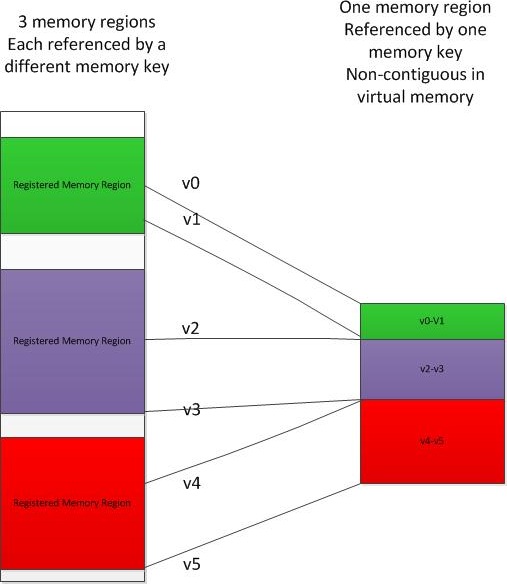
The following figure shows a non-contiguous memory region with regular. This region is defined by a base address, stride between adjacent elements, the extent of each element, and a repeat count.
The following figure shows an example where two non-contiguous memory regions are interleaved, using the repeat structure UMR.
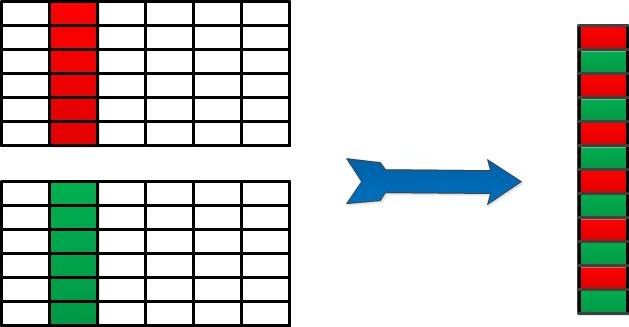
Interfaces
The usage model for the UMR includes:
-
Ability to with ibv_exp_query_device if UMR is supported.
-
If UMR is supported, checking struct ibv_exp_device_attr for it's characteristics
-
Using ibv_exp_create_mr() to create an uninitialized memory key for future UMR use
-
Using ibv_exp_post_send() to define the new memory key. This can be posted to the same send queue that will use the memory key in future operations.
-
Using the UMR defined as one would use any other memory keys
-
Using ibv_exp_post_send() to invalidate the UMR memory key
-
Releasing the memory key with the ibv_dereg_mr()
Device Capabilities
The query device capabilities is queried to see if the UMR capability is supported, and if so, what are it's characteristics. The routine used is:
int ibv_exp_query_device(struct ibv_context *context, struct ibv_exp_device_attr *attr)
The struct ibv_exp_umr_caps umr_caps field describes the UMR capabilities. This structure is defined as:
struct ibv_exp_umr_caps {
 uint32_t max_klm_list_size;
 uint32_t max_send_wqe_inline_klms;
 uint32_t max_umr_recursion_depth;
 uint32_t max_umr_stride_dimension;
};
The fields added to the struct struct ibv_exp_device_attr to support UMR include:
-
exp_device_cap_flags– UMR support available if the flag IBV_EXP_DEVICE_ATTR_UMR is set. -
max_mkey_klm_list_size– maximum number of memory keys that may be input to UMR -
max_send_wqe_inline_klms– the largest number of KLM's that can be provided inline in the work request. When the list is larger than this, a buffer allocated via thestruct ibv_mr *ibv_exp_reg_mr(struct ibv_exp_reg_mr_in *in)function, and provided to the driver as part of the memory key creation -
max_umr_recursion_depth– memory keys created by UMR operations may be input to UMR memory key creation. This specifies the limit on how deep this recursion can be. -
max_umr_stride_dimension– The maximum number of independent dimensions that may be used with the regular structure UMR operations. The current limit is one.
QP Creation
To configure QP UMR support the following routine must be used:
ibv_qp * ibv_exp_create_qp(struct ibv_context *context, struct ibv_exp_qp_init_attr *qp_init_attr)
When the attribute IBV_EXP_QP_CREATE_UMR is set in the exp_create_flags field of struct ibv_exp_qp_init_attr enables UMR support. The attribute IBV_ IBV_EXP_QP_INIT_ATTR_MAX_INL_KLMS is set in the field comp_mask struct ibv_exp_qp_init_attr, with the field max_inl_send_klms defining this number.
Memory Key Manipulation
To create an uninitialized memory key for future use:
struct ibv_mr *ibv_exp_create_mr(struct ibv_exp_create_mr_in *create_mr_in)
is used with
struct ibv_exp_create_mr_in {
    struct ibv_pd *pd;
    struct ibv_exp_mr_init_attr attr;
};
and
struct ibv_exp_mr_init_attr {
    uint64_t max_reg_descriptors; /* maximum number of entries */
    uint32_t create_flags; /* enum ibv_mr_create_flags */
    uint64_t access_flags; /* region's access rights */
    uint32_t comp_mask;
};
To query the resources associated with the memory key:
int ibv_exp_query_mkey(struct ibv_mr *mr, struct ibv_exp_mkey_attr *query_mkey_in)
is used with
struct ibv_exp_mkey_attr {
    int n_mkey_entries;  /* the maximum number of memory keys that can be supported */
     uint32_t comp_mask;
};
Non-inline Memory Objects
When the list of memory keys input into the UMR memory key creation is too large to fit into the work request, a hardware accessible buffer needs to be provided in the posted send request. This buffer will be populated by the driver with the relevant memory objects.
We will define the enum
enum memory_reg_type{
    IBV_MEM_REG_MKEY
};

The memory registration function is defined as:

struct non_inline_data  *ibv_exp_alloc_mkey_list_memory
             (struct ibv_exp_mkey_list_container_attr *attr)
where
struct ibv_exp_mkey_list_container_attr {
  struct ibv_pd *pd;
  uint32_t mkey_list_type;  /* use ibv_exp_mkey_list_type */
  uint32_t max_klm_list_size;
  uint32_t comp_mask; /*use ibv_exp_alloc_mkey_list_comp_mask */
};
This memory is freed with
int ibv_exp_dealloc_mkey_list_memory(struct ibv_exp_mkey_list_container *mem)

where
struct ibv_exp_mkey_list_container {
  uint32_t max_klm_list_size;
  struct ibv_context *context;
};  (NOTE - Need to check with Eli Cohen here - just reading the code).
Memory Key Initialization
The memory key is manipulated with the ibv_exp_post_send() routine. The opcodes IBV_EXP_WR_UMR_FILL and IBV_EXP_WR_UMR_INVALIDATE are used to define and invalidate, respectively, the memory key.
The struct ibv_exp_send_wr contains the following fields to support the UMR capabilities:
union {
    struct {
      uint32_t umr_type; /* use ibv_exp_umr_wr_type */
      struct ibv_exp_mkey_list_container *memory_objects; /* used when IBV_EXP_SEND_INLINE is not set */
      uint64_t exp_access; /* use ibv_exp_access_flags */
      struct ibv_mr *modified_mr;
      uint64_t base_addr;
      uint32_t num_mrs; /* array size of mem_repeat_block_list or mem_reg_list */
      union {
        struct ibv_exp_mem_region *mem_reg_list; /* array, size corresponds to num_mrs */
        struct {
          struct ibv_exp_mem_repeat_block *mem_repeat_block_list; /* array,  size corresponds to num_mr */
          size_t *repeat_count; /* array size corresponds to stride_dim */
          uint32_t stride_dim;
        } rb;
      } mem_list;
    } umr;

where
enum ibv_exp_umr_wr_type {
  IBV_EXP_UMR_MR_LIST,
  IBV_EXP_UMR_REPEAT
};

and

struct ibv_exp_mkey_list_container {
  uint32_t max_klm_list_size;
  struct ibv_context *context;
};

struct ibv_exp_mem_region {
  uint64_t base_addr;
  struct ibv_mr *mr;
  size_t length;
};

and

struct ibv_exp_mem_repeat_block {
  uint64_t base_addr; /* array, size corresponds to ndim */
  struct ibv_mr *mr;
  size_t *byte_count; /* array, size corresponds to ndim */
  size_t *stride; /* array, size corresponds to ndim */
};
Cross-Channel Communications Support
The Cross-Channel Communications adds support for work requests that are used for synchronizing communication between separate QP's and support for data reductions. This functionality, for example, is sufficient for implementing MPI collective communication with a single post of work requests, with the need to check only of full communication completion, rather than on completion of individual work requests.
Terms relevant to the Cross-Channel Synchronization are defined in the following table:
|
Term |
Description |
|---|---|
|
Cross Channel supported QP |
QP that allows send_enable, recv_enable, wait, and reduction tasks. |
|
Managed send QP |
Work requests in the corresponding send queues must be explicitly enabled before they can be executed. |
|
Managed receive QP |
Work requests in the corresponding receive queues must be explicitly enabled before they can be executed. |
|
Master Queue |
Queue that uses send_enable and/or recv_enable work requests to enable tasks in managed QP. A QP can be both master and managed QP. |
|
Wait task (n) |
Task the completes when n completion tasks appear in the specified completion queue |
|
Send Enable task (n) |
Enables the next n send tasks in the specified send queue to be executable. |
|
Receive Enable task |
Enables the next n send tasks in the specified receive queue to be executable. |
|
Reduction operation |
Data reduction operation to be executed by the HCA on specified data. |
Usage Model
-
Creating completion queues, setting the ignore-overrun bit for the CQ's that only hardware will monitor.
-
Creating and configuring the relevant QP's, setting the flags indicating that Cross-Channel Synchronization work requests are supported, and the appropriate master and managed flags (based on planned QP usage). For example, this may happen when an MPI library creates a new communicator.
-
Posting tasks list for the compound operations.
-
Checking the appropriate queue for compound operation completion (need to request completion notification from the appropriate work request). For example, a user may setup a CQ that receives completion notification for the work-request whose completion indicates the entire collective operation has completed locally.
-
Destroying the QP's and CQ's created for Cross-Channel Synchronization operations, once the application is done using them. For example, an MPI library may destroy these resources after it frees all the communicator using these resources.
Resource Initialization
Device Capabilities
The device query function,
int ibv_exp_query_device(struct ibv_context *context,
               struct ibv_exp_device_attr *attr);
is used to query for device capabilities.
A value of
IBV_EXP_DEVICE_CROSS_CHANNEL
in exp_device_cap_flags indicates support for Cross-Channel capabilities.

In addition, the struct calc_cap is used to define what reduction capabilities are supported
struct ibv_exp_device_attr {
 …
    struct ibv_exp_device_calc_cap calc_cap;
 …
};

where,
struct ibv_exp_device_calc_cap {
  uint64_t    data_types;
  uint64_t    data_sizes;
  uint64_t    int_ops;
  uint64_t    uint_ops;
  uint64_t    fp_ops;
};
Where the operation types are given by:
IBV_EXP_CALC_OP_ADD , /* addition */
IBV_EXP_CALC_OP_BAND, /* bit-wise and */
IBV_EXP_CALC_OP_BXOR, /*bit wise xor */
IBV_EXP_CALC_OP_BOR, /* bit-wise or */

and data types supported are described by
IBV_EXP_CALC_DATA_SIZE_64_BIT
Completion Queue
Completion queue (CQ) that will be used with Cross Channel Synchronization operations needs to be marked as such as CQ at creation time. This CQ needs to be initialized with:
struct ibv_cq *ibv_exp_create_cq(struct ibv_context *context,
                 int cqe,
                 void *cq_context,
                 struct ibv_comp_channel *channel,
                 int comp_vector,
                 struct ibv_exp_cq_init_attr *attr)
where the new parameter is defined as:
struct ibv_exp_cq_init_attr{
    uint32_t comp_mask;
    unit32_t flags;
}
The appropriate flag to set is:
IBV_EXP_CQ_CREATE_CROSS_CHANNEL
The comp_mask needs to set the bit,
IBV_EXP_CQ_INIT_ATTR_FLAGS
To avoid the CQ's entering the error state due to lack of CQ processing, the overrun ignore (OI) bit of the Completion Queue Context table must be set.
To set these bit the function
/**
 * ibv_exp_modify_cq - Modifies the attributes for the specified CQ.
 * @cq: The CQ to modify.
 * @cq_attr: Specifies the CQ attributes to modify.
 * @cq_attr_mask: A bit-mask used to specify which attributes of the CQ
 *   are being modified.
 */
static inline int ibv_exp_modify_cq(struct ibv_cq *cq,
            struct ibv_exp_cq_attr *cq_attr,
            int cq_attr_mask)
The bit IBV_EXP_CQ_CAP_FLAGS in  cq_attr_mask needs to be set, as does the bit IBV_EXP_CQ_ATTR_CQ_CAP_FLAGS  in cq_attr_mask's comp_mask.  Finally, the bit IBV_EXP_CQ_IGNORE_OVERRUN needs to be set in the field cq_cap_flags.
QP Creation
To configure the QP for Cross-Channel use following function is used:
struct ibv_qp *ibv_exp_create_qp(struct ibv_context *context,
    struct ibv_exp_qp_init_attr *qp_init_attr)

where

struct ibv_exp_qp_init_attr {
  void           *qp_context;
  struct ibv_cq        *send_cq;
  struct ibv_cq        *recv_cq;
  struct ibv_srq         *srq;
  struct ibv_qp_cap cap;
  enum ibv_qp_type  qp_type;
  int     sq_sig_all;

  uint32_t    comp_mask; /* use ibv_exp_qp_init_attr_comp_mask */
  struct ibv_pd        *pd;
  struct ibv_xrcd        *xrcd;
  uint32_t    exp_create_flags; /* use ibv_exp_qp_create_flags */

  uint32_t    max_inl_recv;
  struct ibv_exp_qpg  qpg;
  uint32_t    max_atomic_arg;
  uint32_t                max_inl_send_klms;
};
The exp_create_flags that are available:
-
IBV_EXP_QP_CREATE_CROSS_CHANNEL– This must be set for any QP to which cross-channel-synchronization work requests will be posted. -
IBV_EXP_QP_CREATE_MANAGED_SEND– This is set for a managed send QP, e.g. one for which send-enable operations are used to activate the posted send requests. -
IBV_EXP_QP_CREATE_MANAGED_RECV– This is set for a managed receive QP, e.g. one for which send-enable operations are used to activate the posted receive requests.
Posting Request List
A single operation is defined with by a set of work requests posted to multiple QP's, as described in the figure below.
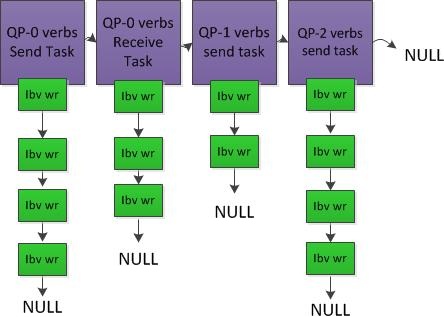
The lists are of tasks are NULL terminated.
The routine:
int ibv_exp_post_task(struct ibv_context *context, struct ibv_exp_task *task, struct ibv_exp_task **bad_task)
is used to post the list of work requests, with

struct ibv_exp_task {
  enum ibv_exp_task_type  task_type;
  struct {
    struct ibv_qp  *qp;
    union {
      struct ibv_exp_send_wr  *send_wr;
      struct ibv_recv_wr  *recv_wr;
    };
  } item;
  struct ibv_exp_task    *next;
  uint32_t                comp_mask; /* reserved for future growth (must be 0) */
};

The task type is defined by:

IBV_EXP_TASK_SEND
  IBV_EXP_TASK_RECV

To support the new work requests, the struct ibv_exp_send_wr is expanded with
union {
    struct {
      uint64_t    remote_addr;
      uint32_t    rkey;
    } rdma;
    struct {
      uint64_t    remote_addr;
      uint64_t    compare_add;
      uint64_t    swap;
      uint32_t    rkey;
    } atomic;
    struct {
      struct ibv_cq *cq;
      int32_t  cq_count;
    } cqe_wait;
    struct {
      struct ibv_qp *qp;
      int32_t  wqe_count;
    } wqe_enable;
  } task;

The calc operation is also defined in ibv_exp_send_wr by the union:

union {
    struct {
      enum ibv_exp_calc_op        calc_op;
      enum ibv_exp_calc_data_type data_type;
      enum ibv_exp_calc_data_size data_size;
    } calc;
  } op;
In addition, in the field exp_send_flags in ibv_exp_send_wr the flag IBV_EXP_SEND_WITH_CALC indicates the presence of a reduction operation, and IBV_EXP_SEND_WAIT_EN_LAST is used to signal the last wait task posted for a given CQ in the current task list.
For ibv_exp_calc_data_type the following types are supported:
-
IBV_EXP_CALC_DATA_TYPE_INT -
IBV_EXP_CALC_DATA_TYPE_UINT -
IBV_EXP_CALC_DATA_TYPE_FLOA
The supported data size for ibv_exp_data_size is IBV_EXP_CALC_DATA_SIZE_64_BIT.
New send opcodes are defined for the new work requests. These include:
-
IBV_EXP_WR_SEND_ENABLE -
IBV_EXP_WR_RECV_ENABLE -
IBV_EXP_WR_CQE_WAIT
ConnectX-3/Connect-IB Data Endianess
The ConnectX-3 and Connect-IB HCA's expect to get the data in network order.
Last updated: