

This section provides information about using the NVUE API.
In addition to the CLI, NVUE supports a REST API. Instead of accessing NVOS using SSH, you can interact with the switch using an HTTP client, such as cURL or a web browser.
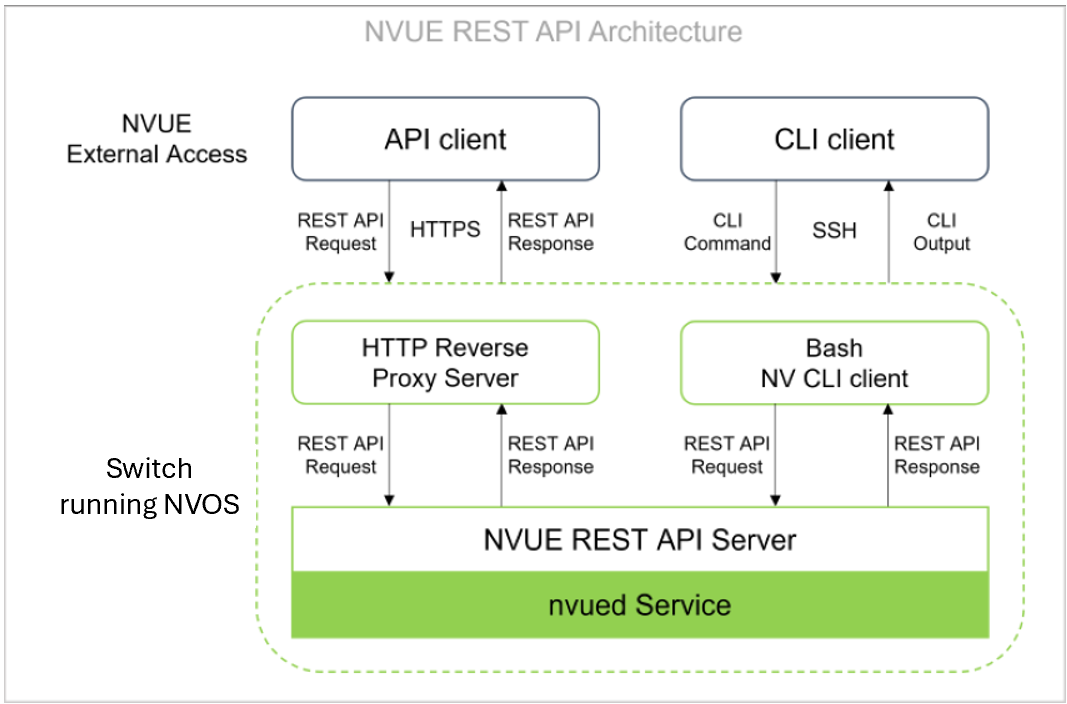
The nued service provides access to the NVUE REST API. NVOS exposes the HTTP endpoint internally, which makes the NVUE REST API accessible locally within the NVOS switch. The NVUE CLI also communicates with the nvued service using internal APIs. To provide external access to the NVUE REST API, NVOS uses an HTTP reverse proxy server, and supports HTTPS and TLS connections from external REST API clients.
The following illustration shows the NVUE REST API architecture and illustrates how NVOS forwards the requests internally.
Supported HTTP Methods
The NVUE REST API supports the following methods:
-
The GET method displays configuration and operational data, and is equivalent to the
nv showcommands. -
The POST method creates and submits operations. You typically use this method for
nv actioncommands and for thenv configcommand to create revisions. -
The PATCH method replaces or unsets a configuration. You use this method for the
nv setandnv config applycommands. You can either perform:-
A targeted configuration patch to make a configuration change, where you run a specific NVUE REST API targeted at a particular OpenAPI end-point URI. Based on the NVUE schema definition, you need to direct the PATCH REST API request at a particular endpoint (for example,
/nvue_v1/interface/<interface-id>/link/mtu) and provide the payload that conforms to the schema. With a targeted configuration patch, you can control individual resources. -
A root patch, where you run the NVUE PATCH API on the root node of the schema so that a single PATCH operation can change one, some, or the entire configuration in a single payload. The payload of the PATCH method must be aware of the entire NVUE object model schema because you make the configuration changes relative to the root node
/nvue_v1. You typically perform a root patch to push all configurations to the switch in bulk; for example, if you use an SDN controller or a network management system to push the entire switch configuration every time you need to make a change, regardless of how small or large. A root patch can also make configuration changes with fewer round trips to the switch. -
The input payload in a PATCH request can have either a
setorunsetjson object for the same resource, but not both. The order in which the API executes thesetandunsetobjects is not deterministic and not supported.
-
-
The DELETE method deletes a configuration and is equivalent to the
nv unsetcommands.
Secure the API
The NVUE REST API supports HTTP basic authentication, and the same underlying authentication methods for username and password that the NVUE CLI supports. User accounts work the same on both the API and the CLI.
Certificates
NVOS includes a self-signed certificate and private key to use on the server so that it works out of the box. The switch generates the self-signed certificate and private key when it boots for the first time. The X.509 certificate with the public key is in /etc/ssl/certs/nvue.pem and the corresponding private key is in /etc/ssl/private/nvue.key.
NVIDIA recommends you use your own certificates and keys. For the steps to generate self-signed certificates and keys, refer to the Ubuntu Certificates and Security documentation.
NVOS lets you manage CA certificates (such as DigiCert or Verisign) and entity (end-point) certificates. Both a CA certificate and an entity certificate can contain a chain of certificates.
You can import certificates onto the switch (fetch certificates from an external source), set which certificate you want to use for the NVUE REST API, and show information about a certificate, such as the serial number, and the date and time during which the certificate is valid.
Import a Certificate
-
You can import a maximum of 25 entity certificates and a maximum of 25 CA certificates.
-
The certificate you import contains sensitive private key information. NVIDIA recommends that you use a secure transport such as SFTP, SCP, or HTTPS.
-
To import an entity certificate, run an
nv action import system security certificate <cert-id> -
To import a CA certificate, run an
nv action import system security ca-certificate <cert-id>command.
If the certificate is passphrase protected, you need to include the passphrase.
You must provide a certificate ID (<cert-id>) to uniquely identify the certificate you import.
The following example imports a CA certificate with a public key and calls the certificate tls-cert-1. The certificate is passphrase protected with mypassphrase. The public key is a Base64 ASCII encoded PEM string.
nvos@switch:~$ nv action import system security ca-certificate tls-cert-1 passphrase mypassphrase data "<public-key>"
The following example imports an entity certificate bundle and calls the certificate tls-cert-1. The certificate bundle is passphrase protected with mypassphrase.
A certificate bundle must be in .PFX or .P12 format.
nvos@switch:~$ nv action import system security certificate tls-cert-1 passphrase mypassphrase uri-bundle scp://user@pass:1.2.3.4:/opt/certs/cert.p12
The following example imports an entity certificate with the public key URI scp://user@pass:1.2.3.4 and private key URI scp://user@pass:1.2.3.4, and calls the certificate tls-cert-1. The certificate is not passphrase protected.
A CA certificate must be in .pem, .p7a, or .p7c format.
nvos@switch:~$ nv action import system security certificate tls-cert-1 uri-public-key scp://user@pass:1.2.3.4 uri-private-key scp://user@pass:1.2.3.4
Set the Certificate to Use
You can configure the NVUE REST API to use a specific certificate.
The following example configures the API to use the certificate tls-cert-1:
nvos@switch:~$ nv set system api certificate tls-cert-1
nvos@switch:~$ nv config apply
The following example configures the API to use the self-signed certificate:
nvos@switch:~$ nv set system api certificate self-signed
nvos@switch:~$ nv config apply
To unset the certificate to use with the NVUE REST API:
nvos@switch:~$ nv unset system api certificate tls-cert-1
Delete Certificates
-
To delete an entity certificate and the key data stored on the switch, run the
nv action delete system security certificate <cert-id>command. -
To delete a CA certificate and the key data stored on the switch, run the
nv action delete system security ca-certificate <cert-id>command.
The following command deletes the certificate tls-cert-1:
nvos@switch:~$ nv action delete system security certificate tls-cert-1
Show Certificate Information
-
To show all the entity certificates on the switch, run the
nv show system security certificatecommand. -
To show all the CA certificates on the switch, run the
nv show system security ca-certificatecommand.
The following example shows all the entity certificates on the switch:
nvos@switch:~$ nv show system security certificate
-
To show the applications that are using a specific entity certificate, run the
nv show system security certificate <cert-id> installedcommand. -
To show the applications that are using a specific CA certificate, run the
nv show system security ca-certificate <cert-id> installedcommand.
The following example shows the applications that are using a specific entity certificate.
nvos@switch:~$ nv show system security certificate tls-cert-1 installed
-
To show detailed information about a specific entity certificate, run the
nv show system security certificate <cert-id> dumpcommand. -
To show detailed information about a specific CA certificate, run the
nv show system security ca-certificate <cert-id> dumpcommand.
The following example shows detailed information about the CA certificate tls-cert-1:
nvos@switch:~$ nv show system security ca-certificate tls-cert-1 dump
Control Plane ACLs
You can secure the API by configuring:
-
A listening address; see NVUE OpenAPI | id (25.02.8008)NVUEOpenAPI APIPortandListeningAddress below.
-
Control plane ACLs; see the following example.
This example shows how to create ACLs to allow users from the management subnet and the local switch to communicate with the switch using REST APIs, and restrict all other access.
nvos@switch:~$ nv set acl API-PROTECT type ipv4
nvos@switch:~$ nv set acl API-PROTECT rule 10 action permit
nvos@switch:~$ nv set acl API-PROTECT rule 10 match ip .protocol tcp .dest-port 443 .source-ip 192.168.200.0/24
nvos@switch:~$ nv set acl API-PROTECT rule 10 remark "Allow the Management Subnet to talk to API"
nvos@switch:~$ nv set acl API-PROTECT rule 20 action permit
nvos@switch:~$ nv set acl API-PROTECT rule 20 match ip .protocol tcp .dest-port 443 .source-ip 127.0.0.1
nvos@switch:~$ nv set acl API-PROTECT rule 20 remark "Allow the local switch to talk to the API"
nvos@switch:~$ nv set acl API-PROTECT rule 30 action deny
nvos@switch:~$ nv set acl API-PROTECT rule 30 match ip .protocol tcp .dest-port 443
nvos@switch:~$ nv set acl API-PROTECT rule 30 remark "Block everyone else from talking to the API"
nvos@switch:~$ nv set system control-plane acl API-PROTECT inbound
Supported Objects
The NVUE object model supports most features on the NVOS switch. The following list shows the supported objects. The NVUE API supports more objects within each of these objects. You can find a full listing of the supported API endpoints here.
|
High-level Objects |
Description |
|---|---|
|
acl |
Access control lists. |
|
interface |
Interface configuration. |
|
platform |
Platform configuration, such as hardware and software components. |
|
system |
Global system settings, such as system login messages, switch reboot history, syslog, ntp etc.. |
|
vrf |
Get VRF. |
|
ib |
IB Devices. |
Use the API
The NVUE CLI and the REST API are equivalent in functionality; you can run all management operations from the REST API or from the CLI. The NVUE object model drives both the REST API and the CLI management operations. All operations are consistent; for example, the CLI nv show commands reflect any PATCH operation (create and update) you run through the REST API.
NVUE follows a declarative model, removing context-specific commands and settings. The structure of NVUE is like a big tree that represents the entire state of a NVOS instance. At the base of the tree are high level branches representing objects, such as system and interface. Under each of these branches are more branches. As you navigate through the tree, you gain a more specific context. At the leaves of the tree are actual attributes, represented as key-value pairs. The path through the tree is similar to a filesystem path.
NVOS enables the NVUE REST API by default. To disable the NVUE REST API, run the nv set system api state disabled command.
To use the NVUE REST API in NVOS, you must change the password for the admin user; otherwise you see 401 responses when you run commands.
API Port and Listening Address
This section shows how to:
-
Set the NVUE REST API port. If you do not set a port, NVOS uses the default port 443.
-
Specify the NVUE REST API listening address; you can specify an IPv4 address, IPv6 address, or
localhost. If you do not specify a listening address, NGINX listens on all addresses for the target port.
NVUE Commands
The following example sets the port to 8888:
nvos@switch:~$ nv set system api port 8888
nvos@switch:~$ nv config apply
You can listen on multiple interfaces by specifying different listening addresses:
nvos@switch:~$ nv set system api listening-address 10.10.10.1
nvos@switch:~$ nv set system api listening-address 10.10.20.1
nvos@switch:~$ nv config apply
The following example configures the listening address on eth0, which has IP address 172.0.24.0 and uses the management VRF by default:
nvos@switch:~$ nv set system api listening-address 172.0.24.0
nvos@switch:~$ nv config apply
Curl Command
The following example sets the port to 8888:
nvos@switch:~$ curl -u 'admin:****' -k --request PATCH https://localhost:443/nvue_v1/system/api?rev=2 -H 'Content-Type:application/json' -d '{"port": 8888 }'
You can listen on multiple interfaces by specifying different listening addresses. The following example sets localhost, interface address 10.10.10.1, and 10.10.20.1 as listen-addresses.
nvos@switch:~$ curl -u 'admin:****' -k --request PATCH https://localhost:443/nvue_v1/system/api/listening-address?rev=2 -H 'Content-Type:application/json' -d '{ "localhost": {}, "10.10.10.1": {}, "10.10.20.1": {}}'
The following example configures the listening address on eth0, which has IP address 172.0.24.0 and uses the management VRF by default:
nvos@switch:~$ curl -u 'admin:****' -k --request PATCH https://localhost:443/nvue_v1/system/api/listening-address?rev=2 -H 'Content-Type:application/json' -d '{"172.0.24.0": {}}'
Show NVUE REST API Information
To show REST API port configuration, state (enabled or disabled), certificate, listening address, and connection information:
NVUE Commands
Run the nv show system api command:
nvos@switch:~$ nv show system api
                     operational  applied
-------------------  -----------  -----------
state                enabled      enabled
port                 443          443
certificate          self-signed  self-signed
[listening-address]  any
connections
  active             1
  accepted           2
  handled            2
  requests           2
  reading            0
  writing            1
  waiting            0
To show connection information only, run the nv show system api connections command:
 nvos@switch:~$ nv show system api connections
          operational
--------  -----------
active    2
accepted  8
handled   8
requests  8
reading   0
writing   2
waiting   0
To show the configured listening address, run the nv show system api listening-address command:
nvos@switch:~$ nv show system api listening-address
---------
localhost
To show all the certificates installed on the switch, run the nv show system security certificate command. To show information about a specific certificate, such as the serial number and how long the certificate is valid, run the nv show system security certificate <certificate> command:
 nvos@switch:~$ nv show system security certificate tls-cert-1
               operational                applied
-------------  -------------------------  -------
installed
 app           TLS
serial-number  67:03:3B:B4:6E:35:D3
valid-from     2023-02-14T00:35:18+00:00
valid-to       2033-02-11T00:35:18+00:00
Curl Command
nvos@switch:~$ curl -u 'admin:****' -k --request GET https://localhost:443/nvue_v1/system/api?rev=2 -H "accept: application/json"
{
  "certificate": "self-signed",
  "listening-address": {
    "10.10.10.1": {},
    "10.10.20.1": {},
    "172.0.24.0": {},
    "localhost": {}
  },
  "port": 8888,
  "state": "enabled"
}
To show the configured listening address:
nvos@switch:~$ curl -u 'admin:****' -k --request GET https://localhost:443/nvue_v1/system/api/listening-address?rev=2 -H "accept: application/json"
{
  "10.10.10.1": {},
  "10.10.20.1": {}
}
To show the certificates on the switch:
nvos@switch:~$ curl -u 'admin:****' -k --request GET https://localhost:443/nvue_v1/system/api/certificate?rev=2 -H "accept: application/json"
{
  "tls-cert-1": {},
  "tls-cert-2": {}
}
To show information about a specific certificate, such as the serial number and how long the certificate is valid:
nvos@switch:~$ curl -u 'admin:****' -k --request GET https://localhost:443/nvue_v1/system/api/certificate/tls-cert-1?rev=2 -H "accept: application/json"
{
  "serial-number": "67:03:3B:B4:6E:35:D3",
  "valid-from": "2023-02-14T00:35:18+00:00",
  "valid-to": "2033-02-11T00:35:18+00:00"
}
Run cURL Commands
You can run the cURL commands from the command line. Use the username and password for the switch. For example:
nvos@switch:~$ curl  -u 'admin:****' --insecure https://127.0.0.1:443/nvue_v1/interface
{
  "eth0": {
    "ip": {
      "address": {
        "192.168.200.12/24": {}
      }
    },
    "link": {
      "mtu": 1500,
      "state": {
        "up": {}
      },
      "stats": {
        "carrier-transitions": 2,
        "in-bytes": 184151,
        "in-drops": 0,
        "in-errors": 0,
        "in-pkts": 2371,
        "out-bytes": 117506,
        "out-drops": 0,
        "out-errors": 0,
        "out-pkts": 762
      }
...
API Use Cases
The following examples show the primary API uses cases.
View a Configuration
Use the following example to obtain the current applied configuration on the switch. Change the rev argument to view any revision. Possible options for the rev argument include startup, pending, operational, and applied.
Curl Command
nvos@switch:~$ curl -k -u 'admin:****' -X GET "https://127.0.0.1:443/nvue_v1/?rev=applied&filled=false"
  "interface": {
    "eth0": {
      "acl": {
        "ACL_MGMT_INBOUND_CP_DEFAULT": {
          "inbound": {
            "control-plane": {}
          }
        },
        "ACL_MGMT_INBOUND_CP_DEFAULT_IPV6": {
          "inbound": {
            "control-plane": {}
          }
        },
        "ACL_MGMT_INBOUND_DEFAULT": {
          "inbound": {}
        },
        "ACL_MGMT_INBOUND_DEFAULT_IPV6": {
          "inbound": {}
        },
        "ACL_MGMT_OUTBOUND_CP_DEFAULT": {
          "outbound": {
            "control-plane": {}
          }
        },
        "ACL_MGMT_OUTBOUND_CP_DEFAULT_IPV6": {
          "outbound": {
            "control-plane": {}
          }
        }
      },
      "type": "eth"
    },
 ...
Python Code
#!/usr/bin/env python3

import requests
from requests.auth import HTTPBasicAuth
import json
import time

auth = HTTPBasicAuth(username="admin", password="password")
nvue_end_point = "https://127.0.0.1:443/nvue_v1"
mime_header = {"Content-Type": "application/json"}

if __name__ == "__main__":
    r = requests.get(url=nvue_end_point + "/?rev=applied&filled=false",
                     auth=auth,
                     verify=False)
    print("=======Current Applied Revision=======")
    print(json.dumps(r.json(), indent=2))
NVUE CLI
nvos@switch:~$ nv config show
- set:
    fae:
      system:
        events:
          table-size: 600
    interface:
      eth0-1:
        acl:
          ACL_MGMT_INBOUND_CP_DEFAULT:
            inbound:
              control-plane: {}
          ACL_MGMT_INBOUND_CP_DEFAULT_IPV6:
            inbound:
              control-plane: {}
          ACL_MGMT_INBOUND_DEFAULT:
            inbound: {}
          ACL_MGMT_INBOUND_DEFAULT_IPV6:
            inbound: {}
          ACL_MGMT_OUTBOUND_CP_DEFAULT:
            outbound:
              control-plane: {}
          ACL_MGMT_OUTBOUND_CP_DEFAULT_IPV6:
            outbound:
              control-plane: {}
        type: eth
...
Replace an Entire Configuration
To replace an entire configuration:
-
Create a new revision ID with a POST:
nvos@switch:~$ curl -u 'admin:****' --insecure -X POST https://127.0.0.1:443/nvue_v1/revision { "1": { "state": "pending", "transition": { "issue": {}, "progress": "" } } } -
Record the revision ID. In the above example, the revision ID is
"1". -
Do a root patch to delete the whole configuration.
nvos@switch:~$ curl -u 'admin:****' -d '{}' -H 'Content-Type: application/json' -k -X DELETE https://127.0.0.1:443/nvue_v1/?rev=1 {} -
Do a root patch to update the switch with the new configuration.
nvos@switch:~$ curl -u 'admin:****' -d '{ "system": { "hostname": "switch01" }, "interface": { "eth0": { "ip": { "address": { "192.168.200.6/24": {} }, }, "type": "eth" }, } }' -H 'Content-Type: application/json' -k -X PATCH https://127.0.0.1:443/nvue_v1/?rev=1 {} -
Apply the changes with a PATCH to the revision changeset.
Curl Commandnvos@switch:~$ curl -u 'admin:****' -H 'Content-Type:application/json' -d '{"state": "apply", "auto-prompt": {"ays": "ays_yes"}}' -k -X PATCH https://127.0.0.1:443/nvue_v1/revision/1 { "state": "apply", "transition": { "issue": {}, "progress": "" } }NVUE CLI
nvos@switch:~$ nv config apply -
Review the status of the apply and the configuration:
Curl Command
nvos@switch:~$ curl -u 'admin:****' -k -X GET https://127.0.0.1:443/nvue_v1/revision/1
{
  "state": "applied",
  "transition": {
    "issue": {},
    "progress": ""
  }
}
nvos@switch:~$ curl -u 'admin:****' --insecure https://127.0.0.1:443/nvue_v1/system { "build": "NVOS Debian GNU/Linux 11 (bullseye)", "date-time": "2024-08-05 07:42:28", "health-status": "OK", "hostname": "switch", "platform": "x86_64-nvidia_q3200_ra-r0", "product-name": "nvos", "product-release": "25.02.0936-010", "status": "System is ready", "swap-memory": "0 MB used / 0 MB free / 0 MB total", "system-memory": "3250 MB used / 12564 MB free / 15814 MB total", "timezone": "Asia/Jerusalem", "uptime": 11659, "version": { "build-date": "Fri Jul 19 14:24:17 UTC 2024", "image": "nvos-25.02.0936-010", "kernel": "5.10.0-23-2-amd64", "onie": "2023.11-5.3.0012-rc6-115200-dev" } }
Python Code
#!/usr/bin/env python3

import requests
from requests.auth import HTTPBasicAuth
import json
import time

auth = HTTPBasicAuth(username="admin", password="password")
nvue_end_point = "https://127.0.0.1:443/nvue_v1"
mime_header = {"Content-Type": "application/json"}

DUMMY_SLEEP = 5  # In seconds
POLL_APPLIED = 1  # in seconds
RETRIES = 10

def print_request(r: requests.Request):
    print("=======Request=======")
    print("URL:", r.url)
    print("Headers:", r.headers)
    print("Body:", r.body)

def print_response(r: requests.Response):
    print("=======Response=======")
    print("Headers:", r.headers)
    print("Body:", json.dumps(r.json(), indent=2))

def create_nvue_changest():
    r = requests.post(url=nvue_end_point + "/revision",
                      auth=auth,
                      verify=False)
    print_request(r.request)
    print_response(r)
    response = r.json()
    changeset = response.popitem()[0]
    return changeset

def apply_nvue_changeset(changeset):
    apply_payload = {"state": "apply", "auto-prompt": {"ays": "ays_yes"}}
    url = nvue_end_point + "/revision/" + requests.utils.quote(changeset,
                                                               safe="")
    r = requests.patch(url=url,
                       auth=auth,
                       verify=False,
                       data=json.dumps(apply_payload),
                       headers=mime_header)
    print_request(r.request)
    print_response(r)

def is_config_applied(changeset) -> bool:
    # Check if the configuration was indeed applied
    global RETRIES
    global POLL_APPLIED
    retries = RETRIES
    while retries > 0:
        r = requests.get(url=nvue_end_point + "/revision/" + requests.utils.quote(changeset, safe=""),
                         auth=auth,
                         verify=False)
        response = r.json()
        print(response)
        if response["state"] == "applied":
            return True
        retries -= 1
        time.sleep(POLL_APPLIED)

    return False

def apply_new_config(path,payload):
    # Create a new revision ID
    changeset = create_nvue_changest()
    print("Using NVUE Changeset: '{}'".format(changeset))

    # Delete existing configuration
    query_string = {"rev": changeset}
    r = requests.delete(url=nvue_end_point + path,
                       auth=auth,
                       verify=False,
                       params=query_string,
                       headers=mime_header)
    print_request(r.request)
    print_response(r)

    # Patch the new configuration

    query_string = {"rev": changeset}
    r = requests.patch(url=nvue_end_point + path,
                       auth=auth,
                       verify=False,
                       data=json.dumps(payload),
                       params=query_string,
                       headers=mime_header)
    print_request(r.request)
    print_response(r)

    # Apply the changes to the new revision changeset
    apply_nvue_changeset(changeset)

    # Check if the changeset was applied
    is_config_applied(changeset)

def nvue_get(path):
    r = requests.get(url=nvue_end_point + path,
                     auth=auth,
                     verify=False)
    print_request(r.request)
    print_response(r)

if __name__ == "__main__":
    payload = {
      "system": {
        "hostname": "switch01"
      },
      "interface": {
        "eth0": {
          "ip": {
            "address": {
              "192.168.200.6/24": {}
            },
          },
          "type": "eth"
		}
      },
    }
    apply_new_config("/",payload)
    time.sleep(DUMMY_SLEEP)
    print("=====Verifying some of the configurations=====")
    nvue_get("/system")
    nvue_get("/interface")
NVUE CLI
nvos@switch:~$ nv show system
                 operational
---------------  ---------------------------------------------
build            NVOS Debian GNU/Linux 11 (bullseye)
uptime           3:20:04
hostname         croc-88-mgmt2
product-name     nvos
product-release  25.02.0936-010
platform         x86_64-nvidia_q3200_ra-r0
system-memory    3268 MB used / 12546 MB free / 15814 MB total
swap-memory      0 MB used / 0 MB free / 0 MB total
health-status    Not OK
date-time        2024-08-05 07:48:13
status           System is ready
timezone         Asia/Jerusalem
Verify a Configuration (Dry Run)
To verify a configuration without applying it (dry run), use the dry-run option in the state-controls field when calling the apply endpoint.
The dry-run field accepts the following values:
brief: Provides basic verification output (default behavior of nv config verify)
verbose: Provides detailed output, including staged files and scheduled services
-
Create a new revision ID with a POST:
nvos@switch:~$ curl -u 'admin:****' --insecure -X POST https://127.0.0.1:443/nvue_v1/revision { "1": { "state": "pending", "transition": { "issue": {}, "progress": "" } } } -
Record the revision ID. In the above example, the revision ID is
"1". -
Patch the Configuration to Verify
curl -u admin:admin --insecure -X PATCH -H "Content-Type: text/plain" "https://10.7.145.61:443/nvue_v1/?rev=5" --data-binary @bad-config.txt -
Run Verification (Dry Run) brief mode:
admin@croc-61:~$ curl -u 'admin:admin' -H 'Content-Type: application/json' -k -X PATCH -d '{"state": "apply", "state-controls": {"dry-run": "brief"}}' --request GET https://10.7.145.61:443/nvue_v1/revision/1 -
Run Verification (Dry Run) Verbose mode:
admin@croc-61:~$ curl -u 'admin:admin' -H 'Content-Type: application/json' -k -X PATCH -d '{"state": "apply", "state-controls": {"dry-run": "verbose"}}' --request GET https://10.7.145.61:443/nvue_v1/revision/1
Verify an existing revision by id:
curl -u admin:admin --insecure -X PATCH -H "Content-Type: application/json" "https://10.7.145.61:443/nvue_v1/revision/5" -d '{"state": "apply", "state-controls": {"dry-run": "brief"}}'NVUE CLI
nvos@switch:~$ nv config verify config.txtnvos@switch:~$ nv config verify revision 5
Make a Configuration Change
To make a configuration change:
-
Create a new revision ID with a POST:
nvos@switch:~$ curl -u 'admin:****' --insecure -X POST https://127.0.0.1:443/nvue_v1/revision { "2": { "state": "pending", "transition": { "issue": {}, "progress": "" } } } -
Record the revision ID. In the above example, the revision ID is
"2". -
Make the change with a PATCH and link it to the revision ID:
Curl Command
nvos@switch:~$ curl -u 'admin:****' -d '{"99.99.99.99/32": {}}' -H 'Content-Type: application/json' -k -X PATCH https://127.0.0.1:443/nvue_v1/interface/eth0/ip/address?rev=2
{
  "99.99.99.99/32": {}
}
NVUE CLI
nvos@switch:~$ nv set interface eth0 ip address 99.99.99.99/32 -
Apply the changes with a PATCH to the revision changeset:
Curl Command
nvos@switch:~$ curl -u 'admin:****' -H 'Content-Type:application/json' -k -X PATCH https://127.0.0.1:443/nvue_v1/revision/2
{
  "state": "apply",
  "transition": {
    "issue": {},
    "progress": ""
  }
}
NVUE CLI
nvos@switch:~$ nv config apply -
Review the status of the apply and the configuration:
Curl Command
nvos@switch:~$ curl -u 'admin:****' -k -X GET https://127.0.0.1:443/nvue_v1/revision/2
{
  "state": "applied",
  "transition": {
    "issue": {},
    "progress": ""
  }
}
nvos@switch:~$ curl -u 'admin:****' -k -X GET https://127.0.0.1:443/nvue_v1/revision/2 { "state": "applied", "transition": { "issue": {}, "progress": "" } }
Python Code
#!/usr/bin/env python3

import requests
from requests.auth import HTTPBasicAuth
import json
import time

auth = HTTPBasicAuth(username="admin", password="password")
nvue_end_point = "https://127.0.0.1:443/nvue_v1"
mime_header = {"Content-Type": "application/json"}

DUMMY_SLEEP = 5  # In seconds
POLL_APPLIED = 1  # in seconds
RETRIES = 10

def print_request(r: requests.Request):
    print("=======Request=======")
    print("URL:", r.url)
    print("Headers:", r.headers)
    print("Body:", r.body)

def print_response(r: requests.Response):
    print("=======Response=======")
    print("Headers:", r.headers)
    print("Body:", json.dumps(r.json(), indent=2))

def create_nvue_changest():
    r = requests.post(url=nvue_end_point + "/revision",
                      auth=auth,
                      verify=False)
    print_request(r.request)
    print_response(r)
    response = r.json()
    changeset = response.popitem()[0]
    return changeset

def apply_nvue_changeset(changeset):
    apply_payload = {"state": "apply", "auto-prompt": {"ays": "ays_yes"}}
    url = nvue_end_point + "/revision/" + requests.utils.quote(changeset,
                                                               safe="")
    r = requests.patch(url=url,
                       auth=auth,
                       verify=False,
                       data=json.dumps(apply_payload),
                       headers=mime_header)
    print_request(r.request)
    print_response(r)

def is_config_applied(changeset) -> bool:
    # Check if the configuration was indeed applied
    global RETRIES
    global POLL_APPLIED
    retries = RETRIES
    while retries > 0:
        r = requests.get(url=nvue_end_point + "/revision/" + requests.utils.quote(changeset, safe=""),
                         auth=auth,
                         verify=False)
        response = r.json()
        print(response)
        if response["state"] == "applied":
            return True
        retries -= 1
        time.sleep(POLL_APPLIED)

    return False

def apply_new_config(path,payload):
    # Create a new revision ID
    changeset = create_nvue_changest()
    print("Using NVUE Changeset: '{}'".format(changeset))

    # Delete existing configuration
    query_string = {"rev": changeset}
    r = requests.delete(url=nvue_end_point + path,
                       auth=auth,
                       verify=False,
                       params=query_string,
                       headers=mime_header)
    print_request(r.request)
    print_response(r)

    # Patch the new configuration

    query_string = {"rev": changeset}
    r = requests.patch(url=nvue_end_point + path,
                       auth=auth,
                       verify=False,
                       data=json.dumps(payload),
                       params=query_string,
                       headers=mime_header)
    print_request(r.request)
    print_response(r)

    # Apply the changes to the new revision changeset
    apply_nvue_changeset(changeset)

    # Check if the changeset was applied
    is_config_applied(changeset)

def nvue_get(path):
    r = requests.get(url=nvue_end_point + path,
                     auth=auth,
                     verify=False)
    print_request(r.request)
    print_response(r)

if __name__ == "__main__":
    payload = {
        "99.99.99.99/32": {}
    }
    apply_new_config("/interface/eth0/ip/address",payload)
    time.sleep(DUMMY_SLEEP)
    nvue_get("/interface/eth0/ip/address")
NVUE CLInvos@switch:~$ nv show interface eth0 ip address ------------- 99.99.99.99/32 127.0.0.1/8 ::1/128
View Differences Between Configurations
To view differences between configurations, run the API GET /nvue_v1/<resource>?rev=<rev-A>&diff=<rev-B> method with the configurations you want to diff. This method is equivalent to the NVUE nv config diff <rev-A> <rev-B> command.
To see the difference between the startup revision and the applied revision:
$ curl -u 'admin:****' --insecure -X GET /nvue_v1/interface?rev=startup&diff=applied
To see the difference between revision 1 and revision 2:
$ curl -u 'admin:****' --insecure -X GET /nvue_v1/<resource>?rev=1&diff=2
The order of the revisions can be changed; for example, GET /nvue_v1/<resource>?rev=2&diff=1.
Troubleshoot Configuration Changes
When a configuration change fails, you see an error in the change request.
Configuration Apply Fails with Warnings
In some cases, such as the first push with NVUE or if you change a file manually instead of using NVUE, you see a warning prompt and the apply fails.
nvos@switch:~$ curl -u 'admin:****' --insecure -X GET https://127.0.0.1:443/nvue_v1/revision/6
{
  "6": {
    "state": "ays_fail",
    "transition": {
      "issue": {
        "0": {
          "code": "client_timeout",
          "data": {},
          "message": "Timeout while waiting for client response",
          "severity": "error"
        }
      },
      "progress": "Aborted apply after warnings"
    }
  }
To resolve this issue, observe the failures or errors, then inspect the configuration that you are trying to apply. After you resolve the errors, retry the API. If you prefer to overlook the errors and force an apply, add "auto-prompt":{"ays": "ays_yes"} to the configuration apply.
nvos@switch:~$ curl -u 'admin:****' -d '{"state":"apply","auto-prompt":{"ays": "ays_yes"}}' -H 'Content-Type:application/json' --insecure -X PATCH https://127.0.0.1:443/nvue_v1/revision/6
Save a Configuration
To save an applied configuration change to the startup configuration file (/etc/nvue.d/startup.yaml) so that the changes persist after a reboot, use a PATCH to the applied revision with the save state.
Curl Command
nvos@switch:~$ curl -u 'admin:****' -k -X PATCH -d '{"state": "save", "auto-prompt": {"ays": "ays_yes"}}' -H 'Content-Type: application/json'  https://127.0.0.1:443/nvue_v1/revision/applied
{
  "state": "save",
  "transition": {
    "issue": {},
    "progress": ""
  }
}
Python Code
#!/usr/bin/env python3

import requests
from requests.auth import HTTPBasicAuth
import json
import time

auth = HTTPBasicAuth(username="admin", password="password")
nvue_end_point = "https://127.0.0.1:443/nvue_v1"
mime_header = {"Content-Type": "application/json"}

DUMMY_SLEEP = 5  # In seconds
POLL_APPLIED = 1  # in seconds
RETRIES = 10

def print_request(r: requests.Request):
    print("=======Request=======")
    print("URL:", r.url)
    print("Headers:", r.headers)
    print("Body:", r.body)

def print_response(r: requests.Response):
    print("=======Response=======")
    print("Headers:", r.headers)
    print("Body:", json.dumps(r.json(), indent=2))

def save_nvue_changeset():
    apply_payload = {"state": "save", "auto-prompt": {"ays": "ays_yes"}}
    url = nvue_end_point + "/revision/applied"
    r = requests.patch(url=url,
                       auth=auth,
                       verify=False,
                       data=json.dumps(apply_payload),
                       headers=mime_header)
    print_request(r.request)
    print_response(r)

if __name__ == "__main__":
    save_nvue_changeset()
NVUE CLI
nvos@switch:~$ nv config save
saved
Unset a Configuration Change
To unset a change, use the null value to the key. For example, to delete start configuration from eth1 port, use the following syntax:
nvos@switch:~$ curl -u 'admin:****' -d '{"eth1":null}' -H 'Content-Type: application/json' --insecure -X PATCH https://127.0.0.1:443/nvue_v1/interface/rev=4
When you unset a change, you must still use the PATCH action. The value indicates removal of the entry. The data is {"eth1":null} with the PATCH action.
Use the API for Active Monitoring
The example below fetches the counters for interface sw1p1.
Curl Command
nvos@switch:~$ curl -u 'admin:****' -k -X GET https://127.0.0.1:443/nvue_v1/interface/sw1p1/link/counters
{
  "buffer-overrun-errors": 0,
  "in-bytes": 16128,
  "in-drops": 0,
  "in-errors": 0,
  "in-pkts": 56,
  "in-symbol-errors": 0,
  "link-downed": 0,
  "link-error-recovery": 0,
  "local-link-integrity-errors": 0,
  "out-bytes": 16128,
  "out-drops": 0,
  "out-errors": 0,
  "out-pkts": 56,
  "out-wait": 0,
  "port-rcv-constraint-errors": 0,
  "port-rcv-remote-physical-errors": 0,
  "port-rcv-switch-relay-errors": 0,
  "qp1-drops": 0,
  "rcv-icrc-errors": 0,
  "tx-parity-errors": 0
}
Python Code
#!/usr/bin/env python3

import requests
from requests.auth import HTTPBasicAuth
import json
import time

auth = HTTPBasicAuth(username="admin", password="password")
nvue_end_point = "https://127.0.0.1:443/nvue_v1"
mime_header = {"Content-Type": "application/json"}

if __name__ == "__main__":
    r = requests.get(url=nvue_end_point + "/interface/sw1p1/link/counters",
                     auth=auth,
                     verify=False)
    print("=======Interface sw1p1 Counters=======")
    print(json.dumps(r.json(), indent=2))
NVUE CLI
nvos@switch:~$ nv show interface sw1p1 link counters --view detail
                                 operational  description
-------------------------------  -----------  ----------------------------------------------------------------------
in-bytes                         15.75 KB     Total number of bytes received on the interface
in-pkts                          56           Total number of packets received on the interface
in-drops                         0            Number of received packets dropped
in-errors                        0            Number of received packets with errors
out-bytes                        15.75 KB     Total number of bytes transmitted out of the interface
out-pkts                         56           Total number of packets transmitted out of the interface
out-drops                        0            The number of outbound packets that were chosen to be discarded even
                                              though no errors had been detected to prevent their being transmitted.
out-errors                       0            The number of outbound packets that could not be transmitted because
                                              of errors.
in-symbol-errors                 0            Total number of minor errors detected on one or more physical lanes
out-wait                         0            The number of ticks during which the port selected by PortSelect had
                                              data to transmit but no data was sent during the entire tick because
                                              of insufficient credits or of lack of arbitration.
link-error-recovery              0            Total number of times the Port Training state machine has successfully
                                              completed the link error recovery process
link-downed                      0            Total number of times the Port Training state machine has failed the
                                              link error recovery process and downed the link
port-rcv-remote-physical-errors  0            Total number of packets marked with the EBP delimiter received on the
                                              port
port-rcv-switch-relay-errors     0            Total number of packets received on the port that were discarded
                                              because they could not be forwarded by the switch relay
port-rcv-constraint-errors       0            Total number of packets received on the switch physical port that are
                                              discarded due to constraints
local-link-integrity-errors      0            Total number of times that the count of local physical errors exceeded
                                              the threshold specified by Local Phy Errors
qp1-drops                        0            Total number of QP1 MADs (packets) dropped due to resource limitations
buffer-overrun-errors            0            The number of times that Overrun-Errors consecutive flow control
                                              update periods occur
rcv-icrc-errors                  0            Total number of icrc payload corruption rx errors
tx-parity-errors                 0            Total number of icrc payload corruption tx parity errors
Retrieve View Types
NVUE provides views for certain show commands. A view is a subset of information.
To see the views available for a show command, run the command with --view and press TAB:
nvos@switch:~$ nv show interface --view <<TAB>>
brief             detail            link-diagnostics  lldp              mac               small
To retrieve view types through the REST API, you use the curl -u 'admin:****' -k -X GET http://path?view=<brief> syntax. For example, the equivalent REST API method for the NVUE nv show interface --view=brief command is:
nvos@switch:~$ curl -u 'admin:****' -k -X GET https://127.0.0.1:443/nvue_v1/interface?view=brief
Convert CLI Changes to Use the API
You can take a configuration change from the CLI and use the API to configure the same set of changes.
-
Make your configuration changes on the system with the NVUE CLI.
nvos@switch:~$ nv set system hostname switch01 nvos@switch:~$ nv set interface eth0 ip address 192.168.200.6/24 -
View the changes as a JSON blob.
nvos@switch:~$ nv config diff -o json [ { "set": { "interface": { "eth0": { "ip": { "address": { "192.168.200.6/24": {} } } } }, "system": { "hostname": "switch01" } } } ] -
Staple the JSON blob to a root patch request as the payload.
nvos@switch:~$ curl -u 'admin:****' -d '{ "interface": { "eth0": { "ip": { "address": { "192.168.200.6/24": {} } } } }, "system": { "hostname": "switch01" } }' -k -X PATCH https://127.0.0.1:443/nvue_v1/?rev=3 -
Apply the changes with a PATCH to the revision changeset.
nvos@switch:~$ curl -u 'admin:****' -H 'Content-Type:application/json' -k -d '{"state": "apply", "auto-prompt": {"ays": "ays_yes"}}' -X PATCH https://127.0.0.1:443/nvue_v1/revision/3 { "state": "apply", "transition": { "issue": {}, "progress": "" } } -
Review the status of the apply and the configuration:
Curl Commandnvos@switch:~$ curl -u 'admin:****' -k -X GET https://127.0.0.1:443/nvue_v1/revision/3 { "state": "applied", "transition": { "issue": {}, "progress": "" } }Python Code
#!/usr/bin/env python3

import requests
from requests.auth import HTTPBasicAuth
import json
import time

auth = HTTPBasicAuth(username="admin", password="password")
nvue_end_point = "https://127.0.0.1:443/nvue_v1"
mime_header = {"Content-Type": "application/json"}

DUMMY_SLEEP = 5  # In seconds
POLL_APPLIED = 1  # in seconds
RETRIES = 10

def print_request(r: requests.Request):
    print("=======Request=======")
    print("URL:", r.url)
    print("Headers:", r.headers)
    print("Body:", r.body)

def print_response(r: requests.Response):
    print("=======Response=======")
    print("Headers:", r.headers)
    print("Body:", json.dumps(r.json(), indent=2))

def create_nvue_changest():
    r = requests.post(url=nvue_end_point + "/revision",
                      auth=auth,
                      verify=False)
    print_request(r.request)
    print_response(r)
    response = r.json()
    changeset = response.popitem()[0]
    return changeset

def apply_nvue_changeset(changeset):
    # apply_payload = {"state": "apply"}
    apply_payload = {"state": "apply", "auto-prompt": {"ays": "ays_yes"}}
    url = nvue_end_point + "/revision/" + requests.utils.quote(changeset,
                                                               safe="")
    r = requests.patch(url=url,
                       auth=auth,
                       verify=False,
                       data=json.dumps(apply_payload),
                       headers=mime_header)
    print_request(r.request)
    print_response(r)

def is_config_applied(changeset) -> bool:
    # Check if the configuration was indeed applied
    global RETRIES
    global POLL_APPLIED
    retries = RETRIES
    while retries > 0:
        r = requests.get(url=nvue_end_point + "/revision/" + requests.utils.quote(changeset, safe=""),
                         auth=auth,
                         verify=False)
        response = r.json()
        print(response)

        if response["state"] == "applied":
            return True
        retries -= 1
        time.sleep(POLL_APPLIED)

    return False

def apply_new_config(path,payload):
    # Create a new revision ID
    changeset = create_nvue_changest()
    print("Using NVUE Changeset: '{}'".format(changeset))

    # Delete existing configuration
    query_string = {"rev": changeset}
    r = requests.delete(url=nvue_end_point + path,
                       auth=auth,
                       verify=False,
                       params=query_string,
                       headers=mime_header)
    print_request(r.request)
    print_response(r)

    # Patch the new configuration

    query_string = {"rev": changeset}
    r = requests.patch(url=nvue_end_point + path,
                       auth=auth,
                       verify=False,
                       data=json.dumps(payload),
                       params=query_string,
                       headers=mime_header)
    print_request(r.request)
    print_response(r)

    # Apply the changes to the new revision changeset
    apply_nvue_changeset(changeset)

    # Check if the changeset was applied
    is_config_applied(changeset)

def nvue_get(path):
    r = requests.get(url=nvue_end_point + path,
                     auth=auth,
                     verify=False)
    print_request(r.request)
    print_response(r)

if __name__ == "__main__":
    payload = {
      "interface": {
        "eth": {
          "ip": {
            "address": {
              "192.168.200.6/24": {}
            }
          }
        }
      },
      "system": {
        "hostname": "switch01"
      }
    }
    apply_new_config("/",payload)
    time.sleep(DUMMY_SLEEP)
    nvue_get("/interface/eth0")
    nvue_get("/system")
API Examples
The following section provides practical API examples.
Configure the System
To set the system hostname, pre-login or post-login message, and time zone on the switch, send a targeted API request to /nvue_v1/system.
Curl Command
nvos@switch:~$ curl -u 'admin:****' -d '{"system": {"hostname":"switch01","timezone":"America/Los_Angeles","message":{"pre-login":"Welcome to NVOS","post-login":"You have successfully logged in to switch01"}}}' -k -X PATCH https://127.0.0.1:443/nvue_v1/?rev=4
Python Code
#!/usr/bin/env python3

import requests
from requests.auth import HTTPBasicAuth
import json
import time

auth = HTTPBasicAuth(username="admin", password="password")
nvue_end_point = "https://127.0.0.1:443/nvue_v1"
mime_header = {"Content-Type": "application/json"}

DUMMY_SLEEP = 5  # In seconds
POLL_APPLIED = 1  # in seconds
RETRIES = 10

def print_request(r: requests.Request):
    print("=======Request=======")
    print("URL:", r.url)
    print("Headers:", r.headers)
    print("Body:", r.body)

def print_response(r: requests.Response):
    print("=======Response=======")
    print("Headers:", r.headers)
    print("Body:", json.dumps(r.json(), indent=2))

def create_nvue_changest():
    r = requests.post(url=nvue_end_point + "/revision",
                      auth=auth,
                      verify=False)
    print_request(r.request)
    print_response(r)
    response = r.json()
    changeset = response.popitem()[0]
    return changeset

def apply_nvue_changeset(changeset):
    # apply_payload = {"state": "apply"}
    apply_payload = {"state": "apply", "auto-prompt": {"ays": "ays_yes"}}
    url = nvue_end_point + "/revision/" + requests.utils.quote(changeset,
                                                               safe="")
    r = requests.patch(url=url,
                       auth=auth,
                       verify=False,
                       data=json.dumps(apply_payload),
                       headers=mime_header)
    print_request(r.request)
    print_response(r)

def is_config_applied(changeset) -> bool:
    # Check if the configuration was indeed applied
    global RETRIES
    global POLL_APPLIED
    retries = RETRIES
    while retries > 0:
        r = requests.get(url=nvue_end_point + "/revision/" + requests.utils.quote(changeset, safe=""),
                         auth=auth,
                         verify=False)
        response = r.json()
        print(response)

        if response["state"] == "applied":
            return True
        retries -= 1
        time.sleep(POLL_APPLIED)

    return False

def apply_new_config(path,payload):
    # Create a new revision ID
    changeset = create_nvue_changest()
    print("Using NVUE Changeset: '{}'".format(changeset))

    # Delete existing configuration
    query_string = {"rev": changeset}
    r = requests.delete(url=nvue_end_point + path,
                       auth=auth,
                       verify=False,
                       params=query_string,
                       headers=mime_header)
    print_request(r.request)
    print_response(r)

    # Patch the new configuration

    query_string = {"rev": changeset}
    r = requests.patch(url=nvue_end_point + path,
                       auth=auth,
                       verify=False,
                       data=json.dumps(payload),
                       params=query_string,
                       headers=mime_header)
    print_request(r.request)
    print_response(r)

    # Apply the changes to the new revision changeset
    apply_nvue_changeset(changeset)

    # Check if the changeset was applied
    is_config_applied(changeset)

def nvue_get(path):
    r = requests.get(url=nvue_end_point + path,
                     auth=auth,
                     verify=False)
    print_request(r.request)
    print_response(r)

if __name__ == "__main__":
    payload = {
      "system":
      {
        "hostname":"switch01",
        "timezone":"America/Los_Angeles",
        "message":
        {
          "pre-login":"Welcome to NVOS",
          "post-login:"You have successfully logged in to switch01"
        }
      }
    }
    apply_new_config("/",payload) # Root patch
    time.sleep(DUMMY_SLEEP)
    nvue_get("/system")
NVUE CLI
nvos@switch:~$ nv set system hostname switch01
nvos@switch:~$ nv set system timezone America/Los_Angeles
nvos@switch:~$ nv set system message pre-login "Welcome to NVOS"
nvos@switch:~$ nv set system message post-login "You have successfully logged into switch01"
Configure Services
To set up NTP, SYSLOG, and SNMP on the switch, send a targeted API request to /nvue_v1/system.
Curl Command
nvos@switch:~$ curl -u 'admin:****' -d '{"system": { "ntp": {"server":{"4.nvos.pool.ntp.org":{}}}}}' -k -X PATCH https://127.0.0.1:443/nvue_v1/?rev=5
Python Code
#!/usr/bin/env python3

import requests
from requests.auth import HTTPBasicAuth
import json
import time

auth = HTTPBasicAuth(username="admin", password="password")
nvue_end_point = "https://127.0.0.1:443/nvue_v1"
mime_header = {"Content-Type": "application/json"}

DUMMY_SLEEP = 5  # In seconds
POLL_APPLIED = 1  # in seconds
RETRIES = 10

def print_request(r: requests.Request):
    print("=======Request=======")
    print("URL:", r.url)
    print("Headers:", r.headers)
    print("Body:", r.body)

def print_response(r: requests.Response):
    print("=======Response=======")
    print("Headers:", r.headers)
    print("Body:", json.dumps(r.json(), indent=2))

def create_nvue_changest():
    r = requests.post(url=nvue_end_point + "/revision",
                      auth=auth,
                      verify=False)
    print_request(r.request)
    print_response(r)
    response = r.json()
    changeset = response.popitem()[0]
    return changeset

def apply_nvue_changeset(changeset):
    # apply_payload = {"state": "apply"}
    apply_payload = {"state": "apply", "auto-prompt": {"ays": "ays_yes"}}
    url = nvue_end_point + "/revision/" + requests.utils.quote(changeset,
                                                               safe="")
    r = requests.patch(url=url,
                       auth=auth,
                       verify=False,
                       data=json.dumps(apply_payload),
                       headers=mime_header)
    print_request(r.request)
    print_response(r)

def is_config_applied(changeset) -> bool:
    # Check if the configuration was indeed applied
    global RETRIES
    global POLL_APPLIED
    retries = RETRIES
    while retries > 0:
        r = requests.get(url=nvue_end_point + "/revision/" + requests.utils.quote(changeset, safe=""),
                         auth=auth,
                         verify=False)
        response = r.json()
        print(response)

        if response["state"] == "applied":
            return True
        retries -= 1
        time.sleep(POLL_APPLIED)

    return False

def apply_new_config(path,payload):
    # Create a new revision ID
    changeset = create_nvue_changest()
    print("Using NVUE Changeset: '{}'".format(changeset))

    # Delete existing configuration
    query_string = {"rev": changeset}
    r = requests.delete(url=nvue_end_point + path,
                       auth=auth,
                       verify=False,
                       params=query_string,
                       headers=mime_header)
    print_request(r.request)
    print_response(r)

    # Patch the new configuration

    query_string = {"rev": changeset}
    r = requests.patch(url=nvue_end_point + path,
                       auth=auth,
                       verify=False,
                       data=json.dumps(payload),
                       params=query_string,
                       headers=mime_header)
    print_request(r.request)
    print_response(r)

    # Apply the changes to the new revision changeset
    apply_nvue_changeset(changeset)

    # Check if the changeset was applied
    is_config_applied(changeset)

def nvue_get(path):
    r = requests.get(url=nvue_end_point + path,
                     auth=auth,
                     verify=False)
    print_request(r.request)
    print_response(r)

if __name__ == "__main__":
    payload = {
      "system":
      {
        "ntp":
        {
          "server:
            {
              "4.nvos.pool.ntp.org": {}
            }
        },
      }
    }
    apply_new_config("/",payload) # Root patch
    time.sleep(DUMMY_SLEEP)
    nvue_get("/system/ntp")
NVUE CLI
nvos@switch:~$ nv set system ntp server 4.nvos.pool.ntp.org
Configure Users
The following example creates a new user, then deletes the user.
Curl Command
This example creates a new user called test1.
nvos@switch:~$ curl -u 'admin:****' -d '{"system": {"aaa": {"user": {"test1": {"hashed-password":"72b28582708d749c6c82f3b3f226041f1bd37090281641eaeba8d44bd915d0042d609a92759d9f6fb96475cb0601cf428cd22613df8a53a09461e0b426cf0a35","role": "monitor","state": "enabled","full-name": "Test User"}}}}}' -k -X PATCH https://127.0.0.1:443/nvue_v1/?rev=5
This example deletes the test1 user.
nvos@switch:~$ curl -u 'admin:****' -k -X DELETE https://127.0.0.1:443/nvue_v1/system/aaa/user/test1?rev=6
Python Code
#!/usr/bin/env python3

import requests
from requests.auth import HTTPBasicAuth
import json
import time

auth = HTTPBasicAuth(username="admin", password="password")
nvue_end_point = "https://127.0.0.1:443/nvue_v1"
mime_header = {"Content-Type": "application/json"}

DUMMY_SLEEP = 5  # In seconds
POLL_APPLIED = 1  # in seconds
RETRIES = 10

def print_request(r: requests.Request):
    print("=======Request=======")
    print("URL:", r.url)
    print("Headers:", r.headers)
    print("Body:", r.body)

def print_response(r: requests.Response):
    print("=======Response=======")
    print("Headers:", r.headers)
    print("Body:", json.dumps(r.json(), indent=2))

def create_nvue_changest():
    r = requests.post(url=nvue_end_point + "/revision",
                      auth=auth,
                      verify=False)
    print_request(r.request)
    print_response(r)
    response = r.json()
    changeset = response.popitem()[0]
    return changeset

def apply_nvue_changeset(changeset):
    # apply_payload = {"state": "apply"}
    apply_payload = {"state": "apply", "auto-prompt": {"ays": "ays_yes"}}
    url = nvue_end_point + "/revision/" + requests.utils.quote(changeset,
                                                               safe="")
    r = requests.patch(url=url,
                       auth=auth,
                       verify=False,
                       data=json.dumps(apply_payload),
                       headers=mime_header)
    print_request(r.request)
    print_response(r)

def is_config_applied(changeset) -> bool:
    # Check if the configuration was indeed applied
    global RETRIES
    global POLL_APPLIED
    retries = RETRIES
    while retries > 0:
        r = requests.get(url=nvue_end_point + "/revision/" + requests.utils.quote(changeset, safe=""),
                         auth=auth,
                         verify=False)
        response = r.json()
        print(response)

        if response["state"] == "applied":
            return True
        retries -= 1
        time.sleep(POLL_APPLIED)

    return False

def apply_new_config(path,payload):
    # Create a new revision ID
    changeset = create_nvue_changest()
    print("Using NVUE Changeset: '{}'".format(changeset))

    # Delete existing configuration
    query_string = {"rev": changeset}
    r = requests.delete(url=nvue_end_point + path,
                       auth=auth,
                       verify=False,
                       params=query_string,
                       headers=mime_header)
    print_request(r.request)
    print_response(r)

    # Patch the new configuration

    query_string = {"rev": changeset}
    r = requests.patch(url=nvue_end_point + path,
                       auth=auth,
                       verify=False,
                       data=json.dumps(payload),
                       params=query_string,
                       headers=mime_header)
    print_request(r.request)
    print_response(r)

    # Apply the changes to the new revision changeset
    apply_nvue_changeset(changeset)

    # Check if the changeset was applied
    is_config_applied(changeset)

def delete_config(path):
    # Create an NVUE changeset
    changeset = create_nvue_changest()
    print("Using NVUE Changeset: '{}'".format(changeset))

    # Equivalent to JSON `null`
    payload = None

    # Stage the change
    query_string = {"rev": changeset}
    r = requests.delete(url=nvue_end_point + path,
                        auth=auth,
                        verify=False,
                        data=json.dumps(payload),
                        params=query_string,
                        headers=mime_header)
    print_request(r.request)
    print_response(r)

    # Apply the staged changeset
    apply_nvue_changeset(changeset)

    # Check if the changeset was applied
    is_config_applied(changeset)

def nvue_get(path):
    r = requests.get(url=nvue_end_point + path,
                     auth=auth,
                     verify=False)
    print_request(r.request)
    print_response(r)

if __name__ == "__main__":

    # Need to create a hashed password - The supported password
    # Here in this example, we use SHA-512
    import crypt
    hashed_password = crypt.crypt("hello$world#2023", salt=crypt.METHOD_SHA512)
    payload = {
        "system": {
            "aaa": {
                "user": {
                    "test1": {
                        "hashed-password": hashed_password,
                        "role": "monitor",
                        "state": "enabled",
                        "full-name": "Test User",
                    }
                }
            }
        }
    }
    apply_new_config("/",payload) # Root patch
    time.sleep(DUMMY_SLEEP)
    nvue_get("/system/user/aaa")

    """Delete an existing user account using the AAA API."""
    delete_config("/system/aaa/user/test1")
    time.sleep(DUMMY_SLEEP)
    nvue_get("/system/user/aaa")
NVUE CLI
This example creates a new user test1.
nvos@switch:~$ nv set system aaa user test1
nvos@switch:~$ nv set system aaa user test1 full-name "Test User"
nvos@switch:~$ nv set system aaa user test1 password "abcd@test"
nvos@switch:~$ nv set system aaa user test1 role monitor
nvos@switch:~$ nv set system aaa user test1 state enabled
This example deletes the user test1.
nvos@switch:~$ nv unset system aaa user test1
Configure an Interface
The following example configures an interface.
Curl Command
nvos@switch:~$ curl -u 'admin:****' -k -d '{"eth1": {"link":{"state":{"up": {}}}}}' -H 'Content-Type: application/json' -k -X PATCH https://127.0.0.1:443/nvue_v1/interface?rev=21
Python Code
#!/usr/bin/env python3

import requests
from requests.auth import HTTPBasicAuth
import json
import time

auth = HTTPBasicAuth(username="admin", password="password")
nvue_end_point = "https://127.0.0.1:443/nvue_v1"
mime_header = {"Content-Type": "application/json"}

DUMMY_SLEEP = 5  # In seconds
POLL_APPLIED = 1  # in seconds
RETRIES = 10

def print_request(r: requests.Request):
    print("=======Request=======")
    print("URL:", r.url)
    print("Headers:", r.headers)
    print("Body:", r.body)

def print_response(r: requests.Response):
    print("=======Response=======")
    print("Headers:", r.headers)
    print("Body:", json.dumps(r.json(), indent=2))

def create_nvue_changest():
    r = requests.post(url=nvue_end_point + "/revision",
                      auth=auth,
                      verify=False)
    print_request(r.request)
    print_response(r)
    response = r.json()
    changeset = response.popitem()[0]
    return changeset

def apply_nvue_changeset(changeset):
    # apply_payload = {"state": "apply"}
    apply_payload = {"state": "apply", "auto-prompt": {"ays": "ays_yes"}}
    url = nvue_end_point + "/revision/" + requests.utils.quote(changeset,
                                                               safe="")
    r = requests.patch(url=url,
                       auth=auth,
                       verify=False,
                       data=json.dumps(apply_payload),
                       headers=mime_header)
    print_request(r.request)
    print_response(r)

def is_config_applied(changeset) -> bool:
    # Check if the configuration was indeed applied
    global RETRIES
    global POLL_APPLIED
    retries = RETRIES
    while retries > 0:
        r = requests.get(url=nvue_end_point + "/revision/" + requests.utils.quote(changeset, safe=""),
                         auth=auth,
                         verify=False)
        response = r.json()
        print(response)

        if response["state"] == "applied":
            return True
        retries -= 1
        time.sleep(POLL_APPLIED)

    return False

def apply_new_config(path,payload):
    # Create a new revision ID
    changeset = create_nvue_changest()
    print("Using NVUE Changeset: '{}'".format(changeset))

    # Delete existing configuration
    query_string = {"rev": changeset}
    r = requests.delete(url=nvue_end_point + path,
                       auth=auth,
                       verify=False,
                       params=query_string,
                       headers=mime_header)
    print_request(r.request)
    print_response(r)

    # Patch the new configuration

    query_string = {"rev": changeset}
    r = requests.patch(url=nvue_end_point + path,
                       auth=auth,
                       verify=False,
                       data=json.dumps(payload),
                       params=query_string,
                       headers=mime_header)
    print_request(r.request)
    print_response(r)

    # Apply the changes to the new revision changeset
    apply_nvue_changeset(changeset)

    # Check if the changeset was applied
    is_config_applied(changeset)

def nvue_get(path):
    r = requests.get(url=nvue_end_point + path,
                     auth=auth,
                     verify=False)
    print_request(r.request)
    print_response(r)

if __name__ == "__main__":
    payload = {
      "eth1":
      {
        "type": "eth",
        "link":
        {
          "state":"up"
          }
        }
      }
    apply_new_config("/interface",payload)
    time.sleep(DUMMY_SLEEP)
    nvue_get("/interface/eth1")
NVUE CLI
nvos@switch:~$ nv set interface eth1
Action Operations
The NVUE action operations are ephemeral operations that do not modify the state of the configuration; they reset counters for interfaces, reboot the system etc...
Curl Command
To upload tech-support ('nv action upload system tech-support files latest scp://username:password@hostname/tmp/'):
nvos@switch:~$ curl -u 'admin:****' -H 'Content-Type:application/json' -d '{"@upload": {"state": "start", "parameters": {"remote-url": "scp://username:password@hostname/tmp/"}}}' -k -X POST https://127.0.0.1:443/nvue_v1/system/tech-support/files/latest
1
nvos@switch:~$ curl -u 'admin:****' -X GET https://127.0.0.1:443/nvue_v1/action/1 -k
{"detail":"File upload successfully","http_status":200,"issue":[],"state":"running","status":"File upload successfully.","timeout":60,"type":""}
To clear counters on sw1p1:
nvos@switch:~$ curl -u 'admin:****' -H 'Content-Type:application/json' -d '{"@clear": {"state": "start", "parameters": {}}}' -k -X POST https://127.0.0.1:443/nvue_v1/interface/sw1p1/counters
1
nvos@switch:~$ curl -u 'admin:****' -X GET https://127.0.0.1:443/nvue_v1/action/1 -k
{"detail":"sw1p1 counters cleared.","http_status":200,"issue":[],"state":"action_success","status":"sw1p1 counters cleared.","timeout":60,"type":""}
Python Code
#!/usr/bin/env python3

import requests
from requests.auth import HTTPBasicAuth
import json
import time

auth = HTTPBasicAuth(username="admin", password="password")
nvue_end_point = "https://127.0.0.1:443/nvue_v1"
mime_header = {"Content-Type": "application/json"}

DUMMY_SLEEP = 5  # In seconds
POLL_APPLIED = 1  # in seconds
RETRIES = 10

def print_request(r: requests.Request):
    print("=======Request=======")
    print("URL:", r.url)
    print("Headers:", r.headers)
    print("Body:", r.body)

def print_response(r: requests.Response):
    print("=======Response=======")
    print("Headers:", r.headers)
    print("Body:", json.dumps(r.json(), indent=2))

def nvue_action(path, payload):
    r = requests.post(url=nvue_end_point + path,
                      auth=auth,
                      verify=False,
                      data=json.dumps(payload),
                      headers=mime_header)
    print_request(r.request)
    print_response(r)
    return r.json()

def nvue_get(path):
    r = requests.get(url=nvue_end_point + path,
                     auth=auth,
                     verify=False)
    print_request(r.request)
    print_response(r)

if __name__ == "__main__":
    payload = {
      "@clear":
      {
        "state": "start",
        "parameters": {}
      }
    }
    action_id=nvue_action("/interface/sw1p1/counters",payload)
    time.sleep(DUMMY_SLEEP)
    nvue_get(f"/action/{action_id}")
NVUE CLI
nvos@switch:~$ nv action clear interface sw1p1 link counters
Example Python Script
In the following python example, the full_config_example() method sets the system pre-login message, and changes a few other configuration settings in a single bulk operation. The API end-point goes to the root node /nvue_v1.
#!/usr/bin/env python3

import requests
from requests.auth import HTTPBasicAuth
import json
import time

auth = HTTPBasicAuth(username="admin", password="password")
nvue_end_point = "https://127.0.0.1:443/nvue_v1"
mime_header = {"Content-Type": "application/json"}

DUMMY_SLEEP = 5  # In seconds
POLL_APPLIED = 1  # in seconds
RETRIES = 10

def print_request(r: requests.Request):
    print("=======Request=======")
    print("URL:", r.url)
    print("Headers:", r.headers)
    print("Body:", r.body)

def print_response(r: requests.Response):
    print("=======Response=======")
    print("Headers:", r.headers)
    print("Body:", json.dumps(r.json(), indent=2))

def sanity():
    # Basic retrieval to check connectivity
    r = requests.get(url=nvue_end_point + "/system",
                     auth=auth,
                     verify=False)
    print_request(r.request)
    print_response(r)

def create_nvue_changest():
    r = requests.post(url=nvue_end_point + "/revision",
                      auth=auth,
                      verify=False)
    print_request(r.request)
    print_response(r)
    response = r.json()
    changeset = response.popitem()[0]
    return changeset

def apply_nvue_changeset(changeset):
    # apply_payload = {"state": "apply"}
    apply_payload = {"state": "apply", "auto-prompt": {"ays": "ays_yes"}}
    url = nvue_end_point + "/revision/" + requests.utils.quote(changeset,
                                                               safe="")
    r = requests.patch(url=url,
                       auth=auth,
                       verify=False,
                       data=json.dumps(apply_payload),
                       headers=mime_header)
    print_request(r.request)
    print_response(r)

def full_config_example():
    # Create an NVUE changeset
    changeset = create_nvue_changest()
    print("Using NVUE Changeset: '{}'".format(changeset))

    # https://www.asciiart.eu/comics/batman
    pre_login_message = u"""
                   ,.ood888888888888boo.,
              .od888P^""            ""^Y888bo.
          .od8P''   ..oood88888888booo.    ``Y8bo.
       .odP'"  .ood8888888888888888888888boo.  "`Ybo.
     .d8'   od8'd888888888f`8888't888888888b`8bo   `Yb.
    d8'  od8^   8888888888[  `'  ]8888888888   ^8bo  `8b
  .8P  d88'     8888888888P      Y8888888888     `88b  Y8.
 d8' .d8'       `Y88888888'      `88888888P'       `8b. `8b
.8P .88P            """"            """"            Y88. Y8.
88  888                                              888  88
88  888                                              888  88
88  888.        ..                        ..        .888  88
`8b `88b,     d8888b.od8bo.      .od8bo.d8888b     ,d88' d8'
 Y8. `Y88.    8888888888888b    d8888888888888    .88P' .8P
  `8b  Y88b.  `88888888888888  88888888888888'  .d88P  d8'
    Y8.  ^Y88bod8888888888888..8888888888888bod88P^  .8P
     `Y8.   ^Y888888888888888LS888888888888888P^   .8P'
       `^Yb.,  `^^Y8888888888888888888888P^^'  ,.dP^'
          `^Y8b..   ``^^^Y88888888P^^^'    ..d8P^'
              `^Y888bo.,            ,.od888P^'
                   "`^^Y888888888888P^^'"
"""

    # https://www.asciiart.eu/comics/superman
    post_login_message = u'''
        _____________________________________________
      //:::::::::::::::::::::::::::::::::::::::::::::\\
    //:::_______:::::::::________::::::::::_____:::::::\\
  //:::_/   _-"":::_--"""        """--_::::\_  ):::::::::\\
 //:::/    /:::::_"                    "-_:::\/:::::|^\:::\\
//:::/   /~::::::I__                      \:::::::::|  \:::\\
\\:::\   (::::::::::""""---___________     "--------"  /::://
 \\:::\  |::::::::::::::::::::::::::::""""==____      /::://
  \\:::"\/::::::::::::::::::::::::::::::::::::::\   /~::://
    \\:::::::::::::::::::::::::::::::::::::::::::)/~::://
      \\::::\""""""------_____::::::::::::::::::::::://
        \\:::"\               """""-----_____:::::://
          \\:::"\    __----__                )::://
            \\:::"\/~::::::::~\_         __/~:://
              \\::::::::::::::::""----""":::://
                \\::::::::::::::::::::::::://
                  \\:::\^""--._.--""^/::://
                    \\::"\         /":://
                      \\::"\     /":://
                        \\::"\_/":://
                          \\::::://
                            \\_//
                              "
'''

    # Prepare payload which configures a few
    # different switch configurations
    payload = {
        "interface":{
            "eth0":{
                "description": "management port"
            }
        },
        "system":{
            "message":{
                "pre-login": pre_login_message,
                "post-login": post_login_message
            },
            "timezone": "Europe/Paris",
        },
    }
    # Stage the change
    query_string = {"rev": changeset}
    r = requests.patch(url=nvue_end_point + "/",  # Root patch
                       auth=auth,
                       verify=False,
                       data=json.dumps(payload),
                       params=query_string,
                       headers=mime_header)
    print_request(r.request)
    print_response(r)

    # Apply the staged changeset
    apply_nvue_changeset(changeset)

    # Check if the changeset was applied
    is_config_applied(changeset)


def message_get():
    # Get the system pre-login/post-login
    # message that was configured.
    r = requests.get(url=nvue_end_point + "/system/message",
                     auth=auth,
                     verify=False)
    print_request(r.request)
    print_response(r)

def is_config_applied(changeset) -> bool:
    # Check if the configuration was indeed applied
    global RETRIES
    global POLL_APPLIED
    retries = RETRIES
    while retries > 0:
        r = requests.get(url=nvue_end_point + "/revision/" + requests.utils.quote(changeset, safe=""),
                         auth=auth,
                         verify=False)
        response = r.json()
        print(response)

        if response["state"] == "applied":
            return True
        retries -= 1
        time.sleep(POLL_APPLIED)

    return False

if __name__ == "__main__":
    sanity()
    time.sleep(DUMMY_SLEEP)
    full_config_example()
    time.sleep(DUMMY_SLEEP)
    message_get()
Try the API
To try out the NVUE REST API, use the NVUE API Lab available on NVIDIA Air. The lab provides a basic example to help you get started. You can also try out the other examples in this document.
Resources
For information about using the NVUE REST API, refer to the NVUE API Swagger documentation. The full object model download is available here.
Considerations
-
Unlike the NVUE CLI, the NVUE API does not support configuring a plain text password for a user account; you must configure a hashed password for a user account with the NVUE API.
-
If you need to make multiple updates on the switch, NVIDIA recommends you use a root patch, which can make configuration changes with fewer round trips to the switch. Running many specific NVUE PATCH APIs to set or unset objects requires many round trips to the switch to set up the HTTP connection, transfer payload and responses, manage network utilization, and so on.
Related Information
Save the Applied Configurations
1. Send a PATCH request to save the currently applied configuration.
curl -u '<username:password>'--insecure --request PATCH 'https://<IP>/nvue_v1/revision/applied' -H 'Content-Type: application/json' -d '{"state": "save"}'
Send an Action
1. Run the nv action disconnect
$ curl -u '<username:password>'  --insecure https://<IP>/nvue_v1/system/aaa/user -H 'Content-Type: application/json' -d '
{"@disconnect": {"state": "start", "parameters": {"user": "monitor"}
}
}'

3
2. Get the action ID from response; "3"
3. Check status
$ curl -u '<username:password>' --request GET 'https://<IP>/nvue_v1/action/3'
{"detail":"all sessions have been terminated","http_status":200,"issue":[],"state":"action_success","status":"all sessions have been terminated","timeout":60,"type":""}
Last updated: