

This example demonstrates how to add a simple flex parser node to the existing hardware defined parse graph.
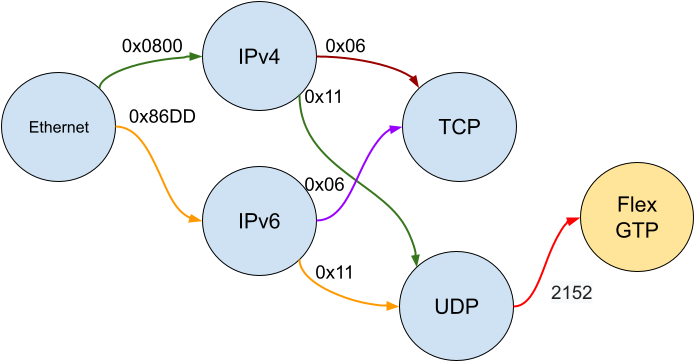
Sample Code
The example starts with some basic definitions.
#include <doca_model.p4>
#include <doca_headers.p4>
#include <doca_externs.p4>
#include <doca_parser.p4>

const bit<32> WIRE_PORT = 32w00;
const bit<32> GTP_VPORT = 32w01;
const bit<32> DEFAULT_VPORT = 32w04;

struct metadata_t {
}
#define GTP_U_PORT 2152
Then we define the GTP-U version 1 header.
header Gtp_v1_h {
    bit<3>        version;               /** For GTPv1, this has a value of 1. */
    bit           protocol_type;         /** GTP (value 1) from GTP' (value 0) */
    bit           reserved;
    bit           extension_header_flag; /** extension header optional field. */
    bit           seq_number_flag;       /** Sequence Number optional field */
    bit           n_pdu_number_flag;     /** N-PDU number optional field */
    bit<8>        message_type;          /** types of messages are defined in 3GPP TS 29.060 section 7.1 */
    bit<16>       message_length;        /** length of the payload in bytes */
    bit<32>       teid;                  /** Tunnel endpoint identifier */
    bit<16>       sequence_number;       /** optional */
    bit<8>        n_pdu_number;          /** optional */
    bit<8>        next_extension_hdr_type; /** optional if any of the E, S, or PN bits are on. The field must be interpreted only if the E bit is on */
}
Then we add NV_FIXED_HEADERS to the headers struct, along with the new GTP header.
struct headers_t {
    NV_FIXED_HEADERS
    Gtp_v1_h   gtpv1;
}
Using the nv_transition_from annotation, the GTP parser state is connected as a select transition from the UDP state.
parser packet_parser(packet_in packet, out headers_t headers) {
    NV_FIXED_PARSER(packet, headers)

    @nv_transition_from("nv_parse_udp", GTP_U_PORT)
    state parse_gtp
    {
        packet.extract(headers.gtpv1);
        transition accept;
    }
}
The control example uses a single flow table that matches on input port and GTP tunnel endpoint ID. The policy is then to forward the GTP packet to a port or drop the packet.
/**
 * This control admits GTP packets only if the tunnel ID matches
 *
 */
 control gtp_tunnel(
    inout headers_t headers,
    in nv_standard_metadata_t std_meta,
    inout metadata_t user_meta,
    inout nv_empty_metadata_t pkt_out_meta
) {
    NvDirectCounter(NvCounterType.PACKETS_AND_BYTES) gtp_counter;

    action send_to_port(nv_logical_port_t port) {
        gtp_counter.count();
        nv_send_to_port(port);
    }

    action drop() {
        gtp_counter.count();
        nv_drop();
    }

    table gtp_table {
        key = {
            std_meta.ingress_port: exact;
            headers.gtpv1.teid: exact;
        }
        actions = {
            send_to_port;
            drop;
        }
        default_action = drop;
        direct_counter = gtp_counter;

        const entries = {
            (WIRE_PORT, 0x000000001) : send_to_port(GTP_VPORT);
            (GTP_VPORT, 0x000000001) : send_to_port(WIRE_PORT);
        }
    }

    apply {
        if (headers.gtpv1.isValid()) {
            if (gtp_table.apply().miss) {
                nv_send_to_port(DEFAULT_VPORT);
            }
        }
        drop();
    }
}

NvDocaPipeline(
    packet_parser(),
    gtp_tunnel()
) main;
See the full DPL example gtp_parsing.p4
Last updated: