

This guide explains how to give DPUs and the services running on them SPIFFE identities issued by a pre-installed SPIRE deployment, instead of relying on bootstrap tokens or shared secrets. DPF registers two kinds of identity this way:
-
the DPU Agent's credential to the management-cluster Kubernetes API server, which it presents as a short-lived JWT-SVID instead of a kubeadm bootstrap token
-
a DPUService's identity for workloads it runs on a DPU, which the workload itself consumes to prove what it is to other services
Overview
By default the DPU Agent joins the management cluster with a kubeadm bootstrap token and then uses a client certificate, and DPUServices have no cryptographic identity at all. In SPIFFE mode, DPF instead relies on a pre-installed SPIRE deployment: each DPU attests to the SPIRE Server using its hardware serial, and the DPU Agent and any opted-in DPUServices then receive their own SVIDs from the SPIRE agent running on that DPU.
The scope of this feature is the DPU Agent's credential to the management-cluster API server, and per-DPUService identities on the DPU cluster. It does not change BMC mTLS or the provisioning CA.
SPIFFE identity is available in Zero Trust deployments only, and is opt-in through a single stanza on the DPFOperatorConfig, plus a per-DPUService opt-in for workload identities.
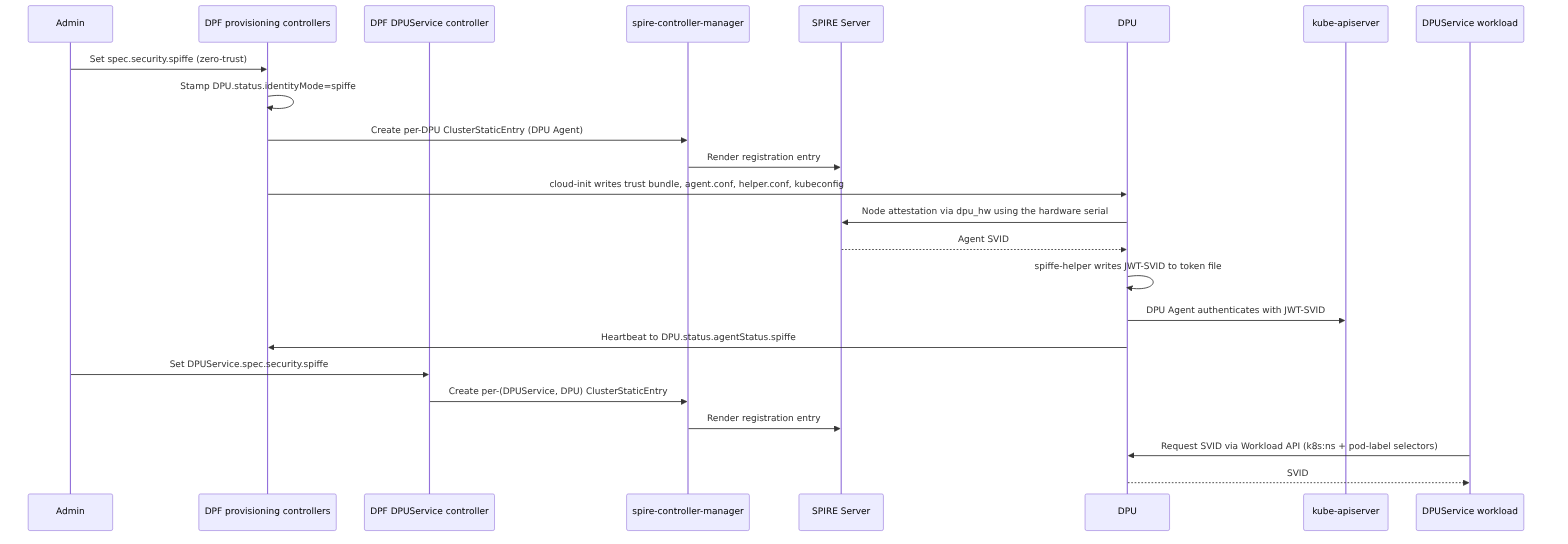
SPIRE attests twice. Node attestation proves the DPU itself to the SPIRE Server, using the hardware serial through the dpu_hw NodeAttestor. Workload attestation then proves the calling process, each time something on that DPU asks the Workload API for an SVID, by matching it against the selectors on a registration entry. The DPU Agent's entry uses unix:uid:0; a DPUService's entry uses narrower Kubernetes-workload selectors (see What gets an identity below), because both share the same parent SPIRE agent and a coarse selector would let any root process on the DPU claim either identity. The Kubernetes workload attestor is enabled separately, once the DPU has completed TLS bootstrap.
What gets an identity
Both identities are parented to the same per-DPU SPIRE agent, but opt in, are named, and are reported on separately:
|
DPU Agent |
DPUService |
|
|---|---|---|
|
Opt-in |
|
|
|
Default ID |
|
|
|
Selectors |
|
|
|
Status condition |
|
|
One ClusterStaticEntry is created per (DPUService, DPU) pair, because an entry carries a single parent. A DPUService targeting ten DPUs therefore has ten entries. A DPUService's entries are also rendered live on every reconcile from the current DPFOperatorConfig, unlike the DPU Agent's, which are written into cloud-init once at provisioning time; see Changing the configuration after DPUs exist.
Prerequisites
DPF does not install or manage the SPIRE control plane. The following must already exist and be reachable from the management cluster before you enable SPIFFE. Each row maps to the spec.security.spiffe field that must be pointed at it, and applies to both the DPU Agent and DPUService identities.
|
You must provide |
Field it maps to |
Notes |
|---|---|---|
|
A running SPIRE Server |
|
|
|
The trust domain that SPIRE Server is configured with |
|
Must match the SPIRE Server's own |
|
A SPIRE OIDC Discovery Provider |
|
Issuer URL the API server fetches signing keys from. See OIDC Discovery Provider. |
|
|
|
The class name must match the controller-manager instance that should render DPF's entries. See spire-controller-manager. |
|
A ConfigMap holding the SPIRE trust bundle |
|
|
|
kube-apiserver |
|
|
|
The |
(none) |
Required for DPUs to attest, so it must be installed before any DPU is provisioned in SPIFFE mode. Delivered out-of-band; contact your NVIDIA representative for the plugin and its deployment overlay. |
DPF packages spire-agent 1.15.0 and spiffe-helper 0.11.0 onto the DPU. These are the DPU-side versions only; DPF does not pin a SPIRE Server version. Your SPIRE Server must be version-compatible with a 1.15.0 agent per the upstream SPIRE compatibility policy.
Enabling SPIFFE
Add the spiffe stanza under spec.security of the DPFOperatorConfig. All six fields are required. This enables SPIFFE identity for the cluster and stamps newly provisioned DPUs into SPIFFE mode; it does not by itself give any DPUService an identity.
apiVersion: operator.dpu.nvidia.com/v1alpha1
kind: DPFOperatorConfig
metadata:
  name: dpfoperatorconfig
  namespace: dpf-operator-system
spec:
  deploymentMode: zero-trust
  security:
    spiffe:
      spireServerAddress: spire-server.spire-system.svc:8081
      spireTrustDomain: cs.internal
      kubeAPIAudience: https://kubernetes.default.svc
      spireOIDCURL: https://spire-oidc.spire-system.svc
      spireControllerManagerClassName: spire-mgmt-spire
      trustBundle:
        name: spire-bundle
        namespace: spire-system
        format: pem
The API server enforces the field formats, and rejects the stanza entirely unless spec.deploymentMode is zero-trust.
For the full field reference see DPFOperatorConfig and the generated API reference.
Opting a DPUService in
A DPUService gets its own identity by setting spec.security.spiffe. The field is presence-gated and has no sub-fields:
spec:
  security:
    spiffe: {}
It can also be set on a DPUServiceTemplate, in which case the DPUDeployment controller propagates it to the DPUServices it generates. It must not be set on a DPUService with spec.deployInCluster: true, which runs on the host and has no per-DPU SPIRE agent to parent to; admission rejects that combination.
Customizing the identity layout
Deployments that follow their own naming scheme can override the rendered SPIFFE IDs with Go templates, one pair per identity:
|
Field |
Renders |
|---|---|
|
|
the DPU Agent identity registered with SPIRE |
|
|
the DPU Agent subject after an external token exchange |
|
|
the DPUService identity registered with SPIRE |
|
|
the DPUService subject after an external token exchange |
spec:
  security:
    spiffe:
      dpuServiceSPIFFEIDTemplate: >-
        spiffe://{{ .TrustDomain }}/tenant/{{ index .DPUServiceMeta.Labels "tenant" }}/dpu/{{ .SerialNumber }}/service/{{ .Namespace }}/{{ .ServiceID }}
Templates are validated when the configuration is applied, not per DPU or per DPUService. A DPU Agent template that does not depend on the DPU serial is rejected, and a DPUService template that does not depend on all of the DPU serial, the namespace and the service ID is rejected: it would hand a single identity to workloads that are meant to be distinct.
DPF never presents a DPUService's exchanged subject anywhere itself, unlike the DPU Agent's, which it uses to build a RoleBinding (see How the DPU Agent authenticates). dpuServiceExchangedSPIFFEIDTemplate still has to render and validate, so that the whole identity layout is declared and checked in one place even though only the workload that receives the SVID reads it.
Which DPUs are affected
DPU.status.identityMode records the mechanism a DPU uses. It is stamped exactly once, during the Initializing phase, and is immutable afterwards.
|
|
Meaning |
|---|---|
|
|
The DPU Agent authenticates with a SPIRE-issued JWT-SVID. |
|
|
The DPU Agent authenticates with a kubeadm bootstrap token. |
|
unset |
Legacy DPU provisioned before SPIFFE existed. Treated as |
Because the stamp happens at initialization, enabling SPIFFE affects newly provisioned DPUs only. DPUs already running in bootstrap-token mode continue to work unchanged, and a cluster can hold a mix of both; DPF skips bootstrap-token DPUs when registering DPUService identities, so a DPUService opting in during such a migration only gets entries on the DPUs that have already moved to SPIFFE.
Disabling SPIFFE
The spiffe stanza cannot be removed from a live DPFOperatorConfig; the API server rejects the update, because SPIFFE-mode DPUs depend on it.
If you must return the cluster to bootstrap-token identity, delete and recreate the DPFOperatorConfig without the stanza. This is a disruptive escape hatch: every existing SPIFFE-mode DPU must then be re-provisioned, because its stamped identityMode cannot change.
Changing the configuration after DPUs exist
Edits to spec.security.spiffe are accepted after bootstrap, but most fields are written into a DPU's cloud-init at provisioning time and never rewritten, so an edit usually reaches new DPUs only. DPUService entries are the exception: the DPUService controller re-renders them from the current configuration on every reconcile, so they follow an edit immediately.
|
Field |
Effect of changing it |
|---|---|
|
|
Breaks every existing SPIFFE-mode DPU Agent. DPF patches DPU Agent entries into the new trust domain, but the on-disk |
|
|
New DPUs only for the DPU Agent; existing DPU Agents keep the values baked in when they were provisioned, and the kube-apiserver must keep accepting the old |
|
|
Safe. Existing entries of both kinds are patched in place to the new class, and nothing on the DPU refers to it. |
|
|
Not read by DPF, but it must still match the issuer in the kube-apiserver |
|
|
New DPUs only; baked into cloud-init at provisioning time. |
|
|
Re-rendered for every opted-in DPUService on the next reconcile. |
What DPF creates
SPIFFE identifiers
The default workload IDs are listed under What gets an identity above; see Customizing the identity layout to override them. Both share one parent per DPU, the identity of the SPIRE agent running on it:
-
Agent ID:
spiffe://<trustDomain>/spire/agent/dpu_hw/<serial>
The DPU serial comes from DPUDevice.spec.serialNumber, which is immutable, and is lowercased into the identity. It must be at most 64 characters and use only RFC 3986 unreserved characters (a-z, 0-9, -, ., _, ~). The DPUService namespace and service ID are normalized and constrained the same way.
ClusterStaticEntry
ClusterStaticEntry is used rather than ClusterSPIFFEID, which would otherwise generate entries automatically from pods: spire-controller-manager only watches the cluster it runs in and identifies nodes by their Kubernetes identity, but these workloads run in a DPUCluster and DPUs are identified by hardware serial through the dpu_hw attestor. DPF therefore writes each entry explicitly.
DPF creates one ClusterStaticEntry per SPIFFE-mode DPU for the DPU Agent, named dpu-agent-<serial>, and one per (DPUService, DPU) pair for each opted-in DPUService, named dpu-service-<namespace>-<dpuServiceName>-<serial>-<digest>. Both are deleted when their owning object is removed: a finalizer, provisioning.dpu.nvidia.com/spiffe-deregistration, holds the DPUDevice until its DPU Agent entry is gone, and dpu.nvidia.com/dpuservice-spiffe-deregistration holds the DPUService until all of its entries are gone. This ordering means a reflashed DPU or a deleted DPUService cannot race a stale identity.
spec.spiffeID, spec.parentID and spec.selectors are the workload ID, agent ID and selectors given under What gets an identity and SPIFFE identifiers above. The remaining fields are the same for both entry kinds:
|
Field |
Value |
|---|---|
|
|
1 hour |
|
|
2 minutes |
|
|
|
|
|
Your |
DPF owns both specs. Out-of-band edits are reverted on the next reconcile and reported as an event.
RBAC
In SPIFFE mode the per-DPU RoleBinding subject for the DPU Agent is the literal SPIFFE ID URI instead of the certificate username used for bootstrap-token DPUs. The bound Role is otherwise identical, so the DPU Agent's permissions do not change with identity mode.
Because the subject is that URI, the username the kube-apiserver derives from the JWT sub claim must equal it exactly. In the AuthenticationConfiguration, claimMappings.username must therefore yield the bare SPIFFE ID, with no added prefix.
A DPUService identity is not used to authenticate to any Kubernetes API server; it is consumed by whatever the workload itself talks to, so DPF creates no RBAC object for it.
The spire-agent-rbac component
Enabling SPIFFE also deploys a system DPUService named spire-agent-rbac to the DPU cluster. It contains no workload, and creates only a ClusterRole and ClusterRoleBinding named dpf-spire-kubelet-pods, granting get on nodes/pods to the system:nodes group. The SPIRE agent runs on the DPU host OS rather than as a pod, so it has no ServiceAccount and authenticates with the kubelet client certificate; this grant is what its Kubernetes workload attestor needs. There is nothing to configure.
On the DPU
cloud-init installs spire-agent, spiffe-helper and the dpu-hw-agent NodeAttestor plugin, and orders the DPU Agent to start after both. It writes:
|
Path |
Contents |
|---|---|
|
|
SPIRE agent configuration (server address, trust domain, |
|
|
Trust bundle, when |
|
|
Trust bundle, when |
|
|
Kubernetes workload attestor configuration |
|
|
systemd drop-in for the Kubernetes workload attestor |
|
|
spiffe-helper configuration |
|
|
SPIRE agent Workload API socket |
|
|
The |
|
|
JWT-SVID written by spiffe-helper and read by the DPU Agent |
|
|
Kubeconfig referencing the token file |
A DPUService workload fetches its own SVID directly from /run/spire/agent.sock using the Workload API; DPF writes nothing extra to the DPU for it.
How the DPU Agent authenticates
This is the one flow where an identity is consumed by DPF itself, and it is worth understanding because it involves the Kubernetes API server. A DPUService's identity has no equivalent flow: DPF issues it but never presents it anywhere.
The DPU Agent needs to write its own DPU status in the host cluster. In SPIFFE mode it presents a JWT-SVID instead of a bootstrap token, and the API server validates it as an OIDC token.
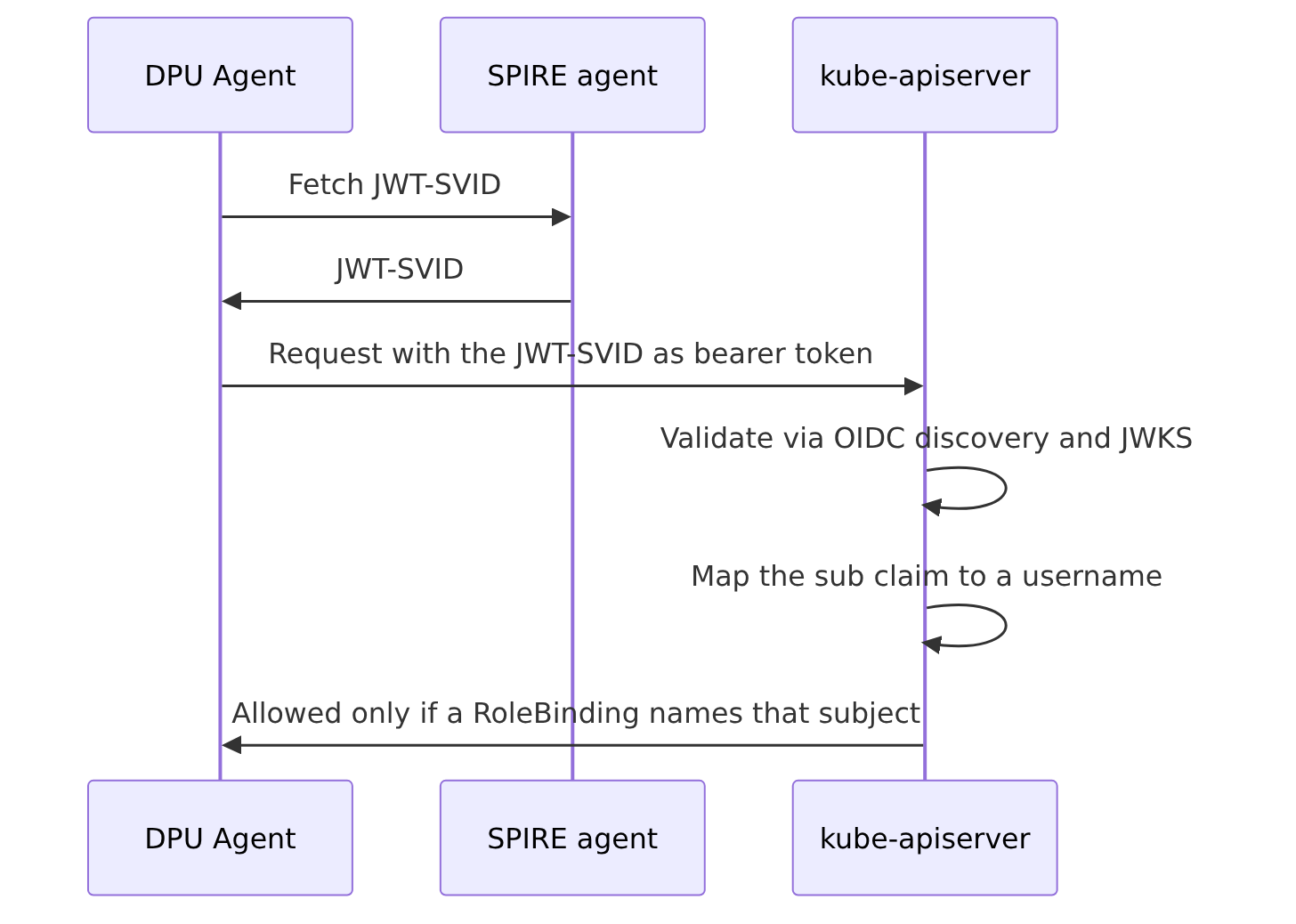
A mismatch anywhere in this chain, the OIDC issuer/audience or the RoleBinding subject described under RBAC, lets the DPU Agent authenticate but leaves it unauthorized, reporting 403 ... cannot get resource "dpus"; see The DPU Agent is not reaching the API server.
Token exchange
Some environments exchange the JWT-SVID for a token from a different issuer before it reaches the API server. In that case the subject the API server sees is not the one registered with SPIRE, so DPF has to be told both: it registers dpuAgentSPIFFEIDTemplate with SPIRE and builds the RoleBinding from dpuAgentExchangedSPIFFEIDTemplate.

The exchange service is expected to implement RFC 8693 token exchange, and the API server has to trust the exchanged token's issuer in addition to the SPIRE one. Where the exchange happens and how it is configured is deployment-specific and outside the scope of this page; dpuAgentExchangedSPIFFEIDTemplate only tells DPF what subject to expect, so that the RoleBinding it creates matches what the API server sees.
Verification
Check which identity mode each DPU was stamped with:
kubectl -n dpf-operator-system get dpu -o jsonpath='
{range .items[*]}
{.metadata.name}{"\t"}
{.status.identityMode}
{"\n"}
{end}'
Check that each DPU's DPU Agent registration entry has been rendered by spire-controller-manager:
kubectl -n dpf-operator-system get dpudevice -o jsonpath='
{range .items[*]}
{.metadata.name}{"\t"}
{range .status.conditions[?(@.type=="SPIFFEEntryReady")]}{.status}{"/"}{.reason}{"\t"}{.message}{end}
{"\n"}
{end}'
Check the same for a DPUService's entries:
kubectl -n dpf-operator-system get dpuservice <name> \
  -o jsonpath='{.status.conditions[?(@.type=="SPIFFEEntriesReady")]}'
SPIFFEEntriesReady is True with no entries when a DPUService does not use SPIFFE, so it never holds back the readiness of services that do not opt in.
Check that the DPU Agent is reporting its SPIFFE heartbeat, and whether it has enabled the Kubernetes workload attestor:
kubectl -n dpf-operator-system get dpu -o jsonpath='
{range .items[*]}
{.metadata.name}{"\t"}
{.status.agentStatus.spiffe.lastProbeTime}{"\t"}
{.status.agentStatus.spiffe.lastProbeMessage}{"\t"}
{range .status.agentStatus.conditions[?(@.type=="SPIREWorkloadAttestorEnabled")]}{.status}{"/"}{.reason}{end}
{"\n"}
{end}'
List the entries DPF created, of either kind:
kubectl get clusterstaticentries -l provisioning.dpu.nvidia.com/dpudevice-name
kubectl get clusterstaticentries -l dpu.nvidia.com/dpuservice-name
A healthy SPIFFE-mode DPU shows identityMode: spiffe, SPIFFEEntryReady=True/Success, SPIREWorkloadAttestorEnabled=True, and a lastProbeTime that advances (the DPU Agent probes every 30 seconds). A healthy opted-in DPUService shows SPIFFEEntriesReady=True.
Troubleshooting
SPIFFEEntryReady condition (DPU Agent)
The condition mirrors the upstream ClusterStaticEntry status onto the DPUDevice. Because the reason values are generic, use the message to distinguish cases.
|
Status |
Reason |
Message |
Meaning and action |
|---|---|---|---|
|
|
|
— |
The entry is rendered. No action needed. |
|
|
|
|
The entry exists but the controller-manager has not picked it up. Check that |
|
|
|
|
The controller-manager accepted the entry but has not rendered it to the SPIRE Server yet. Check controller-manager logs and SPIRE Server reachability. |
|
|
|
|
Terminal. The DPU serial cannot form a valid identity. The |
|
|
|
|
Transient. Usually the |
|
|
|
|
Another entry in SPIRE shadows DPF's. Find and remove the conflicting entry. |
|
|
|
|
The status written by |
If the condition is absent entirely, the DPUDevice has no SPIFFE-mode DPU bound to it. That is expected for bootstrap-token DPUs and for devices that have not been attached yet.
SPIFFEEntriesReady condition (DPUService)
|
Status |
Reason |
Meaning and action |
|---|---|---|
|
|
— |
No entries (SPIFFE not opted in), or every desired entry is rendered. No action needed. |
|
|
|
Waiting for |
|
|
|
Entries left over from a DPU or DPUCluster the DPUService no longer targets are still being deleted. Resolves on its own. |
|
|
|
A target DPU cannot form a valid identity for this DPUService (see the serial/namespace/service ID constraints above), or an entry is masked by another entry. Needs operator action; the condition message lists the affected entries or DPUs. |
SPIREWorkloadAttestorEnabled condition
The DPU Agent reports this on status.agentStatus.conditions of the DPU, retrying once a minute until the Kubernetes workload attestor is enabled. Enabling it restarts spire-agent.service once, which does not disturb the DPU Agent's existing token. DPUService workloads on that DPU cannot obtain an SVID until this condition is True.
|
Status |
Reason |
Meaning and action |
|---|---|---|
|
|
|
The attestor is configured. No action needed. |
|
|
|
Expected for a while after boot. If it persists, the DPU has not completed kubelet TLS bootstrap. |
|
|
|
The configuration merge, its validation, or the agent restart failed. A message of |
Events
DPF emits events on the DPUDevice for the DPU Agent identity, and on the DPUService for its workload identities:
kubectl -n dpf-operator-system get events --field-selector involvedObject.name=$DPUDEVICE_NAME
kubectl -n dpf-operator-system get events --field-selector involvedObject.name=$DPUSERVICE_NAME
|
Reason |
Type |
Meaning |
|---|---|---|
|
|
Normal |
The DPU Agent's |
|
|
Warning |
The DPU Agent's entry could not be created or updated. |
|
|
Warning |
Another entry shadows the DPU Agent's entry. |
|
|
Normal |
DPF issued a delete for the DPU Agent's entry during deprovisioning. |
|
|
Warning |
An out-of-band edit to an entry spec was reverted. |
|
|
Warning |
More than one SPIFFE-mode DPU is bound to a single |
The DPU Agent is not reaching the API server
If SPIFFEEntryReady=True but status.agentStatus.spiffe.lastProbeTime is stale or absent, the registration is healthy and the problem is on the DPU or at the API server. Check, in order:
-
spire-agentattested successfully. Attestation fails if thedpu_hwNodeAttestor plugin is missing on the SPIRE Server, or if the DPU's hardware serial is unreadable. -
spiffe-helperwrote/var/lib/dpf/dpuagent/spiffe/token. The DPU Agent waits for this file. -
The API server accepts the JWT. The
AuthenticationConfigurationissuer must equalspireOIDCURLand its audiences must containkubeAPIAudience; a mismatch produces authentication failures with a valid token. -
The username the API server derives from the token matches the
RoleBindingsubject. When it does not, the DPU Agent authenticates successfully and is then denied with 403 on every request.
A DPU Agent or DPUService identity was deleted but its entry remains
Deletion is ordered by a finalizer, so an object stuck in Terminating usually means one of its ClusterStaticEntry objects could not be deleted. Check whether something added a finalizer to it:
kubectl get clusterstaticentry dpu-agent-$SERIAL -o jsonpath='{.metadata.finalizers}{"\n"}'
Limitations
-
The DPU Agent's workload selector is a coarse
unix:uid:0. Any root process on the DPU can obtain the DPU Agent SVID, thoughspec.parentIDconfines that to the one DPU the entry was created for. -
Node attestation evidence is currently transmitted in plaintext; the serial is not cryptographically bound to the hardware.
-
Trust domain federation is not supported. DPF never sets
federatesWithon the entries it creates. -
SPIFFE cannot be turned off in place. See Disabling SPIFFE.
Related topics
-
Generated API reference -
DPFOperatorConfig.spec.security.spiffe,DPUService.spec.security.spiffe,DPU.status.identityModeandDPU.status.agentStatus.spiffefield definitions
Last updated: