
NVIDIA Minerva is an intelligent, AI-native AIOps platform purpose-built for AI Factory operations. It integrates telemetry from NICs, NVLink, east-west and north-south Ethernet switches, schedulers, and AI workloads, and applies advanced AI/ML algorithms to deliver actionable intelligence. It supports turnkey and decomposable consumption models.
Architecture
NVIDIA Minerva is a distributed, real-time system made up of microservices packaged and deployed via the NVIDIA Minerva Installer. It is composed of six functional components:
|
Component |
Responsibility |
|---|---|
|
Ingestion |
Collects data from external sources (for example, OTEL, syslog, and gNMI collectors) and normalizes it for processing. |
|
Object Modeling |
Builds a relationship graph from ingested data. For example, BGP peering relationships between devices are modeled using OTEL data. |
|
Data Enrichment |
Adds contextual attributes to normalized data in real time. For example, a syslog is tagged with a device role such as top-of-rack. |
|
Machine Learning |
Applies ML algorithms to enriched data (for example, NLP on syslogs for zero-day anomaly detection). |
|
Data Storage |
Persists data from object modeling, enrichment, and ML for historical and real-time use. |
|
Presentation |
Exposes data to external systems for consumption and notifications. For example, creating ServiceNow tickets for detected anomalies. |
Consumption Models
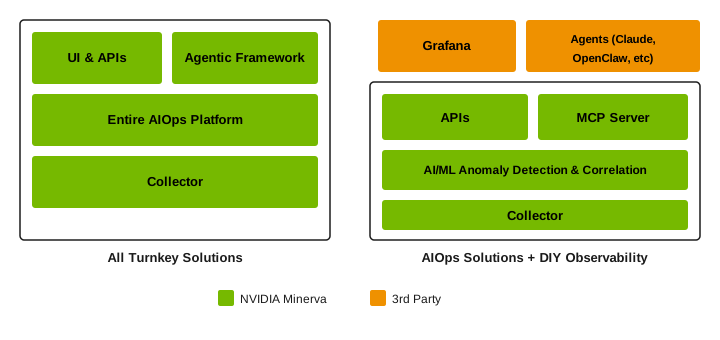
NVIDIA Minerva supports two consumption models: a Do-it-yourself (DIY) Observability solution that integrates NVIDIA Minerva's AI/ML insights into your own Grafana stack or agents, or a fully turnkey solution.
Collector Stack and Platform Stack
The Collector Stack handles data ingestion and forwarding. It supports pull-based and push-based methods — including gNMI polling and syslog streaming — and must be deployed on-premises because it requires direct network access to monitored devices. It is lightweight in terms of CPU, memory, and storage, and can forward data to the Platform Stack as well as to any OTLP-compatible receiver such as Prometheus or VictoriaMetrics.
The Platform Stack provides all other functional components: object modeling, data enrichment, machine learning, storage, and presentation. It can run on-premises alongside the Collector Stack, or in the cloud as a SaaS offering.
Deployment Models
NVIDIA Minerva is installed using the NVIDIA Minerva Installer on a Linux cluster. The system supports horizontal scaling, so deployments can start with a single host and expand as needed. NVIDIA Minerva supports two deployment models:
-
Unified deployment: The Collector and Platform stacks are co-located, either on-premises or in the cloud.
-
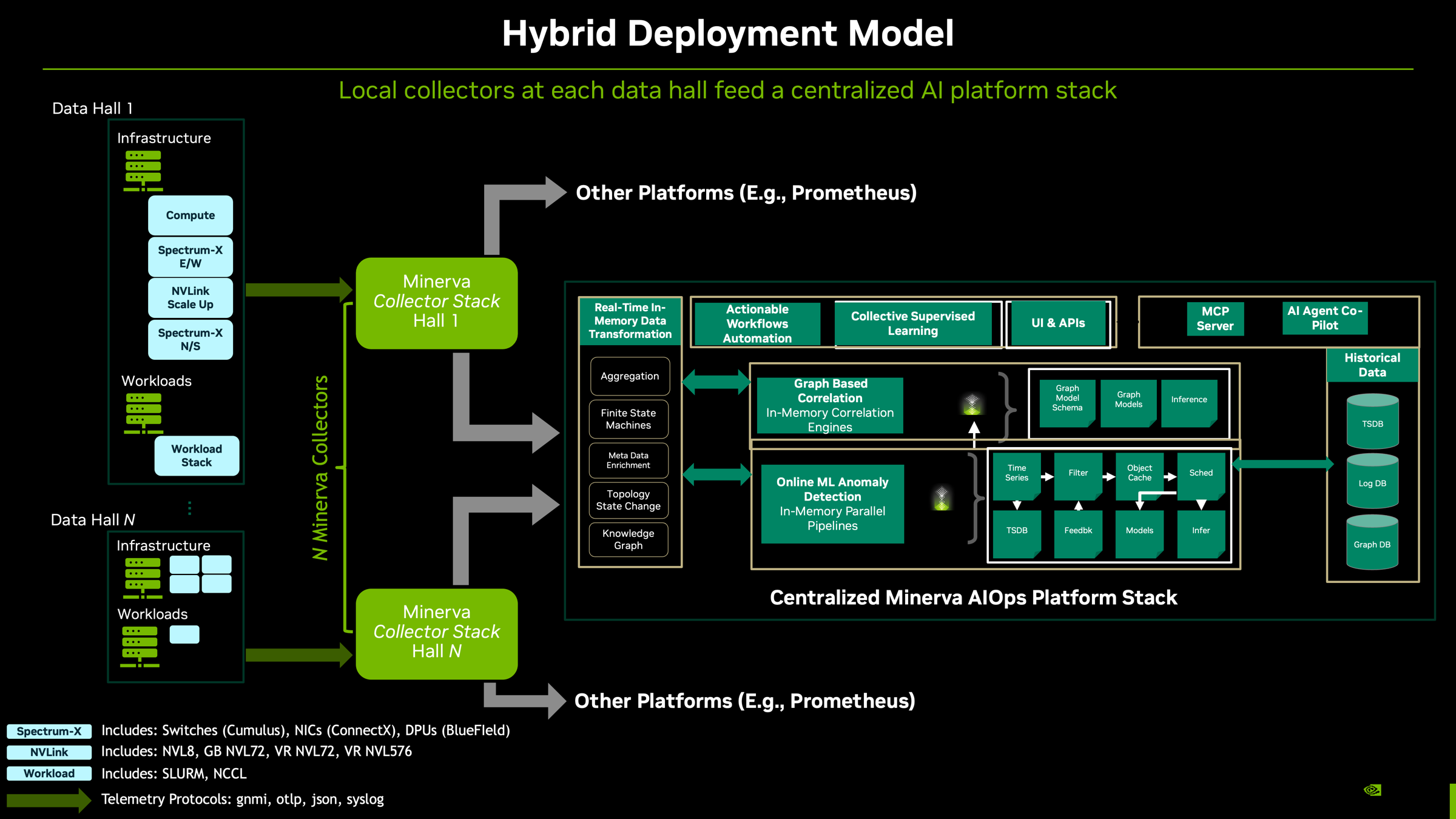
Hybrid deployment: The Collector and Platform stacks are deployed separately. For example, there may be a Collector on-premises per data center while the Platform runs on-premises in a single data center or in the cloud.
The installer includes NVIDIA Minerva Service Orchestration, which simplifies stack management on Linux clusters. In addition to starting and stopping services, the orchestrator supports rolling and in-place upgrades.
Turnkey Deployment
In a turnkey hybrid deployment, local Collector Stacks at each data hall feed a centralized NVIDIA Minerva Platform Stack. The Platform Stack handles all AI/ML processing, storage, and presentation, and can forward data to third-party platforms such as Prometheus.
DIY Observability and AIOps
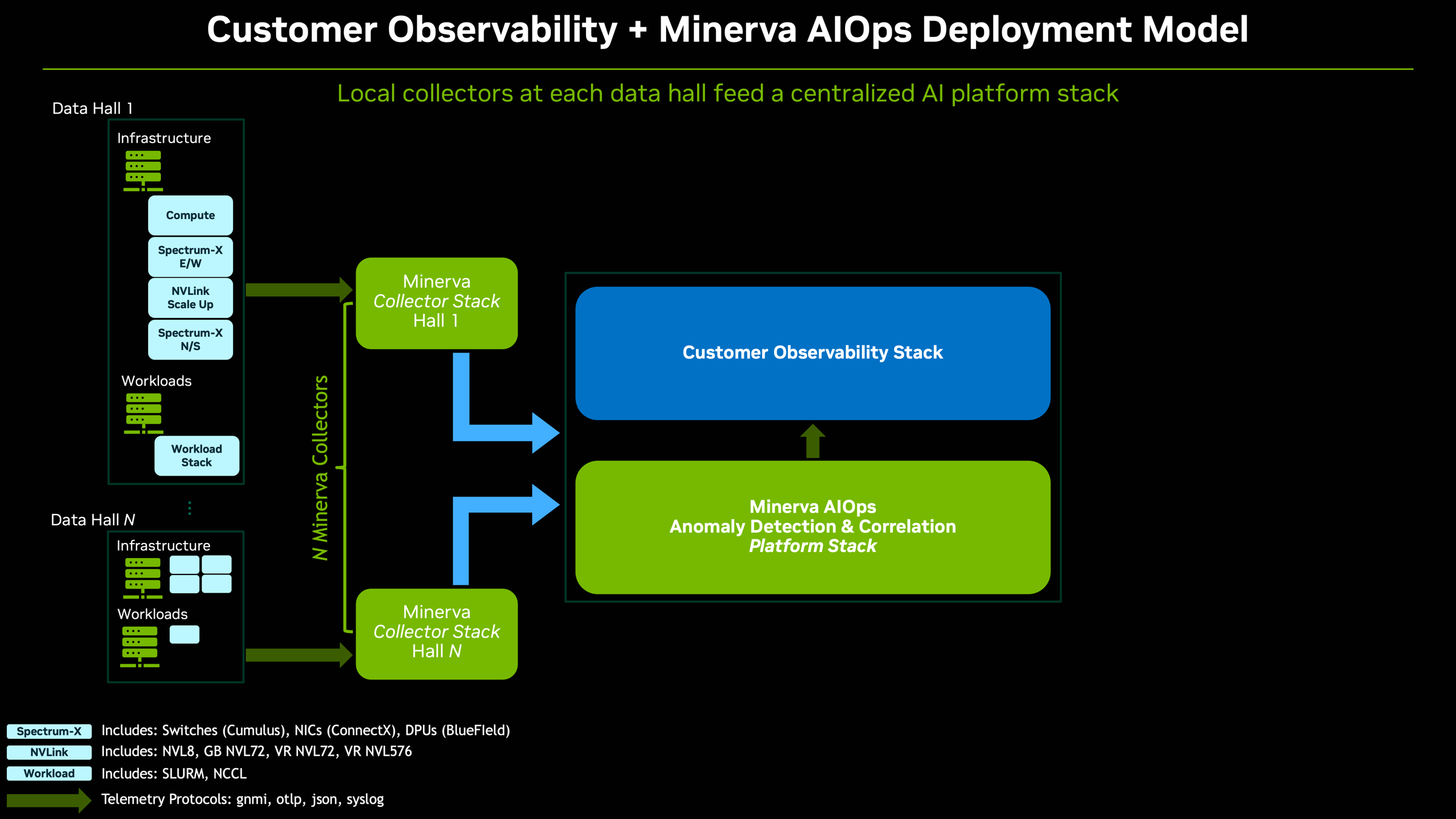
NVIDIA Minerva can also operate alongside a customer-managed observability stack. In this model, the Collector Stack feeds both the customer's own tooling and the NVIDIA Minerva AIOps Platform Stack, giving teams flexibility to integrate NVIDIA Minerva's anomaly detection and correlation into an existing operations workflow.
Last updated: